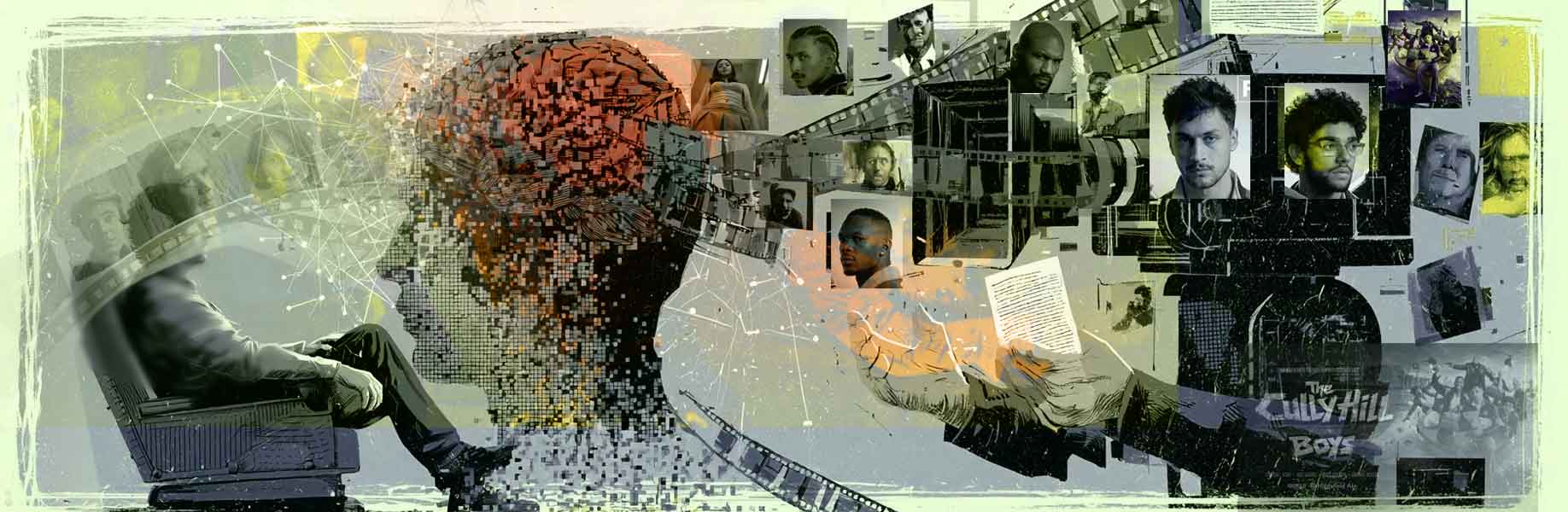

“We made the first 110-minute AI feature film with a real cast, The Cully Hill Boys, on Higgsfield for $2,000,000,” Higgsfield AI posted on X on August 10. “Watch full film below.” Higgsfield has also posted the full film on YouTube.
That post marked the public release of the full film and its production pipeline. The company framed The Cully Hill Boys as a milestone: a feature-length action-comedy built entirely with generative AI, using licensed likenesses of real people rather than generic synthetic faces, and then giving away the entire creative toolkit so others could study or rebuild it. “Licensed likeness” means that the characters generated by artificial intelligence (AI) look like specific persons, and the originals get paid.
Days earlier, the project had already made a high-profile debut. Higgsfield held an exclusive premiere screening at The Glasshouse in New York. The event brought together media, creators, and industry figures. Opening remarks came from CEO and co-founder Alex Mashrabov. The film’s digital stars were represented in person by some of the real people whose likenesses appear on screen. Outside, the project received Times Square visibility with Nasdaq support, turning the premiere into a hybrid of tech demo and red-carpet moment for an AI-native production.
Reactions arrived quickly and from different corners. In the AI creator community on X, the dominant note was admiration for the open-sourcing itself. Users repeatedly praised the transparency of a $2 million pipeline that included roughly 1,000 production-ready assets across more than 100 locations. Variety covered the licensing deals in an exclusive, highlighting how streamer Mikyle “N3on” Rafiq, UFC star Israel Adesanya, Quinton “Rampage” Jackson, and basketball player Matt Kiatipis had each signed agreements allowing their images and voices to be used. N3on himself told the outlet he was “really, really excited,” noting that the process required only a short voice recording and some photographs and offered “a pretty good check with very little work.” Some observers remained more cautious, questioning whether a fully AI-generated feature could hold audience attention for nearly two hours or whether the open release was primarily a marketing play for Higgsfield’s Cinema Studio platform. Overall, the conversation centered less on pure celebration or pure skepticism and more on the practical question of what this workflow actually enables.
How the film was made
How The Cully Hill Boys was made reveals both the ambition and the constraints of current AI filmmaking. A 28-person team completed the 110-minute project in approximately four weeks on a reported $2 million budget. The core generation model was Seedance 2.5, used for video sequences and speech. Claude from Anthropic helped craft and refine the large volume of prompts. Seedream (ByteDance) and Nano Banana (Google) handled image and video editing and polishing. Production began with detailed character sheets built from the licensed talents’ photographs and audio. These sheets locked facial features, body proportions, clothing, and voice characteristics before any major generation began. Teams worked in parallel, managing continuity across locations and sequences through a shared canvas system that held sheets, locations, props, and state information. The result is a fast-paced, beat-driven story about three underachieving East London rappers who accidentally steal money from a crime boss and find themselves caught in a messy underworld conflict.
The project drew attention in technology-focused discussions, including coverage on Peter Diamandis’ Moonshots podcast. In a recent episode examining rapid AI breakthroughs, the film was highlighted as a concrete example of exponential cost and time compression in creative production: a 110-minute feature with licensed celebrity likenesses made by a 28-person team in four weeks for roughly $2 million (about half of that going to compute), versus the $20–100 million and 12–18 months typical for a comparable traditional production. The open-sourcing of the full workflow was framed as further evidence that high-end filmmaking tools are becoming radically more accessible.
Diamandis and the Moonshots team mentioned the Future Vision XPRIZE for filmmakers and aspiring filmmakers to create 3-minutes trailers about optimistic visions for our future. The winner will receive funding for a feature film based on the trailer. The $2.6 million grand prize is not sufficient to make a high-profile traditional film, but it could be sufficient to make a very good film with Higgsfield technology - which is likely being used by the competitors to produce the trailers.

Human creativity is still needed (but for how long?)
A detailed critical examination comes from The Verge. In a piece published August 13 titled “I looked inside an AI generated movie, and the best parts were all human” (open copy), the magazine described Cully Hill Boys as one of the few AI features this year that approaches the look and feel of a conventionally produced film. A significant part of that coherence, the review argued, stems from the human foundations: Tim Planagan’s screenplay provides narrative structure, while many of the published prompts explicitly invoke the visual and editing styles of the directors. The article notes that these references, combined with the real screenplay, underscore how the strongest elements remain human-derived even when the pixels are machine-generated. At the same time, The Verge positioned the film as a polished proof of concept rather than a finished mainstream work ready for wide theatrical audiences. Typical generative-video limitations - illegible on-screen text, occasionally weak character interactions, and a general sense that the movie is demonstrating a pipeline more than telling a story for its own sake - remain visible. Fans of N3on, Adesanya, or the other licensed personalities may enjoy seeing familiar faces in a feature-length context, the review suggested, but general moviegoers are less likely to seek it out purely for entertainment.
The Cully Hill Boys seems positioned less as a pure entertainment product and more as a public case study. Higgsfield has shown what a small team can produce in a short window when character continuity, prompt engineering, and multi-model workflows are carefully managed - and then invited everyone else to examine the results. Whether this accelerates genuine creative use of the tools or simply raises the production values of AI demos remains an open question, but the film and its accompanying assets now sit in public view for anyone to study, critique, or build upon.
My impressions
Of course I watched the film. I was mostly interested in the video generation technology, and I was asking myself all the time if I could tell that the video and sound were AI-generated. And I could tell. But I already knew that the filming was done by AI automation, so I paid attention to certain telltale signs and noticed that, for example, some props were too crisp and clean, the teeth of some characters were too white, and other things of that sort. I didn’t spot any oddities in lip syncing, which was one of the things I was paying attention to.
A more interesting question is, could I have told that the video and sound were AI-generated if I hadn’t known? My honest answer is, probably yes, but perhaps only if I watched with real attention. Meaning that, seeing some scenes on TV while thinking about other things, I guess I wouldn’t have asked myself the question. Therefore, and in view of the fact that this is still very news, kudos and five stars to Higgsfield.
What about the film itself? Well, I guess it is not Oscar material (but then, thinking of some films that have won Oscars, perhaps it is). Some scenes are evidently meant to showcase the capabilities of the AI tools used, but without exaggerating (and again, this is one of the things that I probably wouldn’t have even noticed as a casual viewer).
I could have watched the film for only 15 minutes to check the technical aspects, but I watched it all because it was interesting and fun enough, certainly on a par with most Netflix content. As The Verge’s review notices, likely this isn’t due to AI but to the humans involved. But The Cully Hill Boys shows that things are moving in a certain direction - and who’s to say that a film made entirely (that means, including conception and screenwriting) by AI won’t win an Oscar in a few years?