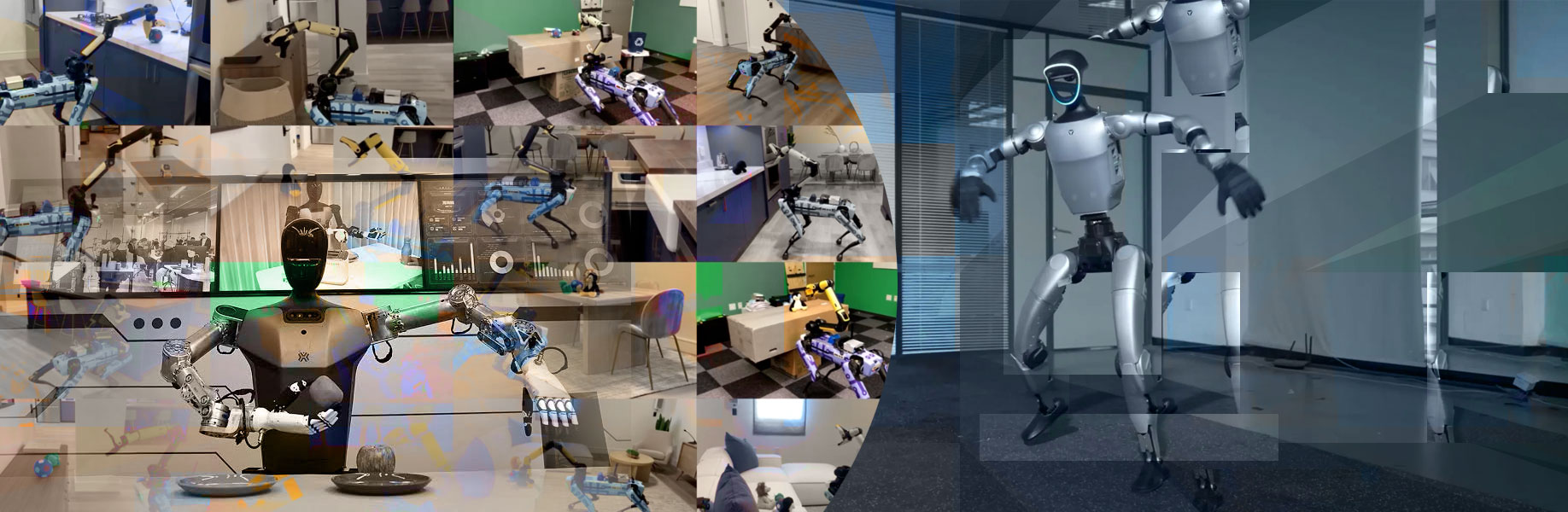

Dyna Robotics has unveiled a model called Dyna-2. Dyna-2 is a world-action model that predicts both how a scene will look in the future and what actions should be taken next. It was pre-trained on more than one million hours of video of people performing ordinary manipulation tasks such as cooking, tidying, and assembling objects, recorded from a head-mounted camera. This volume of data is roughly equivalent to 170 years of continuous waking human experience.
The model is built on a video-diffusion backbone, a type of generative architecture that learns by gradually removing noise from data. It uses a mixture of transformers that process video and action streams together during training through a method called flow matching, which teaches the network to recover clean samples from noise. For the scaling studies the model is trained jointly on predicting future video frames and future actions. Nested subsets of the human video data, ranging from one thousand to one million hours, were used so that larger amounts simply add more of the same distribution.
Scaling laws and transfer to robots
Performance improves smoothly as more hours are added, measured by continuous error metrics and thresholded accuracy. More importantly, the same increase in human data also improves the model’s ability to predict actions on robot data that it has never seen during pre-training. This human-to-robot transfer scaling law appears for the first time at this scale. The transfer depends on the training objective: predicting future video is essential, while training only on actions does not produce the same cross-embodiment gains. After a short period of fine-tuning on a few hours of robot data, or in one case only ten minutes for a bottle-cap opening task with two five-fingered hands, the model performs useful work on several different robot platforms, including arms with parallel jaws and more dexterous hands. Relative gains match the offline trends. Additional tests show improved ability to recover from physical disturbances, higher precision on contact-rich tasks, stronger response to language instructions, and the capacity to generate future video in a single step.