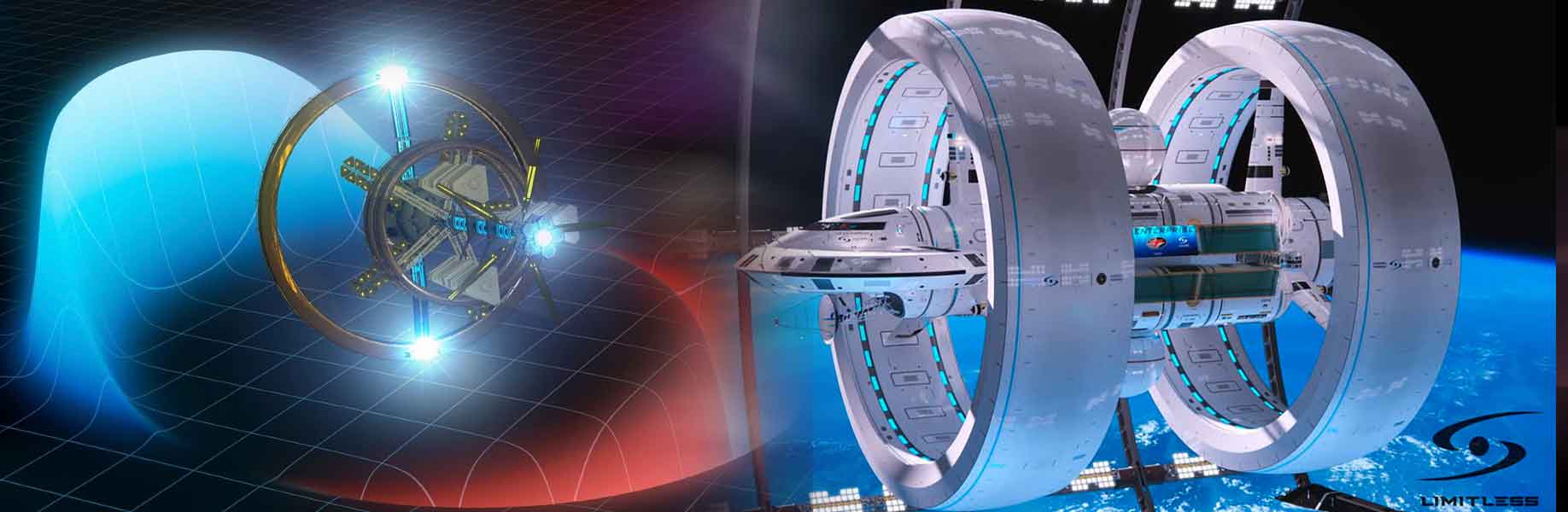

Physicist and aerospace engineer Harold "Sonny" White and his colleagues at Casimir have published an update to the theory of warp drives, moving the concept of faster-than-light travel closer to a potential engineering reality. Their research is published in Classical and Quantum Gravity. White recommends a review published in The Debrief.
In the 1990s, physicist Miguel Alcubierre first proposed a scientific basis for this propulsion using the theory of general relativity. His model relied on a continuous ring of "exotic matter" - theoretical materials with negative energy density - to warp spacetime. While scientifically credible, the original concept required impossible amounts of energy and created dangerous conditions for any potential crew.
White and his collaborators have now introduced a different approach that modifies the geometry of the warp field. Instead of a single smooth ring, the new design utilizes a series of distinct, cylinder-shaped structures. These structures would handle the energy required to distort space. Interestingly, this segmented design bears a strong physical resemblance to the propulsion systems seen on fictional spacecraft in Star Trek.
Creating a stable environment for passengers
The primary advantage of this new configuration involves the stability of the "warp bubble," which is the protective region of spacetime that surrounds the vessel. Using a mathematical framework called ADM 3+1 formalism, the researchers calculated how to slice spacetime into manageable sections to analyze its behavior. This method allowed the researchers to verify that the interior of the bubble remains flat and unaffected by the intense gravitational forces occurring on the outside.
Consequently, clocks inside the ship would stay synchronized with those on Earth, and the passengers would not experience crushing tidal forces. Although this technology remains strictly theoretical and may take centuries to realize, the study provides a mathematical argument to support the possibility that functional warp drives could eventually be built with modular, engineered components rather than impossible physics.