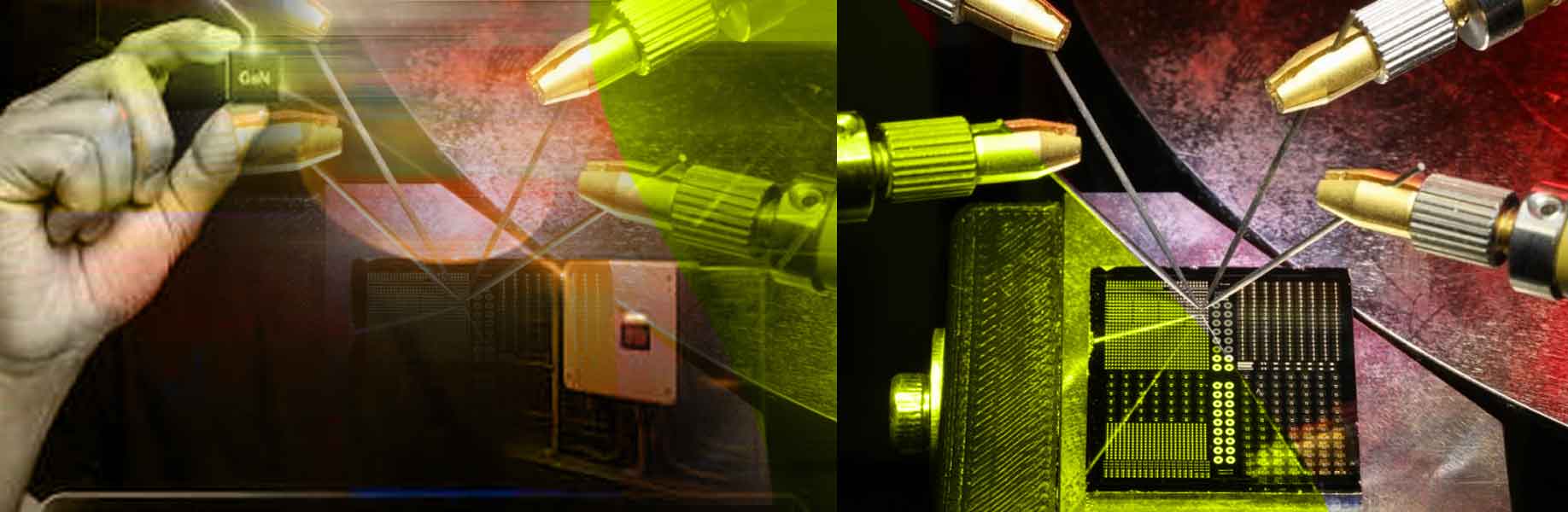

Today, transistors are often made from gallium nitride (GaN). At very high voltages, though, today’s GaN switches still fail earlier than the best silicon ones. The reason is that the electric field, the stress created by voltage, can crowd into a single spot and punch through the material (breakdown).
EPFL engineers report a new kind of GaN transistor, the intrinsic polarization superjunction, or iPSJ. The chip is made from GaN layers on a cheap silicon wafer. It holds nearly 4 kilovolts before breakdown. Commercial GaN power devices usually fail around 600 to 650 volts, so the new device stands more than five times that stress. It also keeps low electrical resistance, which means less energy is wasted as heat. That mix matters for power conversion in AI data centres and renewable energy systems.
Why ordinary GaN switches crack
In GaN’s crystals, voltage then piles up at one place, like standing on a single point of thin ice, and the device can break.
The new layers are grown so that a second sheet of positive charge forms naturally next to the electron sheet. By setting the thickness of the layers, the two sheets stay balanced along the whole device. When the switch turns off, spare charge does not gather, and the voltage spreads along the length of the transistor, more like lying down on the ice. The design does not use chemical doping. Doping in GaN often changes with temperature. The researchers say the device holds high voltage across a wide temperature range, which would suit electric vehicles and industrial systems. Doping-free balance is central to that robustness.
The researchers add that the method uses a polarization effect that is unique to GaN and could bring sturdy high-voltage electronics down to a much smaller size. Separate work from the same laboratory adds several current paths in a device, like extra lanes on a road, to cut resistance and heat. The next aim is to join the two ideas: hold very high voltage safely, and lose as little energy as possible. The study is published in Nature Electronics.