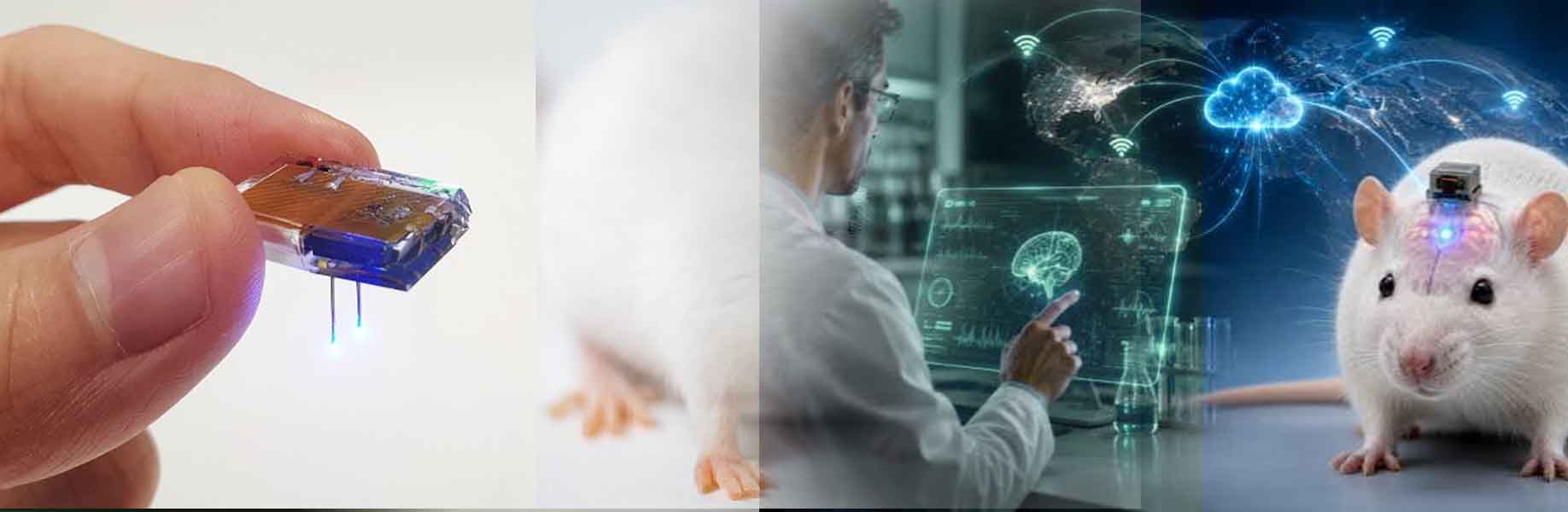

Scientists built a small wireless implant that can be run over the internet. In a demonstration, a researcher in Chicago operated a device implanted in a rat in Daejeon in real time. The aim is to study brain circuits for long periods without standing next to the animal, and later to support medical implants that act only when needed.
The device can be started from a distance or set to run on its own at a chosen time. It is about the size of a sugar cube and is described as light enough that a rat can still behave in a natural way.
How the device is built and tested
The implant combines two ways of changing brain activity. A microfluidic system can send a drug to a chosen brain region. A micro-LED can shine on selected neurons. Those two actions can be used alone or together. The drug container attaches with a magnet, so it can be swapped or refilled without another surgery.
The device stayed in rats for four weeks. In one test, cocaine was sent into the brain by wireless command while light was applied to specific neurons at the same time. According to the release, addiction-related behaviors could be reduced. The scientists present this as evidence that drugs and light can be combined to probe neural circuits while the animal moves freely.
The scientists said the work turns short-range light-and-drug implants into internet-linked tools for long, automated, remote experiments, and that similar devices might one day help diagnose or treat brain disorders. Also, the platform should help link particular circuits to behavior in models of addiction, depression, and neurodegenerative disease.
The scientists speculate on a possible later mix of brain-state sensing and artificial intelligence so that drugs or stimulation would be delivered only when required. That step is described as a future goal, not as something already shown.
This research is published in Science Advances.