Aging BMX and Skateboarding Zine Kid Brings The Mediated Pain
In this wide-ranging interview, Roy Christopher explores media evolution, post-human desire, punk resistance and why the urge to transcend the body may end in annihilation.
Roy Christopher is, in his own words, “an aging BMX and skateboarding zine kid,” with a history of writing and publishing about life, music, film, and everything else from a perspective that might be best labeled post-punk, although no label quite captures his restless textual extravagances and insights. Christopher has two books currently in circulation and both of them chart the post-everything mad bad dangerous and intriguing zeitgeist we’re all experiencing in the delirious 21st century.
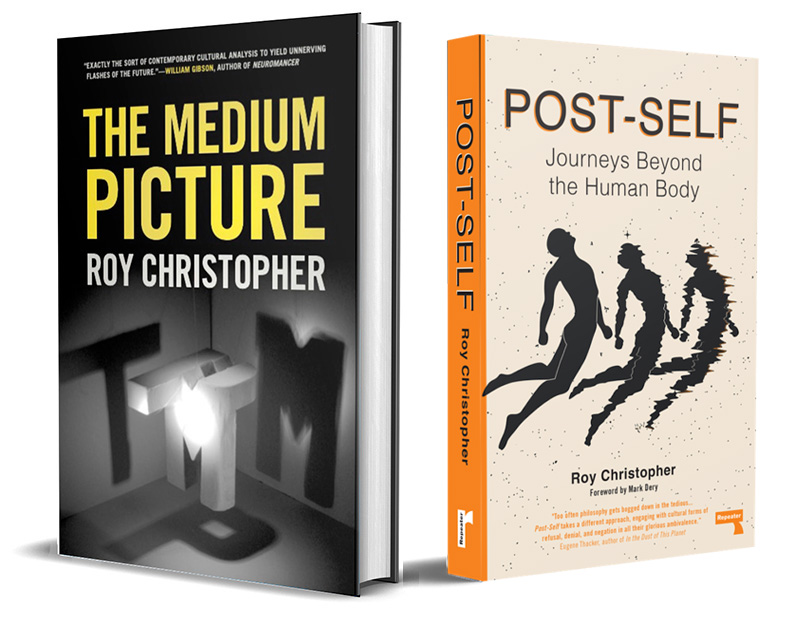
Book one: The Medium Picture is a cogent Post-McLuhan romp through the mediums of the late 20th and early 21st centuries and the speedy subcultures that emerge, conjugate and mutate as young people find the others using style, tools (well… skateboards) and (dare we mention?) content. In the words of technoculture writer Howard Rheingold, “Roy Christopher is old enough to recall vinyl, punk, and zines—social media before TikTok and smartphones. The Medium Picture deftly illuminates the connections between post-punk music critique, the increasing virtualization of culture, the history of formal media theory, the liminal zones of analog vs digital, pop vs high culture, capitalism vs anarchy.” Yes, all that.
Book two is a stranger animal. The title—Post-Self:Journeys Beyond The Human Body—might lead my Mindplex readers to assume that this will be another exploration of the obsession manifested amongst various stripes of transhumanism and singularitarianism with escaping or transcending “the meat” and, surely, about the cyberpunk genre’s dark-but-fascinated critique of this same pursuit. And yes, that’s part of it. But the main title here is post-self, not post-body—so where does that take us?
You might be thinking of AI—the project fantasized by some fanatics that would have us giving up the human self—giving up consciousness of selfhood by sacrificing it to our technological betters. That’s not what’s driving the book. There are stranger and more original multivalent narrative impulses at work here.
And I’m not herein referring to the pursuit of transcendence of the self via drugs, technology and mind tricks as practiced by the likes of John Lilly, although that too is part of the rumination.
But here’s where we finally land—the book at first and at last takes up the desire to end the self by the only method known to work… by dying. And, as it transpires, possibly by taking all the other humans along. It’s a dark trip for our dark moment, navigated partly via references to that master of understated deadpan text revealing 20th century western human perversity, J.G. Ballard.
It doesn’t stop there. Christoper brings the pain with an emotive exploration of black metal. Here, aside from Christopher himself, our guide in this trek through the darkness of black metal leading you to varied visions of absolute pain and annihilation is Justin Broadrick, founding member of Godflesh and a central figure in extreme metal and hardcore industrial music.
I interviewed Christopher via email and began by discussing The Medium Picture.
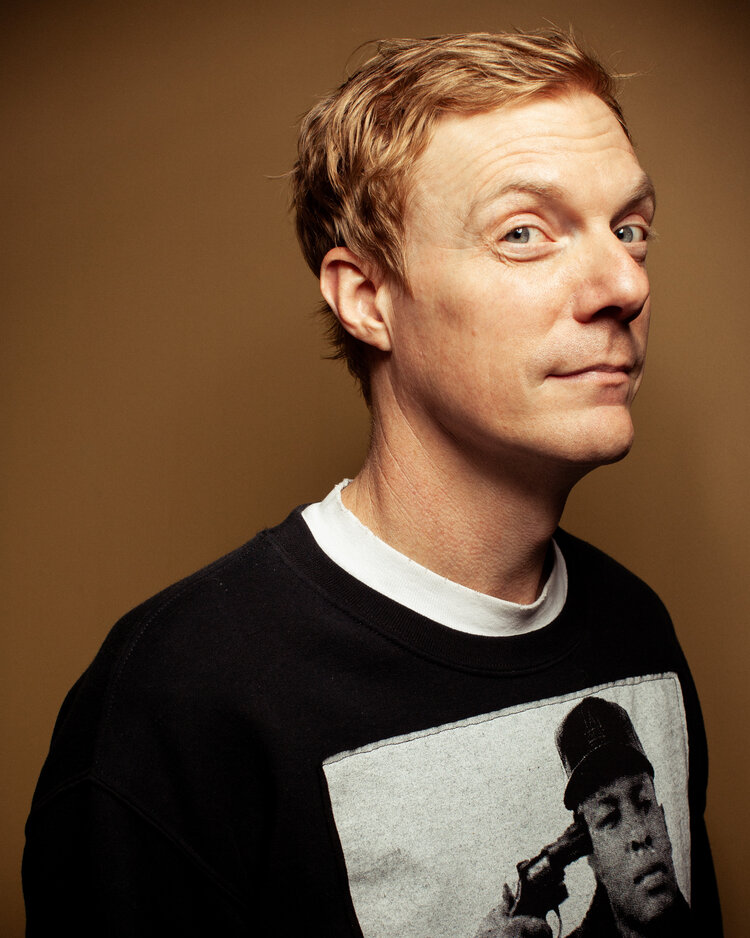
Credit: Photo by Nick Thomsen
RU Sirius: The Medium Picture doesn’t just present a coherent narrative of how the mediums have been the message—how they’ve altered how we share and receive mediated communication and creative work—it indicates a kind of firehose or changing medias—all piling up upon each other, all pretty much remaining present in some form however diluted in popularity. And this got me thinking about Napster which happened just after Mondo 2000’s dissolution and seemed the final proving point that digitalization was changing everything.
But the other weird thing is that Apple, with the iPod, engineered a kind of retrenchment. The salability of recorded music seemed broken and the convenience and reliability of Apple Music brought it partly back from the dead… but just barely. In any case, what would you say about the not-so-straight line of alleged progress in media and how we relate to them?
Roy Christopher: By analogy, I have been taking an evolutionary view of media technology. Darwin saw genes as waves of possibilities, passing from species to species in random configurations. The species themselves weren’t the point, they were mere collections of genes interacting with each other in their environment, assemblages of traits and trivia. Species are organizing principles, much in the way that media platforms are. An LP is around 45 minutes long—23 minutes per side. A CD is over an hour (80 minutes). That’s why a release by a band in the 1960s is typically shorter than one from the 1990s. The technological limits not only determine the shape, size, and duration of the artifact but also our expectations of it.
RU: I did a search for artificial intelligence in the book. It’s scarce. So what’s the addendum to The Medium Picture? Is AI… or what they’re calling AI… becoming the all-in-one app? Or will it be a great diversifier? Or just some clusterfuck where anything useful, artful or fun goes to turn into slop?
RC: I’d like to think one can apply the archaeological and ecological approaches to media in The Medium Picture to emerging media as well. What passes for AI will be like the other epochal changes we’ve seen in media. Remember in the 1960s when television was going to kill movie theaters? Remember in the 1990s when the internet was going to kill the book? None of these changes happen as fast as we think they will. Theaters are still around, and books are doing fine. MP3 trading and streaming haven’t prevented vinyl records from selling more now than when they were the primary format for music—even at four times the price! So, yeah, AI will eventually change almost everything, but it will take longer than we think.
RU: I was pleased to see Malcolm McLaren’s subversive take on new media possibilities (audio taping particularly) acknowledged in The Medium Picture. Reading the book, it almost feels like punk as a culture literally had to happen. So much of the semiotics (skateboarding particularly) around the use or misuse of new technology feels like punk.
Is there an inevitability of young people finding their own use for technology… with attitude? (Hip hop/rap included) Or did punk save us from an intolerable dullness by some acts of will?
RC: There’s something inherently punk about youth, and young people are always at least two steps ahead of the co-opting capitalist marketing machine. Taking what’s there and making it your own is the very spirit of punk, from the repurposing of turntables in hip-hop to the affordance mining of skateboarding to any other intentional coloring outside the lines.
RU: You spoke to, read and studied a lot of writers and thinkers about mediation and the impact it’s had on humans recently and in the past. Of all the people you came across or spoke to in your research, is there one that really blew up or illuminated your sense of the medium picture?
RC: In the Preface to TMP, I write that if I were to follow through with the book’s cover image, inspired by Douglas Hofstadter’s Pulitzer Prize-winning first book, Gödel, Escher, Bach, and name TMP after the three people who shaped it, it would be called Gibson, Eno, McLuhan. William Gibson’s thought hangs heavy over a lot of my work. Nearly every time I come up with a way to theorize and think about the process of technological mediation or cultural evolution, I find Gibson got there first. Brian Eno’s thinking on music and media is both vast and deep, and I’ve been yammering about his idea of edge culture for years. He kindly granted me permission to explore and expand on it further in TMP. I can only hope I did his thought and gesture justice. And anyone who tries to do what I attempt to do has to contend with Marshall McLuhan, whose name and thought are evident in all of my work. If you want to study media and mediation, he’s the starting point.
But to answer your question more directly, it was talking to Ian MacKaye that not only helped make some of the connections stronger but provided new ones as well. MacKaye is the cofounder of Dischord Records and the bands Minor Threat and Fugazi, two of my all-time favorites, among others. His views on the importance of independence, keeping personal archives, punk’s reliance on paper, and more aligned with and realigned the arguments in the book. I am proud that he became a larger part of it than I’d imagined at the beginning.
RU: The coming of “AI” accounts for some of the apocalypticism of the current zeitgeist. But you apparently believe AI as a media is still part of the continuum of mediated formats. So how would you relate the issues and questions and possibilities raised by The Medium Picture to what I read as the apocalyptic spirit of the newer book? Is there a “medium picture” connection to Post-Self?
RC: They are definitely connected beyond my being the author of both. There was even a time when I tried to put them together as one book. That exercise convinced me definitively that they were separate statements.
If The Medium Picture is about how we mediate our worlds with our technologies, then Post-Self is about all the ways in which we wish we could leave our frail human bodies behind for the mediated world we’ve created. If one is about mediated ontology, the other is about escaping into it.
RU: Moving into your book Post-Self, there are two peculiar narratives running through here. One is the posthumanity that was in some ways popular during the cyberpunk/transhumanoid 90s and then this very dark exploration of what Mark Dery in his intro calls the Misanthropocene. This kind of captures dual moods, given that the earlier version of posthumanity—transcending the meat via technology lingers and even accelerates with the enthusiasms of billionaires and tech bros, and then, by the end of the book, it seems as though Post-Self suggests a satisfactory solution might be to end embodied existence by classical means… by killing everyone in a giant black metal apocalypse. Have I got that right?
RC: That’s a blunt summary, yes.
Post-Self is a survey of the escape routes out of our human bodies, an exploration of all the ways we attempt to expand or evade the limits of our corporeal cages (e.g., machines, drugs, rapture, death). By ending with death and extinction, it concludes that we can’t. There is no escape. This is not an exit.
In the Afterword, I tried to bring it all back to a positive note, pointing out that though we can’t escape, at least we have each other. We’re all in this together.
RU: It’s a wild ride.
Let’s start with the meat as it was understood by both dystopian cyberpunk novelists and by cyber-transhumanist enthusiasts. There are various states of rapture we can experience—from the intellectual pleasures of abstract thinking to the pleasures of psychedelic or meditative altered states. The body, in this context, can be a drag. Pain, incapacitation, ad infinitum interrupts or stops the rapture. Softening or ending the tribulations involved in embodiment seems like a reasonable pursuit.
So where do we draw the line when it comes to relieving the body while remaining corporeal? Do we not cure diseases? Not triage an ER visitor?
RC: Some people wanting to escape their body via any means doesn’t mean some others don’t mind taking their chances. Every day someone makes decisions in answer to your questions. The line is drawn by a multitude of contingencies—legal, ethical, economic, religious—and they’re all sliding scales.
RU: Okay, what do you think are the boundaries regarding offering relief or escape from aspects of messy embodiment?
RC: We all do what we can with what we have, right? Isn’t that the burden of the body in one tidy cliché? The same goes for the augmentation, which means the rich always have more. And that’s where the contingencies come back in. Augment to each their own unto their economic status.
I think everyone should do whatever they want with their own bodies as long as it doesn’t impinge on the limits of the next body over.
RU: You jump fairly quickly into a discussion of Ballard’s Crash and Cronenberg’s film version of the book. What are the resonances with the current moment?
RC: Ballard’s brilliant satire of our technological death-drive mixed with our sex-drive—the “drive” part being literal as the car is a special case—can be mapped onto most technologies since. Look at the contemporary conversations around smartphones, social media, and AI. If you invented something that killed as many people daily as the car, you wouldn’t be able to manufacture and sell it, yet the impact of these technologies is still a net loss for us. Ballard (and Cronenberg) illustrated this using the simplest analogy and most widespread technology.
Credit: Tesfu Assefa
RU: Also, in terms of Cronenbergian body horror, many narratives revolve around pursuing enhancements and alterations. Horror and fascination seem intertwined with a kind of ambiguous desire for a less prosaic future. It's all in some ways experienced by many contemporary people as aesthetically pleasing.
RC: The cyberpunks looked to prosthetics as inspiration for future elective extensions to the body—extensions as a matter of want instead of need. Benjamin Bratton points out that insurance companies are the real designers of cars. It’s a spectrum that runs from augmentation for its own sake to risk assessment as speculative design, from risking it for the hell of it to “designing the risk away,” as Bruce Sterling puts it. The only available path to the future is through a loophole.
Metal Apocalypse Now
RU: So, black metal. It seems to be made almost exclusively by white people. One guy quoted in the book rants about wanting to see not just mass death but maximum misery and suffering. Of course, the first dumped off steerage in civilization collapse are the poorest people with the darkest skin. They already see a lot of misery and suffering. Do you think apocalypse desiring coming from, for example, Norway has an intrinsically racist component? The rants do rather remind me of some of the misanthropy associated with Boyd Rice and other American freaks who play along the edges of naziism.
RC: You don’t have to look very far to find a racist component in so-called True Norwegian Black Metal. One of the genre’s founders, Varg Vikernes (Count Grishnackh) of the bands Burzum and Mayhem, is proudly racist, homophobic, and boasts of familial ties to nazis.
The destruction of all of humankind is one of the aspects of black metal that I apply in Post-Self—not the destruction of some of us or certain kinds of us—all of us. The withdrawing into oneself and the return to simpler times closer to the earth are two others, discussed primarily via the American black metal of Deafheaven and Wolves in the Throne Room. I do not condone the racist aspects of black metal, but I also don’t give them any attention in the book. The “giant black metal apocalypse” you mention doesn’t care about race.
RU: When you conceived of Post-Self, did you start by thinking about the various ways that people profess or plan to transcend the meat while preserving consciousness or did you start by thinking about the wish for annihilation or was it the congruence between those two pursuits that made you want to explore the topic?
RC: I started by wanting to write a book about Godflesh’s first full-length record, Streetcleaner. I had been penciled in a couple of times to write entries in the 33 1/3 Series, where each book is about a record. After typing out a straight-forward proposal, I tried to approach the record from an angle that would give me more to work with creatively. I thought of it as an ancient artifact, unearthed by some future civilization. As I tried to interpret the record through those eyes from the future, connections started to emerge.
For one, the cover art is a screen-cap from a hallucination sequence from Ken Russell’s 1980 movie Altered States. The story is about psychedelic drugs and sensory deprivation tanks and a scientist trying to escape their body through their mind. It's loosely based on Dr. John C. Lilly who did a lot of experiments with ketamine and sensory deprivation tanks and trying to explore the universe through his mind and through these drugs. So, the novel and screenpla—both written by Paddy Chayevsky—is loosely based on him. Anyway, there’s one string of connections: escaping the human body through the mind via drugs.
At the beginning of the title track, “Streetcleaner,” there’s a sample of an interview with the serial killer Henry Lee Lucas discussing his motivations: “I didn’t hear voices. It was a conscious decision on my part. It was a power thing. I simply acted on my fantasies.” In addition, there’s a serial killer from England known as the Yorkshire Ripper, Peter Sutcliffe. When he was active, he sent poems to local papers, signed “The Streetcleaner.” Sutcliffe and Lucas killed sex workers, believing they were cleaning up the streets. So, there’s another connection: destroying the human body for higher purposes.
The rest followed from there, and eventually I had a whole book of escape routes beyond the limits of the human body.
Kids These Days
RU: It seems that young people creating identities out of musical genres might have been a late-20th Century thing (in a way, starting in the 1970s at least in the west) and that this sort-of musical tribalism has passed. Would you agree? And if you do, is there something you would say about that as relates to The Medium Picture?
RC: I don’t think the tribalism has diminished, but the musical genres, like their attendant technologies, have splintered to a point where we share fewer and fewer of them. That is, the tribes align along different interstices. “The media,” which once was “the mass media,” has trickled down from a one-to-many broadcast model to more of a one-to-one, individualized state. If we’re all watching a channel on broadcast television, we’re all seeing the same shows. If we’re all on the same social network, no two of us are seeing the same thing. The limited access to content via broadcast media used to unite us. Now we’re only loosely united via the platform, and the platform itself doesn’t matter. The same goes for genre.
We still need to connect, but less of it happens by dint of genre distinctions. That is, less of the work is done for us simply by categorization. In 1994 Megatrends author John Naisbitt asked which of the cultural movements of the 1990s would become universal and which would remain tribal. I would say far more of them became tribal, but the tribes are smaller and more numerous. It’s the long tail of cliques.
RU: Do you have a final thought in terms of what you hope readers will take away from your books? A through-line or whatever?
RC: I hope my work shows readers that they can do whatever they want to do—in the most punk-rock, DIY sense. I am privileged to write about whatever I want because I don’t rely on my writing for anything else. Dan Hancox at The Guardian described my book, Dead Precedents, as “written with the passion of a zine-publishing fan and the acuity of an academic.” That's the kind of compliment you hope for, and it comes from pursuing a certain kind of goal.
The desire to tell others about something cool is the core reason I do just about everything I do. It’s the reason I make zines. It’s the reason I make websites. It’s the reason I’m a writer. It’s the reason I’m a teacher. It’s the reason I write books. It’s the reason I'm writing this right now. I don’t do it for my income. I don’t do it in the academic pursuit of tenure. I do it because I want to tell people about this stuff. In content and form, I write about underground enterprises, and I write with that spirit.