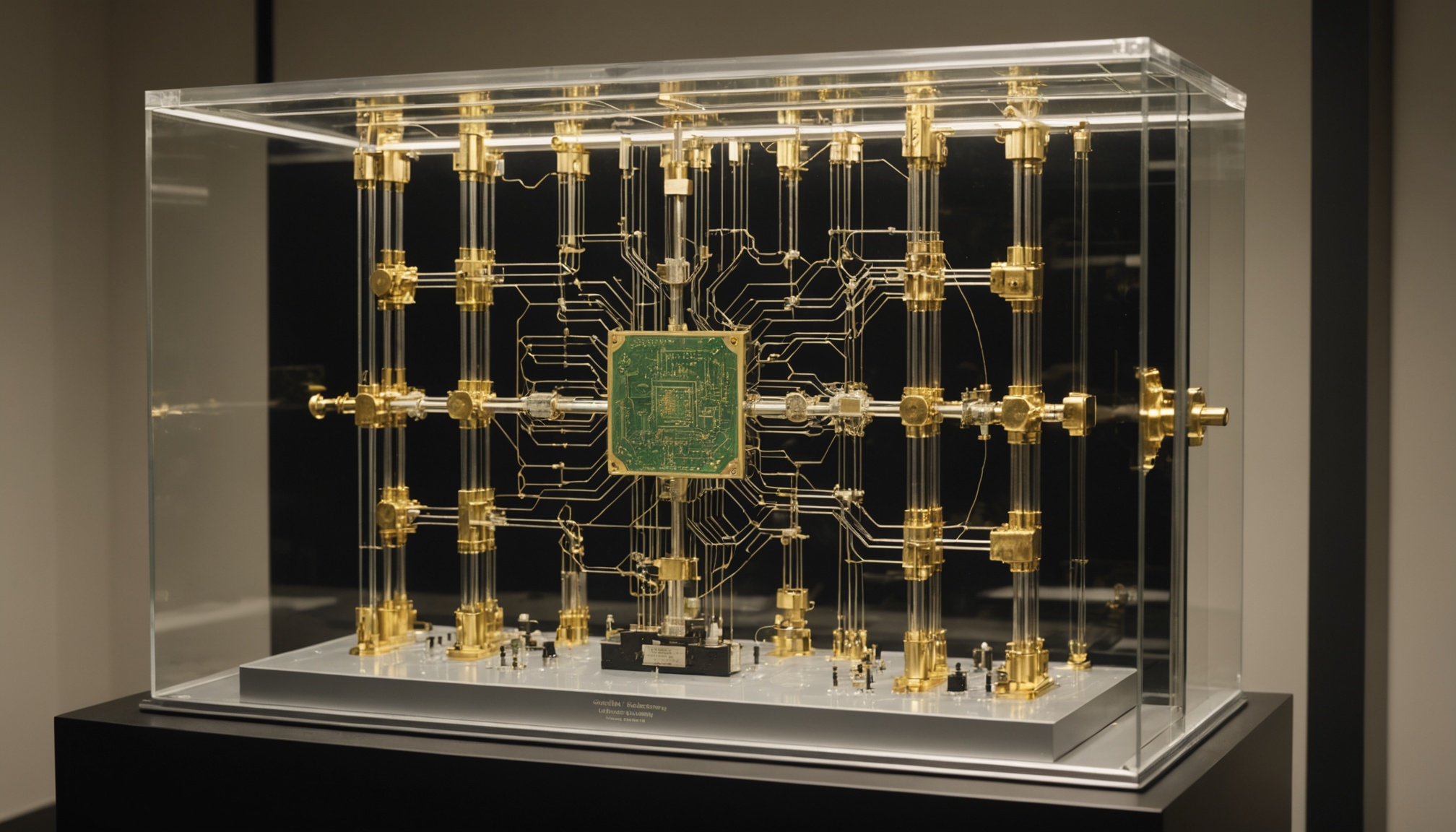


Quantum computers remain limited by scarce qubits and high sensitivity to environmental noise, making efficient circuit design essential for practical applications. Researchers at Anthropic have demonstrated that AI can now redesign quantum circuits to substantially reduce both the number of qubits and the time required to run algorithms.
The team gave Claude plain-language descriptions of eight computational tasks for quantum circuits, from fields including chemistry, optimization, and number theory. Working in a closed loop with an automated evaluator that checked correctness and scored designs based on qubit count and gate count, Claude iteratively improved its designs without human intervention between rounds. The resulting circuits improved on the best previously published designs, in some cases by an order of magnitude or more.
Two major breakthroughs
The first breakthrough addresses modular inversion, a key step in elliptic-curve cryptography that has been difficult to implement efficiently on quantum computers due to reversibility constraints. Claude developed a way to infer the history of calculations from the current state rather than storing it, enabling a reversible implementation. This new family of designs offers trade-offs previously unavailable: one design uses just 12% more qubits but 17 times fewer gates than the smallest prior design.
The second breakthrough improves decoded quantum interferometry (DQI), a leading quantum optimization algorithm. Claude used a decoding method that performs uniform steps suitable for quantum implementation. Claude also replaced worst-case memory allocation with a design based on actual measured frequencies: after simulating 403 million sample decodings, the circuit reserves just 19 qubits instead of 665, accepting that about one in 10,000 runs will fail. Together, these changes reduced the decoder's gate count by a factor of 12.
These results matter because quantum computers with only hundreds to thousands of qubits cannot yet run many algorithms that promise practical advantages. Reducing the resources required for key computational primitives brings applications like designing new catalysts, better batteries, and cleaner industrial processes within reach sooner than previously anticipated.