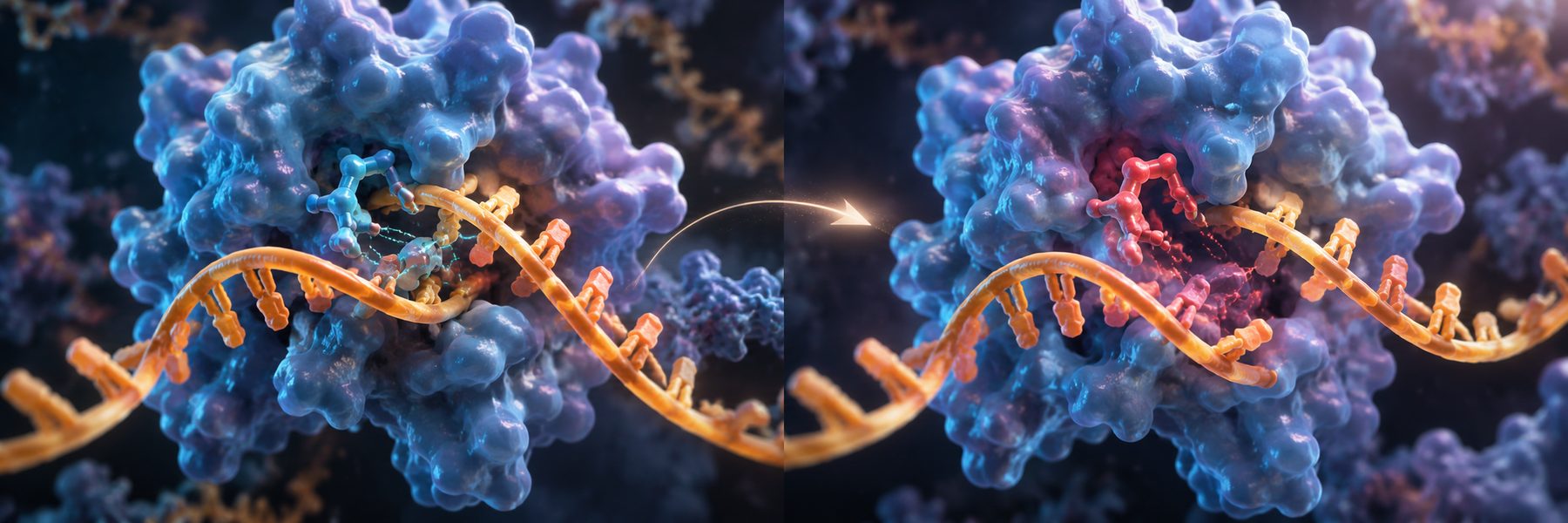

Researchers have introduced Pred-MutPRI, a physics-informed machine-learning framework designed to estimate how mutations alter binding free energy in protein–RNA complexes. Protein–RNA interactions influence gene regulation, RNA processing and many other cellular functions, but predicting mutation effects remains difficult because experimental datasets are limited and uneven.
The study combines structural, sequence and thermodynamic information rather than relying on a single signal. That approach fits a wider trend in computational genomics, where researchers are using AI to identify regulatory DNA patterns, as seen in work on a model that found a key DNA switch for gene activation. Other recent genomic models compare species to identify variants likely to matter, while large precomputed resources now score billions of possible single-letter DNA changes.
Pred-MutPRI was trained on curated experimental measurements and incorporates physical consistency into its learning process. The authors also use representations of local molecular interactions and sequence constraints to estimate how a mutation changes a protein–RNA interface.
On a blind test set separated from training data by sequence and with low structural overlap, the researchers report a Pearson correlation of 0.705, outperforming the comparison methods used in the study. The team has released the dataset and Python implementation. The result is a research tool, not a clinical diagnostic, and broader validation will be needed before it can support medical decision-making.