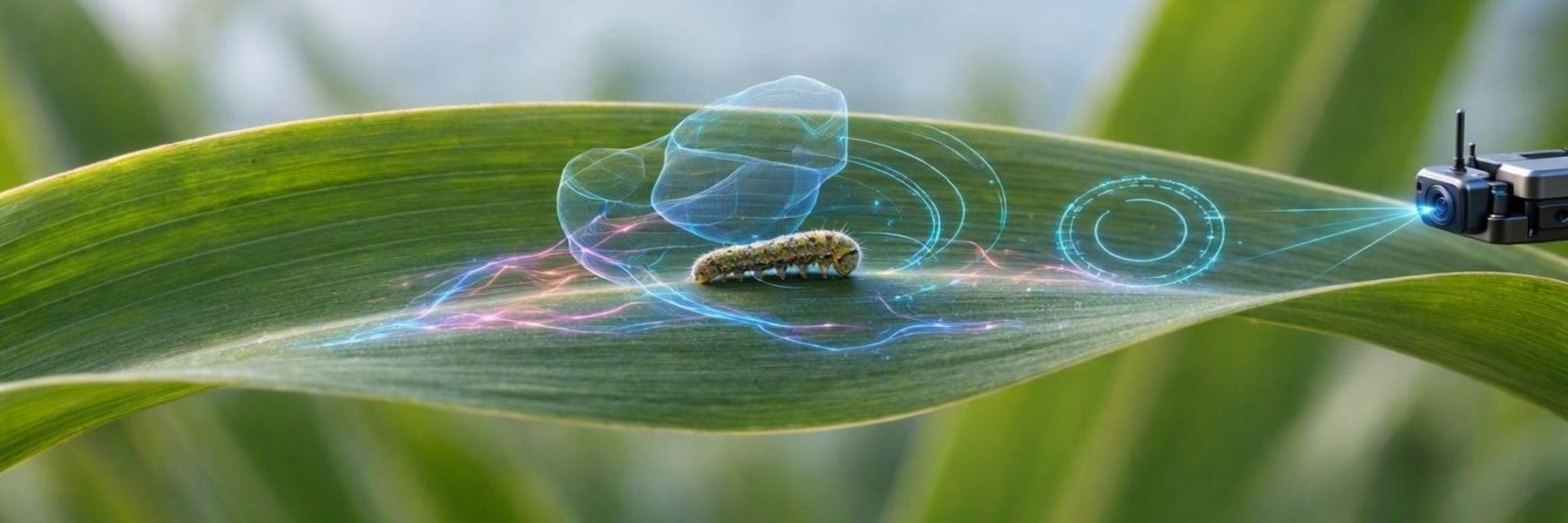

Researchers have unveiled a new AI system that can spot tiny, camouflaged crop pests with near-perfect accuracy while slashing energy use. The discovery can be long awaited breakthrough that could transform how farmers protect their harvests.
The system, called Trans-Neu-Pest, combines four cutting-edge technologies into a single, tightly integrated framework. At its core, it uses a Swin Transformer which is a powerful visual recognition model capable of scanning images of crops. But unlike standard AI, when the system finds a potential pest, it doesn't just stop at a single 2D image. It activates a Neural Radiance Field (NeRF) module to reconstruct the region in 3D, verifying whether the suspicious spot is a genuine insect or just a harmless leaf blemish.
"It's like giving the AI a pair of 3D glasses," explains the research team. "If a detection doesn't hold up when viewed from a different angle, the system knows to ignore it, dramatically reducing false alarms". This multi-view verification is particularly critical for spotting pests that are smaller than a fingernail or partially hidden under leaves.
The system also incorporates a Reinforcement Learning (RL) agent that acts like a curious entomologist, actively deciding where to zoom in or pan the camera to get the best possible view of a suspicious pest. This active-vision policy allows it to resolve ambiguous cases that would stump conventional systems.
For farmers worried about energy costs, the framework includes a specialized Spiking Neural Network (SNN) head that mimics the energy-efficient, event-driven communication of the human brain. This neuromorphic component allows the system to run on low-power drones and edge devices without sacrificing accuracy.
Tested on the challenging IP102 dataset which contains over 75,000 images of 102 pest species, Trans-Neu-Pest achieved a classification accuracy of 84.2% and a detection precision (mAP@0.5) of 93.1% [6†L21-L22]. It significantly outperformed existing models like ROI-ViT and Cascade R-CNN, especially when dealing with tiny objects and cluttered backgrounds. The system also proved remarkably robust under challenging field conditions, including motion blur, low light, and partial occlusion.
By enabling earlier, more accurate pest detection, this technology could help farmers reduce pesticide use, cut costs, and boost crop yields—all while running on energy-efficient hardware suitable for real-world agricultural deployment.