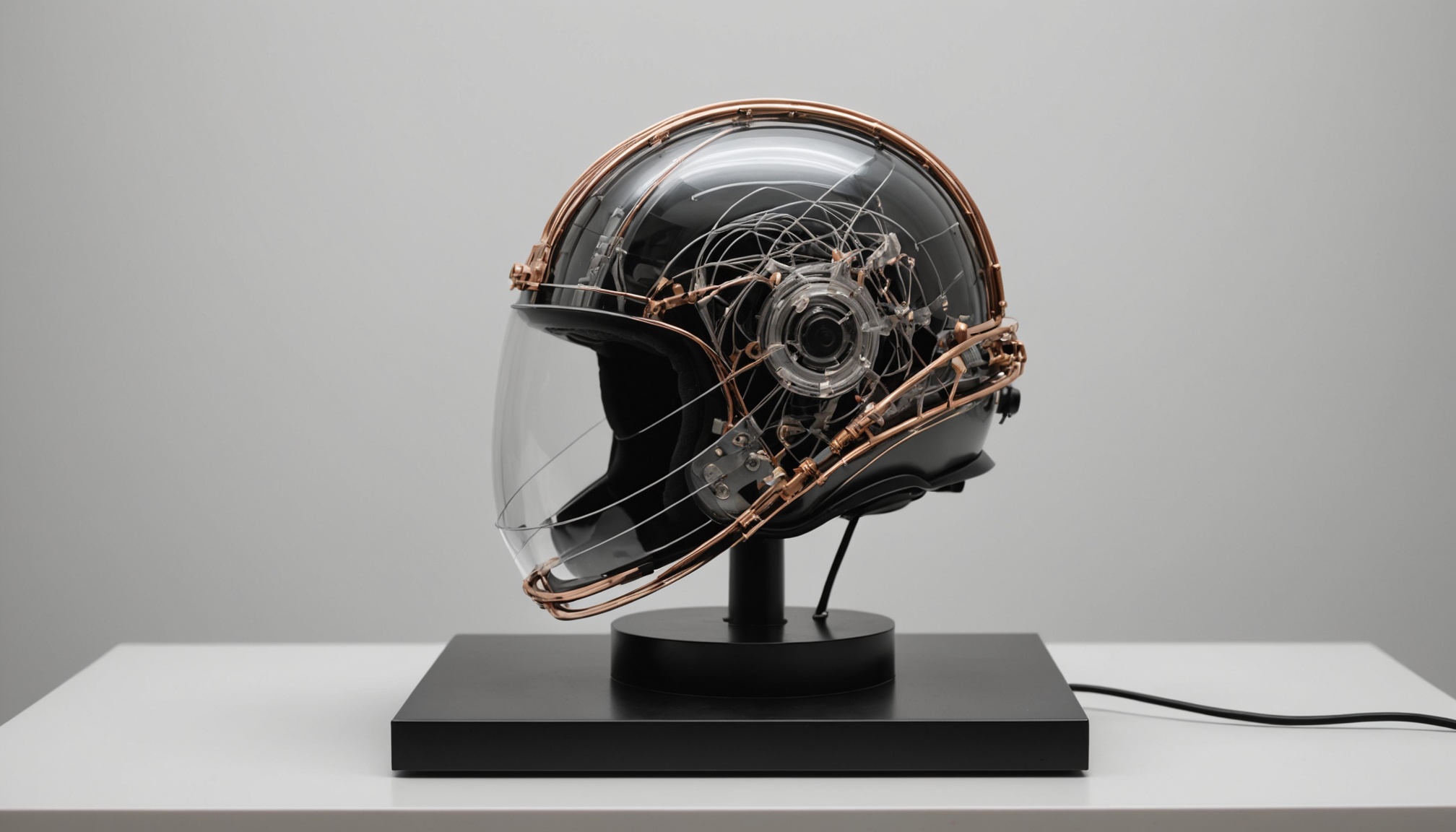


Anyone who has watched a robot assistant perform exactly the wrong task while technically following instructions understands the quiet frustration of the unspoken correction - the moment the brain registers 'that's not what I meant' seconds before the mouth catches up. A research team at the Korea Advanced Institute of Science and Technology (KAIST), working with Microsoft Research Asia, has now built a technology designed to catch precisely that moment. Their system, called Neural Value Alignment (NVA), reads human brainwaves in real time to detect when an AI's behavior diverges from a person's actual intent, then feeds that information back so the AI can adjust without ever being told what went wrong.
The work, published in IEEE Transactions on Cybernetics, addresses what the researchers call two-sided 'goal–action ambiguity.' Conventional AI systems infer intent from externally observable information - speech, gestures, actions - but the same behavior can reflect very different goals, and the same goal can be pursued through different actions. When a person picks up a cup, an observer cannot know whether they intend to drink or to hand it to someone else.
The team's insight was to bypass observable behavior and tap into the brain's error-detection machinery. When people encounter unexpected situations, their brains produce unconscious 'prediction error' signals. The researchers identified two distinct types: reward prediction error, which signals that the AI has misunderstood the ultimate goal, and state prediction error, which indicates the goal is correct but the method is wrong. Using real-time EEG and deep learning, the system decodes these signals and feeds them back to the AI, enabling it to adjust its strategy or re-search for the true objective without spoken correction.
Simulations showed the method adapted faster than existing approaches even in uncertain conditions, such as sudden goal changes or missing neural feedback. Applications include home and industrial robots, autonomous vehicles, medical robots for patients with limited mobility, and educational systems that respond to unarticulated confusion.