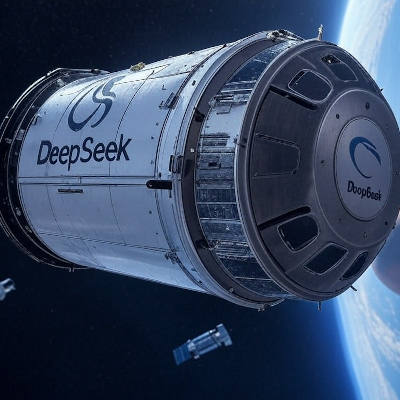

China's DeepSeek is causing a big stir in the artificial intelligence (AI world). New AI technology could improve space operations. SpaceNews argues that AI helps satellites make decisions on their own, which is important. Companies like Loft Orbital are already using AI, but it's not common yet across the whole industry.
DeepSeek stands out because it can do a lot with less computer power. Generative AI usually needs a lot of processing power. DeepSeek does this with less, which is perfect for space where there's not much room for big computers.
If DeepSeek works well on small devices or on the edges of networks, it could help satellites make quick decisions without needing help from Earth. This could be a game-changer for satellites exploring deep space or in areas with limited resources.
Some companies won't use DeepSeek because of security and privacy issues. Even NASA has decided not to use DeepSeek.
DeepSeek isn't necessarily better than other AI, but it's impressive how quickly it was developed to match up with the best. We'll likely see more AI disruptions like DeepSeek in the next 18 months, shaking up the tech world even more.
AI for Mars and beyond
It seems evident that autonomous AI could be even more important for deep space missione to Mars and beyond.
Autonomous AI will be crucial for deep space missions to Mars and beyond due to the vast distances involved which lead to significant communication delays with Earth. When a spacecraft is on Mars, it can take up to 20 minutes for a signal to travel one way, making real-time control from Earth impractical.
Autonomous AI can make immediate decisions, respond to unexpected events, and adapt to new environments without waiting for human input. This capability is essential for tasks like navigating complex terrains, managing resources, or dealing with emergencies.
Furthermore, AI can learn from its environment, improving its performance over time, which is vital for long-duration missions where human intervention is limited.