


The most consequential contest in technology is not about which model tops a benchmark. It is about who gets to own, govern, and profit from systems that increasingly shape economies, public institutions, jobs, information, and everyday decisions. The question also faces forward: who should hold authority over systems that may eventually surpass today's in capability and autonomy? Companies, governments, or the public who must live with the results? Emm, even which public?
For now, default is settling the matter in favor of a small club. Stanford HAI's 2025 AI Index reports that nearly 90% of notable AI models in 2024 came from industry, up from 60% a year earlier, and geography narrows the circle further: U.S. institutions produced 40 notable models, China 15, Europe three. The barriers are material: training compute doubles roughly every five months and training power demand annually, so entry requires capital, chips, and energy few command. U.S. private AI investment hit $109.1 billion in 2024, nearly twelve times China's $9.3 billion, and governments are buying their way in too, with China's $47.5 billion semiconductor fund and Saudi Arabia's $100 billion Project Transcendence.
The corporate case is not frivolous. Frontier research is expensive, and commercial incentives have delivered: the cost of querying a GPT-3.5-level model fell more than 280-fold between November 2022 and October 2024. Companies argue that intellectual property and the prospect of profit are what make such investment rational. But concentrated control carries documented costs. Tracked AI incidents reached a record 233 in 2024, up 56 percent, and standardized responsible-AI evaluations remain rare among major industrial developers. A company answers to its shareholders; a technology that mediates hiring, credit, and information answers to everyone.
Governments are pushing back, unevenly.
It saddens me to say that there is still relatively little to celebrate when it comes to AI governance and regulation on the African continent. The African Union adopted its Continental AI Strategy in 2024, while countries including Egypt, Rwanda, Ethiopia, Kenya, and Nigeria have introduced national AI strategies. Yet these initiatives remain largely policy frameworks rather than comprehensive, enforceable regulatory regimes. Despite these encouraging steps, Africa continues to lag behind in translating AI governance ambitions into binding laws, institutional oversight, and effective regulatory enforcement.
Across Asia, AI governance is advancing through markedly different regulatory approaches. China has enforced rules governing generative AI services since 2023 and introduced mandatory AI-generated content labeling requirements in September 2025. Japan's AI Promotion Act, fully effective since September 2025, emphasizes innovation and government coordination rather than sweeping restrictions. South Korea took a more regulatory approach, bringing its AI Basic Act into force in January 2026, with provisions addressing transparency and high-impact AI systems. India, meanwhile, introduced AI Governance Guidelines in November 2025, favoring a principles-based framework that builds on existing laws rather than a single comprehensive AI statute.
The EU's AI Act, Regulation 2024/1689, is the first comprehensive regime: it bans nine practices outright, imposes strict obligations on high-risk uses such as recruitment screening and credit scoring, and since August 2025 holds providers of general-purpose models to transparency and copyright duties, with risk assessment for models posing systemic risk.
U.S. federal agencies introduced 59 AI regulations in 2024, and state-level AI laws more than doubled in a year to 131. Yet governments have their own conflict of interest. AI is at once an object of regulation and an instrument of state power; the EU act itself exempts military and national-security uses.
A third set of contenders would disperse control rather than relocate it. Open-weight models have cut their gap with closed ones from 8% to 1.7% on some benchmarks within a year. Academia still produces the most highly cited research. And the UN's high-level advisory body, after consulting more than 2,000 participants, proposed seven recommendations for an inclusive global governance architecture in its September 2024 report, Governing AI for Humanity. None of these routes guarantees accountability. Openness spreads capability without ensuring safe use, decentralization diffuses responsibility along with power, and international frameworks remain voluntary where enforcement matters most.
For everyone else, the stakes are already concrete. Seventy-eight percent of organizations report using AI, so a job applicant screened out by an algorithm or a borrower denied credit already lives under private rulemaking. Falling prices widen access, but access without recourse is thin. The EU's demands for human oversight and traceable documentation in high-risk systems exist because an unanswerable decision is an unaccountable one.
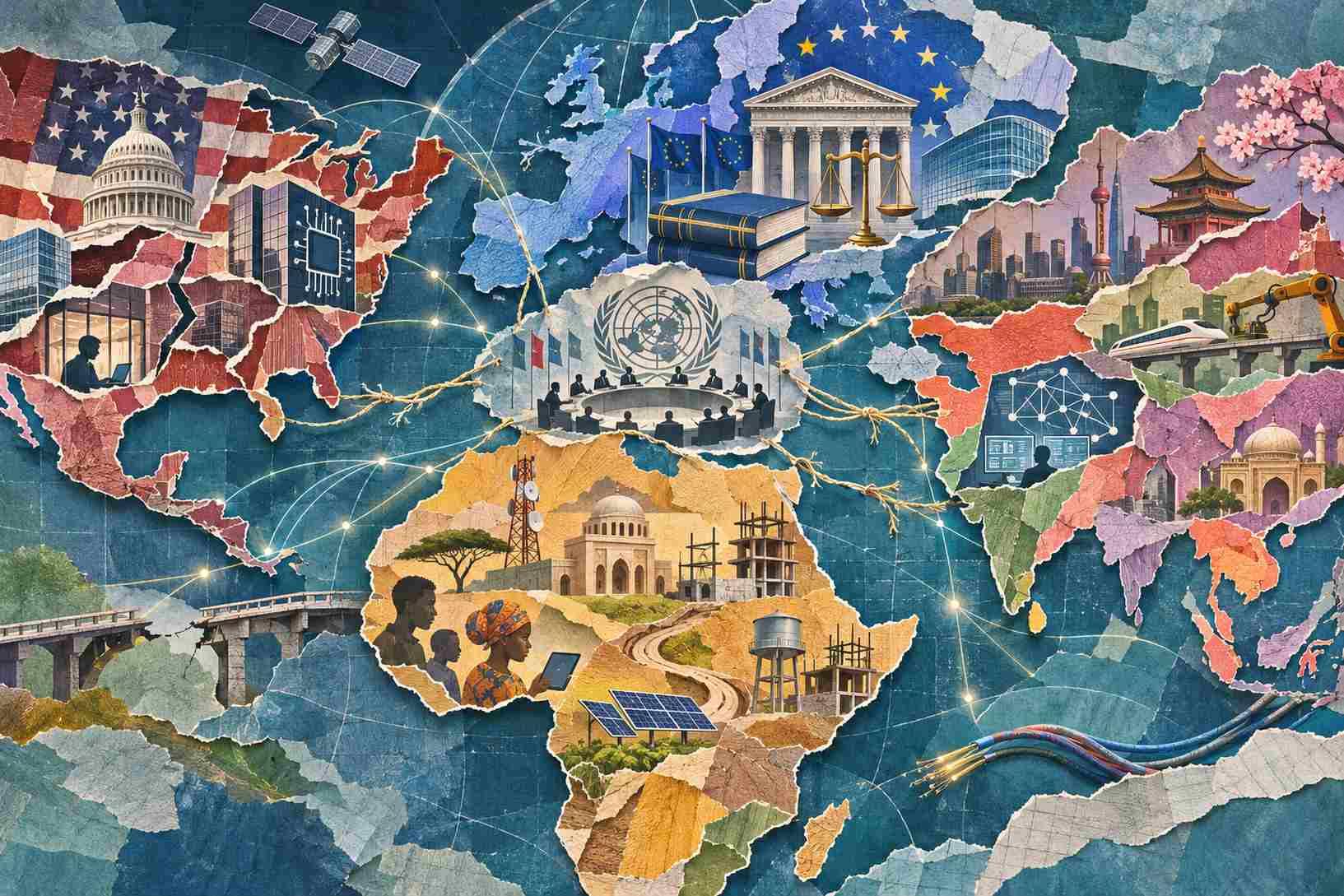
Control is also a map of dependence. China leads in AI publications and patents and has closed benchmark gaps with U.S. models to near parity, while most of the world must buy from one camp or the other. Two-thirds of countries now offer or plan basic computer-science education, with Africa and Latin America progressing fastest, yet in many African countries infrastructure as basic as electricity still blocks participation. The African Union joined the OECD, EU, and UN in issuing AI governance frameworks in 2024, a bid to write rules rather than merely receive them. Nations without compute, capital, or domestic models risk becoming permanent customers of foreign intelligence.
None of this requires believing that artificial general intelligence is imminent; honesty demands separating today's evidence from tomorrow's projections. But the trajectory is documented: models keep growing more general-purpose, agents already outperform humans on some time-bounded tasks, and regulators have begun writing capability-keyed rules like the EU's systemic-risk tier. If autonomy keeps rising, questions now treated as theoretical will become administrative.
Which is why government versus corporation is too small a frame. A world run by ministries can be as opaque as one run by boardrooms. The substantive questions cut across both. Who may inspect these systems? Who shares the productivity gains? Who can appeal a machine's decision, and to whom? Competing answers are on the table, from binding EU-style regulation and industrial policy with public stakes in private capability to open ecosystems and international oversight. Each trades speed against scrutiny differently, and none merits blind allegiance.
Technologies do not distribute power; institutions do. The ownership structures and forums being assembled now, in Brussels, Washington, Beijing, and the African Union, will determine whether AI's returns pool in a few firms and states or spread across the societies supplying its data and absorbing its disruptions. The question to ask of every arrangement is not whether it speeds the technology or slows it, but something older and harder: when a machine exercises real authority over human lives, who, exactly, has to answer?