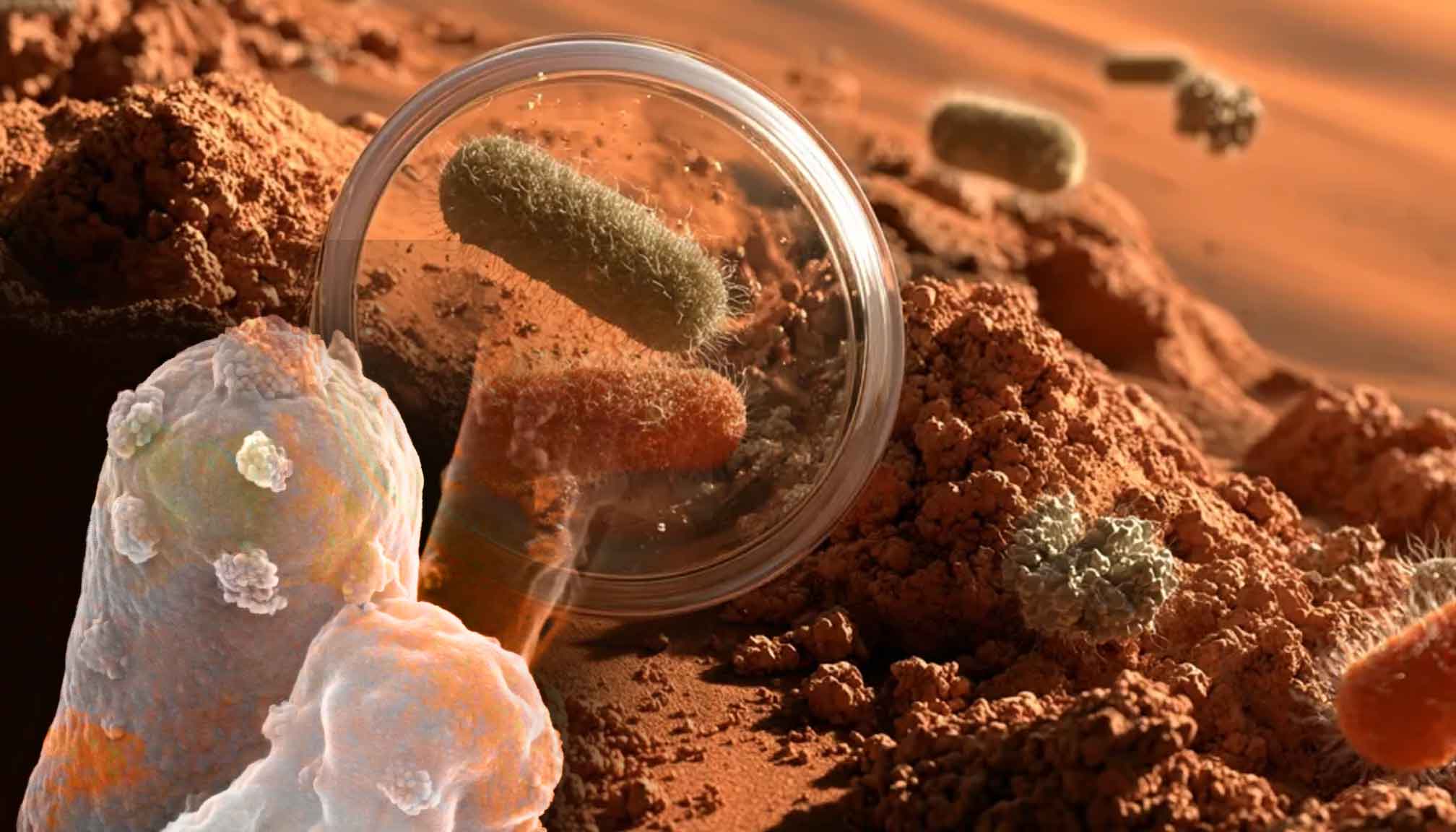

Pioneer Labs says it has built a bacterium named sPL.001 as an early step toward terraforming Mars. The microbe is said to grow on nutrients already in Martian soil, water, and treated air, without fertilizer from Earth and without first washing poisons from the dirt. The same cells would make building material inside a closed tank and, according to the company, cannot spread on the open surface.
Martian soil holds chemicals life needs, but also toxic materials. Plans for plants on Mars often rinse the soil, add fertilizer, or grow crops only in indoor water systems. Pioneer Labs argues those methods cannot be scaled across a planet. The company claims sPL.001 takes all its nutrients, including tiny amounts of metals, from Mars-like dirt, water, and processed air, so the living matter is made only from local atoms. If that is right, the dirt’s chemistry would not by itself stop Earth life from growing there.
The announcement gives links to three technical papers.
How a city might be built from plastic
sPL.001 would grow only in a bioreactor - a sealed, stirred, heated tank. As it multiplies it makes bioplastics that could be used like cabin logs to form pressurized, radiation-blocking rooms. One paper describes gear that would fit on a single rocket and, over about four years, supply material for a small city. Another paper says an Earth microbe was improved by directed evolution, meaning cells that grow and produce better on Mars-like nutrients are kept and grown again.
The microbe dies quickly outdoors, especially without liquid water. It cannot make food from sunlight and grows only if fed acetate, a simple carbon compound made from processed Martian air. A third paper says even a large tank leak would stay far below planetary protection limits, the rules meant to keep Earth microbes from contaminating Mars. Pioneer Labs presents sPL.001 as a human tool, not something that could green Mars by itself, and the first of five organisms planned for that goal.