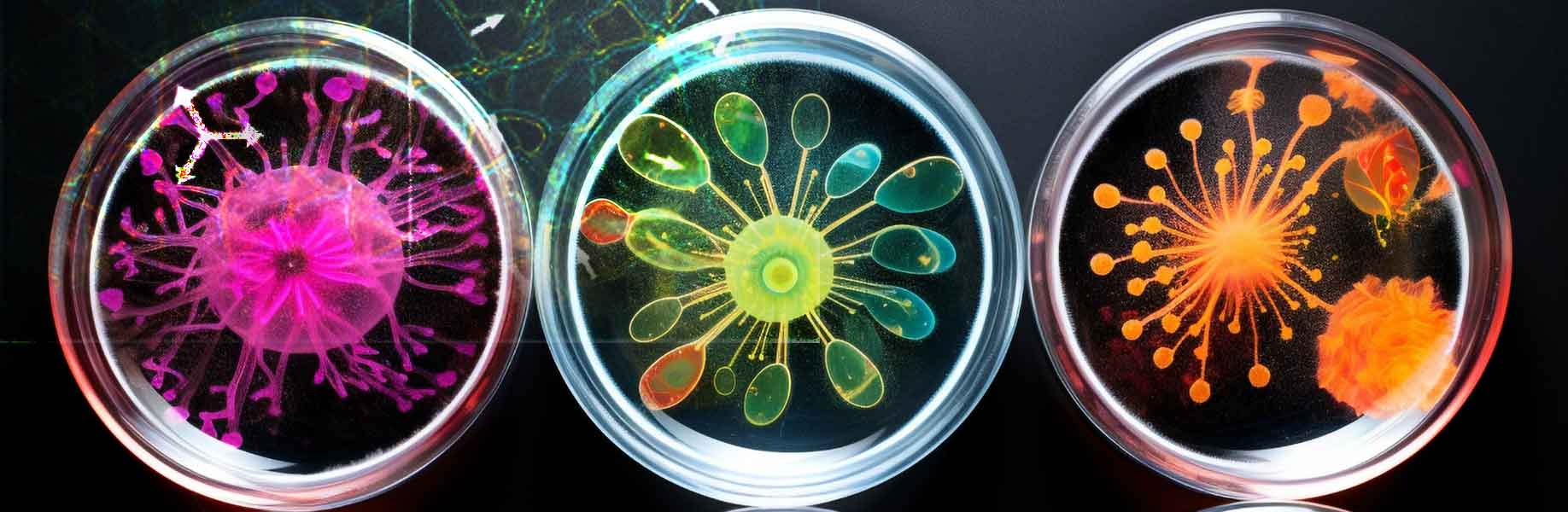

Researchers at Rice University built a special artificial intelligence (AI) system to study how groups of bacteria organize themselves. These bacteria live in the soil as separate rod-shaped cells that hunt together in swarms. When food runs out, these cells stop moving freely and gather into a mound known as a fruiting body. Inside this structure, some cells die while others turn into tough spores that can survive until food returns. This change from many independent cells to one complex form happens without any central leader.
The process has been hard to understand because the patterns keep changing in complex ways. To learn more, the researchers recorded time-lapse videos of bacteria as they developed over 24 hours. The videos showed shifts in cell density but could not track single cells. A deep-learning framework turned each video frame into a short list of 13 numbers describing the overall shape and arrangement.
The system included an image encoder that simplified pictures, a generative model that could recreate realistic images from the numbers, and a contrastive network that separated important biological differences from random noise.
The approach revealed hidden clues in the very first moments after starvation began. Even when images looked almost the same to the human eye, the model could predict with 80 to 85 percent accuracy whether the bacteria would form proper groups hours later. It also showed how specific gene changes alter the outcome, such as producing thin collectives or irregular shapes instead of normal fruiting bodies.
Early patterns shape later bacterial organization
This work challenges the old idea that the period right after starvation is just chaotic preparation. Instead, spatial patterns present at the start already contain information about future development. The method offers a precise way to link an organism’s genes, called its genotype, to its visible traits and actions, known as its phenotype. It provides a new tool for studying complex self-organization in biology, where simple parts create ordered structures without outside direction.
This research is published in PNAS.