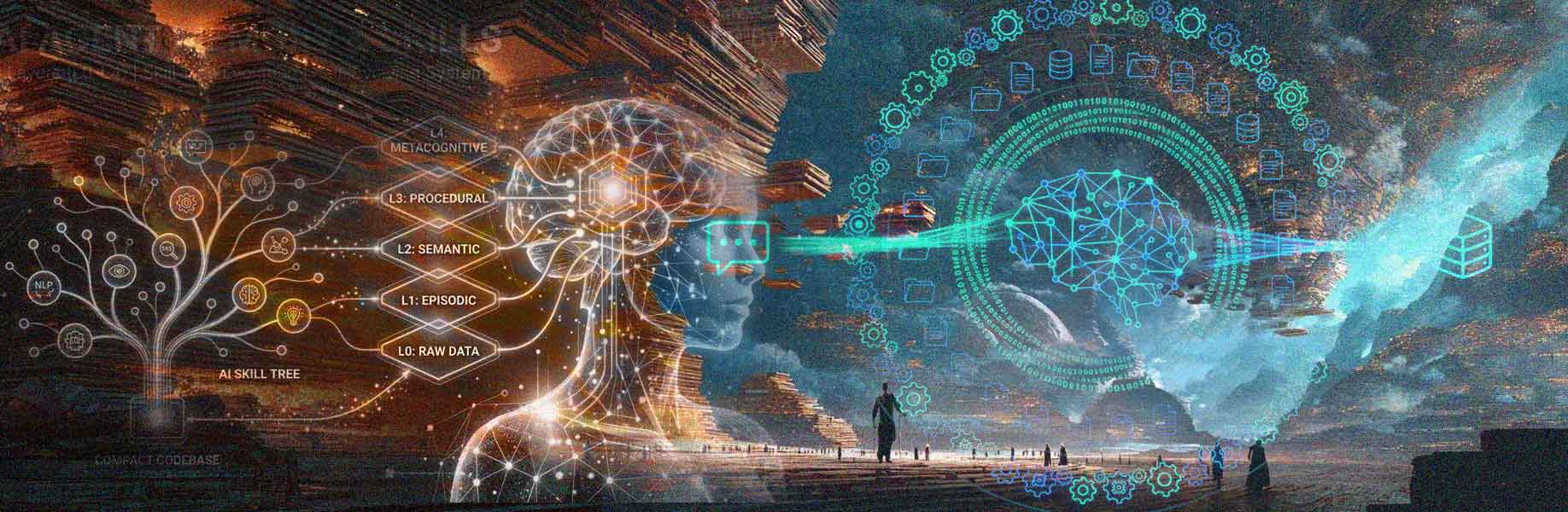

Imagine trying to master a complex video game, but every time you start a new level, your memory wipes clean. This is the reality for most Large Language Model agents. They lack the ability to accumulate knowledge over time, a process crucial for genuine lifelong learning. Researchers from the University of Chinese Academy of Sciences and partner institutions discovered a breakthrough in how AI can continuously learn. The science of AI agents has seen a recent breakthrough due to lifelong learning mechanisms, which has significantly changed the field. Memory consolidation has been a central feature of human cognition for some time, but a recent study has shown how it can be adapted for artificial minds. What is self-consolidation, and how is it changing AI development? A recent research paper provides insight, demonstrating how this concept is redefining the landscape and presenting new possibilities for future innovation.
The Bottleneck of Static AI Agents
Modern artificial intelligence can write code, analyze data, and solve intricate logic puzzles. However, most agents operate under a task-isolation paradigm. They function as stateless entities that reset after every session. To bridge this gap, developers previously tried feeding agents text logs of their past successful interactions.
While this sounds like a logical step, it suffers from two major flaws. First, it completely ignores the value of failure. When agents only review their wins, they miss the opportunity to understand why certain approaches fail, making them likely to repeat the same logical errors. Second, forcing an agent to read thousands of past chat logs exhausts its context window—the strict limit on how much text an AI can process at once. Stuffing this window with history introduces noise, dilutes the model's focus, and eventually causes the system to crash.

Learning from Contrastive Reflection
To resolve these issues, the researchers developed a new framework called EvoSC (Self-Consolidation), which mimics human cognitive learning. The first major component of this system is a contrastive reflection strategy. Instead of looking only at the positive outcomes, the framework forces the agent to analyze both successful and failed attempts side by side.
By contrasting these outcomes, the agent pinpoints the exact logical step where a failed trajectory diverged from a successful one. The system then extracts two specific types of guidance. It identifies error-prone insights, which act as warning signs to help the agent avoid known pitfalls, and it abstracts successful patterns to replicate effective strategies. This dual approach provides clear, explicit guardrails for navigating complex problems.
Turning Text into Parametric Intuition
The second major breakthrough involves solving the memory limit problem. The researchers designed a self-consolidation mechanism that distills massive amounts of text-based experience into compact, learnable parameters.
Instead of requiring the agent to read through verbose, explicit memories every time it faces a task, the framework compresses this historical knowledge directly into the model's latent space. One can think of this as transforming a thick instruction manual into pure, ingrained intuition. This allows the agent to internalize vast amounts of historical experience without occupying valuable token slots in its context window, keeping the system fast, focused, and immune to memory overload.
Triumphs in Complex Environments
The researchers confirmed these concepts through an experiment across three dynamic, long-horizon environments: Database management, Operating Systems, and Knowledge Graphs.
The results clearly demonstrate the superiority of the EvoSC framework. Compared with older methods that crashed due to memory overloads when fed too much history, the new framework maintained a stable, upward learning curve. For highly complex tasks, such as navigating Knowledge Graphs, the agent achieved remarkable performance boosts. The data are conclusive: extracting lessons from mistakes and compressing memory allows an agent to tackle tasks that standard, text-heavy replay methods simply cannot handle.
Conclusion
Artificial intelligence has reached a point where it can solve tasks, but the ability to grow over time remains the final frontier. Currently, AI agents face a severe limitation: they operate as static entities that reset after every task, failing to accumulate long-term knowledge. Overcoming this amnesia is critical for deploying AI in complex, evolving real-world scenarios like automated research or long-term personal assistance. The specific issue lies in retaining vast amounts of past experiences without overwhelming the system's memory limits or ignoring the educational value of past failures.
To resolve this, this study presents a dual-evolution framework that teaches agents to analyze their mistakes and compress long histories into intuitive, parametric memory. Developers should prioritize adopting this self-consolidation method to build more resilient, adaptable agents that do not require constant context-window retraining. Looking ahead, scaling this approach to larger models will likely unlock even more sophisticated lifelong learning, paving the way for AI that truly learns from a lifetime of experience.