

The statistics emerging from Beijing's "Robot Week" are remarkable. By 2025, China's robotics sector surpassed 300 billion yuan (approximately $44.24 billion) in revenue, achieving an impressive annual growth rate of over 20% for five consecutive years. In the first half of 2026 alone, China shipped more than 40,000 humanoid robots, capturing over 97% of global shipments. In stark contrast, the United States managed to ship approximately 450 units from its top three companies throughout all of 2025. This is not merely a competition; it constitutes a clear dominance.
The 2026 World Robot Conference attracted over 300 exhibitors from 26 countries, reflecting a 69% increase from 2025. On the first day of the conference, Unitree Robotics debuted on Shanghai's STAR Market, with its shares skyrocketing by 629%. More than 3,000 products were displayed, with nearly 300 making their global debut.
Meanwhile, the associated World Humanoid Robot Games featured 2,056 robots from 666 teams across 16 nations. Ignoring the conspiracy theory and the 666, this is four times the participation of the previous year featuring competions in 51 different disciplines.
Pushing the Limits
A humanoid robot developed by Beijing's X-Humanoid completed a 100-meter sprint in 9.39 seconds, breaking Usain Bolt's previous world record of 9.58 seconds. Additionally, this same robot achieved a standing high jump of 2.88 meters, surpassing Javier Sotomayor's human record of 2.45 meters. Organizers noted that winning times had increased in speed by twofold within just one year. The games also featured competitions in boxing, football, weightlifting, gymnastics, and tug-of-war, highlighted by the unveiling of Unitree's new "Superman" robot, which generated significant excitement.
The Supply Chain Advantage
China's edge lies not only in its assembly capabilities but also in its comprehensive supply chain ecosystem. The industrial parks in the Yangtze River Delta and Pearl River Delta can provide every necessary component from motors to micro-sensors) within a three-hour drive. Research from TrendForce indicates that system-on-chip (SoC) chips and memory account for over 65% of the semiconductor value integral to robotic costs, with the humanoid robot market anticipated to become a key driver of semiconductor growth, potentially exceeding 100 billion yuan or roughly 15 billion USD by 2035 (the global humanoid robot chip and memory market by 2035). Chinese robotics firms now source over 90% of their core components domestically.
Military Innovations
The Aviation Industry Corporation of China (AVIC) introduced Fengxing-001, a humanoid robot standing 1.8 meters tall and weighing 80 kilograms, designed for missile loading a task that once required the labor of four to six workers. The robot is also being evaluated for piloting aircraft; retrofitting older aircraft into unmanned platforms via a modified humanoid would cost significantly less than traditional methods. Other exhibitors presented robotic dogs equipped with electromagnetic net launchers capable of immobilizing targets at distances ranging from five to ten meters.
Global Attention and the U.S. Dilemma
The conference garnered international media coverage from outlets such as Reuters, EFE, BBC, CNN, Al Jezira, The Independent, and countless other major media outlets. Andrés Kecskeméthy, the President of the International Federation for the Promotion of Mechanism and Machine Science (IFToMM), noted that China is now responsible for over 50% of key publications in the premier journal of the robotics field.
However, the United States still maintains leadership in foundational model research and venture capital, capturing 52% of global robotics investment amounting to $4.9 billion in 2025. U.S. robotics research remains at the forefront globally, with companies like Tesla and Nvidia holding competitive advantages in artificial intelligence systems and core physical AI technologies. The 2026 publication by Robotics Center states: a) The US hosts the world's most concentrated humanoid venture market, of the $9.4B deployed globally in 2025, 52% ($4.9B) went to US-headquartered companies, and b) VLA architectures remain US-originated and US-dominated expecting OpenAI, Google DeepMind, and NVIDIA to ship robotics-specific foundation models in 2026–2027 that compress the data advantage currently held by Chinese operators.
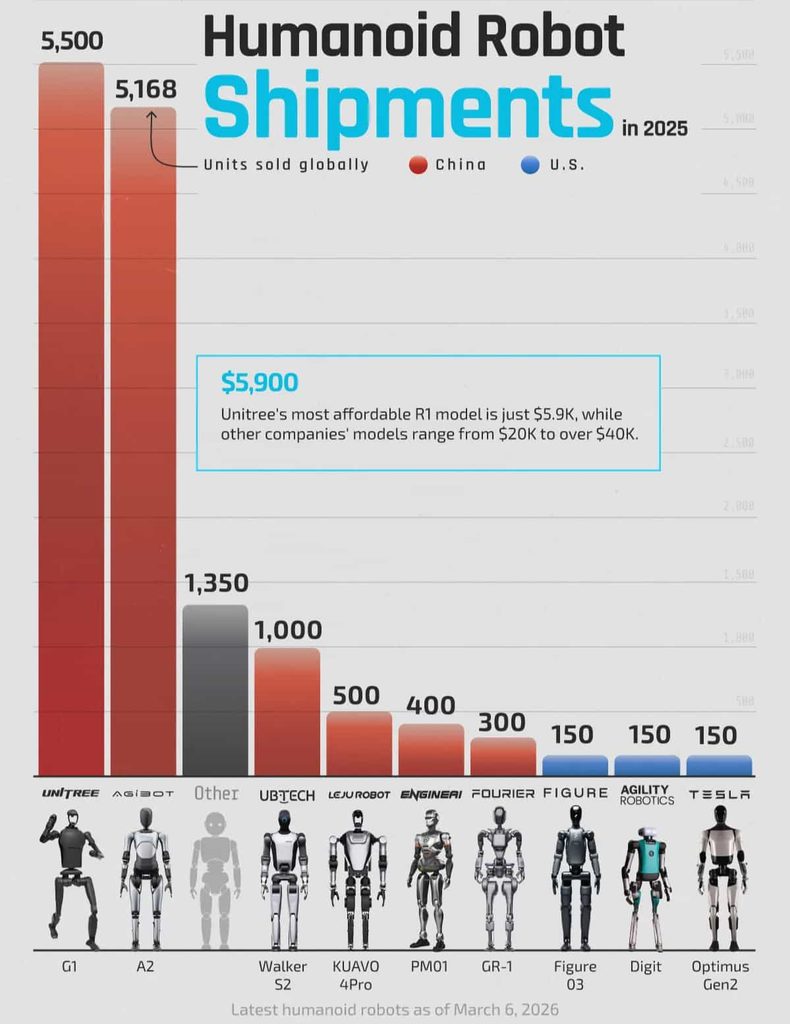
Yet, based on the same reports stat, one can see the gap between the two nations regarding hardware production is widening. While U.S. companies such as Figure AI, Agility Robotics, and Tesla collectively shipped around 150 humanoid units in 2025, China's Unitree and AgiBot exported 5,500 and 5,168 units respectively.
Data from Goldman Sachs highlights that China controls approximately 26% of the global actuator market, compared to just 5% for the United States, and dominates 60% of rare-earth production. In response to national security concerns, the U.S. implemented a ban on imports of Chinese-made humanoid and quadruped robots in July 2026.
China is not simply manufacturing robots; it is establishing a robust supply chain, developing training facilities (with over 70 currently operational and 46 more planned), crafting a supportive policy environment, and creating public spectacles. The U.S., conversely, is focusing on software development and elevating valuations. One approach is yielding results in the current market, while the other is banking on future potential. The critical question remains whether the future will arrive before the market landscape is irrevocably altered.