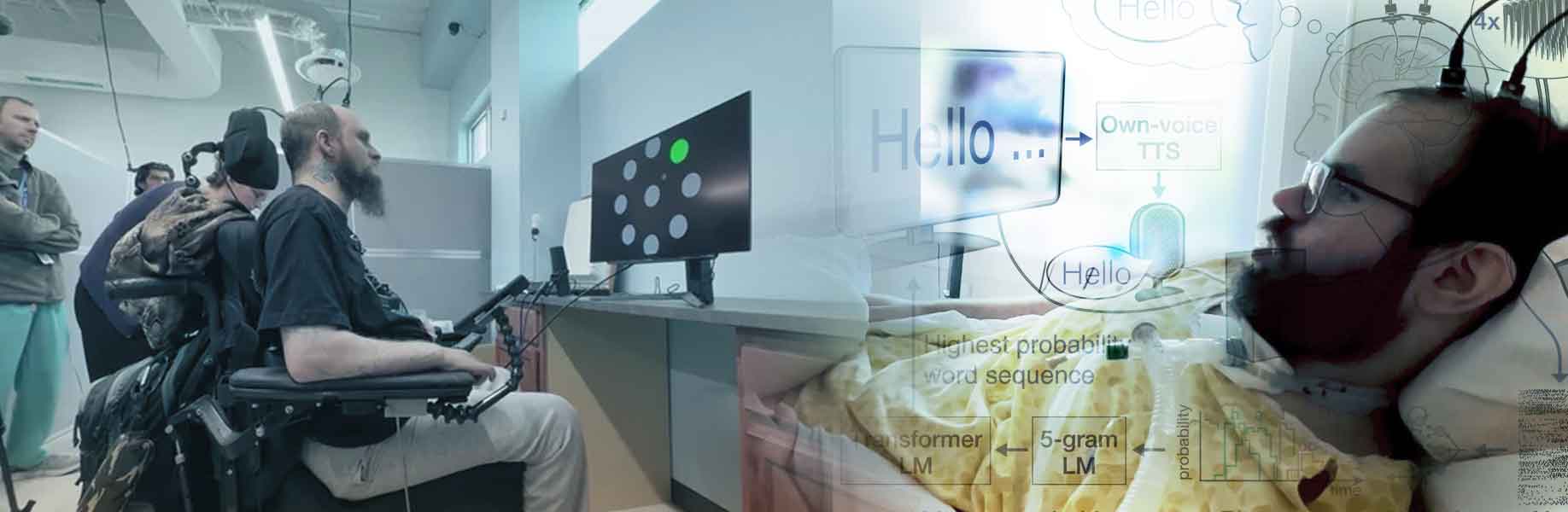

A recent study published in Nature Medicine shows that a brain-computer interface (BCI) can let a person with amyotrophic lateral sclerosis, or ALS, communicate and operate a computer independently at home. The system reads brain signals linked to attempted speech and movement, then turns them into text or cursor commands without any researcher present to assist. This addresses earlier limits where such devices worked only in controlled lab settings and needed constant support to start.
In 2023, doctors operated a patient and placed four small sensor arrays inside a brain region involved in planning speech and movement. These arrays record signals from 256 points on the brain surface. Over nearly two years, the patient used the system at home for more than 3,800 hours on a near-daily basis without outside help. He produced more than 183,000 sentences containing close to two million words at an average rate of 56 words per minute. He rated 92 percent of the sentences as accurate or mostly correct, while controlled tests showed over 99 percent accuracy for individual words across a vocabulary of 125,000 terms.
Long-term reliability and scientific value
The updated system maintains stable performance even when the user attempts to speak faster, and it no longer requires researchers to set it up each time. The patient now sends emails and messages, browses the internet, and maintains regular contact with family, friends, and colleagues. He has described the technology as supporting a fuller life with more natural exchanges than earlier tools allowed, including the ability to share memories with his wife and daughter in his own words. Researchers note that this marks a shift from proof-of-concept devices to practical daily use.
The extended home recordings also created the largest known collection of brain activity data from a single person at the level of individual nerve cells during speech attempts. Scientists are studying this information to better understand how the brain produces speech, which may help improve future systems. The findings come from the ongoing BrainGate2 clinical trial, which continues to enroll participants. Overall, the results indicate that these interfaces are approaching real-world usefulness for restoring communication and digital access in people with severe paralysis from conditions such as ALS.