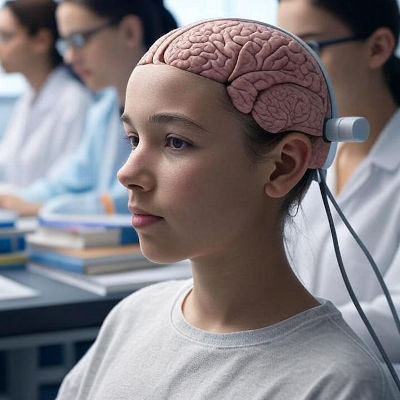

A recent study published in PLOS Biology shows that brain stimulation can help young adults improve their math skills. Transcranial random noise stimulation (tRNS) uses gentle electrical currents to stimulate the brain. It is safe, often unnoticeable, and has shown no cognitive side effects in past research. The study suggests this method could be especially helpful for people who struggle with math due to how their brain regions communicate.
The study involved 72 young adults aged 18 to 30 who learned new math techniques over five days. Some received tRNS, while others got a placebo. The tRNS was applied to one of two brain areas: the dorsolateral prefrontal cortex, which helps with memory and learning new skills, or the posterior parietal cortex, which handles math processing. Brain scans and measurements of gamma-aminobutyric acid (GABA), a chemical linked to brain plasticity (the brain’s ability to adapt), were taken before and after training. Participants with weaker connections between brain regions, often linked to poorer math learning, showed significant improvement when tRNS was applied to the prefrontal cortex. This helped them catch up to peers with stronger brain connections.
Brain Stimulation and Learning Outcomes
The improvement likely occurs due to stochastic resonance, where adding a small amount of random noise makes weak brain signals clearer. tRNS may boost underactive neurons, helping them reach their firing threshold. Importantly, tRNS does not enhance already strong learners, making it a tool to close gaps rather than widen them. While the study focused on healthy university students, similar research on children with learning disabilities or attention disorders suggests tRNS could benefit them too.
This approach could lead to new educational tools that target brain biology directly, helping learners who struggle due to natural brain differences. However, brain-based methods like tRNS must work alongside efforts to address issues like poor school funding or social barriers to ensure all students have equal opportunities, argues researcher Roi Cohen Kadosh in an article published in The Conversation.