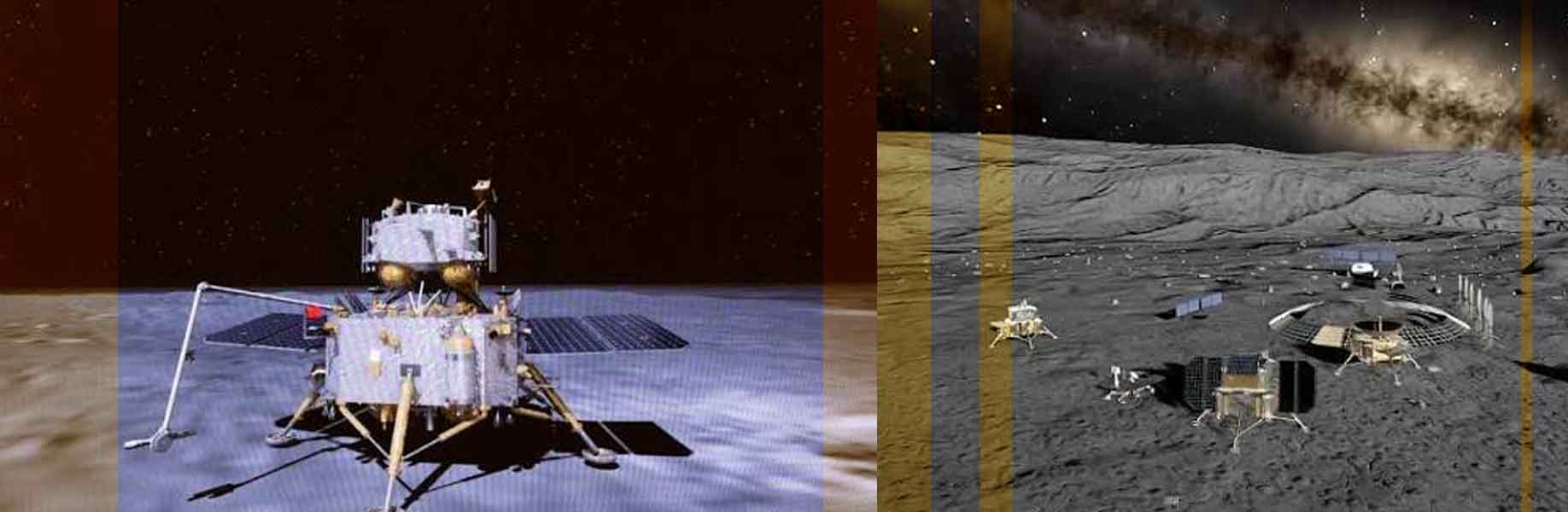

Chang'e 7 is China's next major robotic mission to the Moon. It forms part of the fourth phase of the Chinese lunar exploration program and is designed to study the south polar region in detail. The launch could happen soon, CGTN News reports.
The mission carries four main elements: an orbiter that will circle and map the Moon, a lander that will set down on the surface, a rover that will drive across the terrain, and a small hopping probe. The hopping probe is a compact craft able to make short rocket-powered jumps into areas that ordinary wheeled vehicles cannot reach. Communication will rely on the already-orbiting Queqiao-2 relay satellite. The preferred landing zone is an elevated, sunlit rim near Shackleton crater, chosen for good solar power and close access to permanently shadowed regions where water ice and may have been preserved for billions of years.
Ars Technica notes that China’s upcoming Chang’e 7 landing near the lunar south pole will serve as a wake-up call for the United States, underscoring the geopolitical stakes of the space race; a successful Chinese presence in this resource-rich region could allow Beijing to claim a propaganda victory and possibly assert territorial claims, while the U.S. must avoid falling behind.
Main goals of the mission
The primary scientific aims are to detect and study water ice and other volatiles in the lunar soil, to map the topography, composition and subsurface structure of the south polar region at high resolution, and to examine the Moon's internal structure, magnetic field and thermal properties. Instruments on the orbiter will survey the area from above with cameras, radar and spectrometers. The lander and rover will make measurements on the surface, including ground-penetrating radar and chemical analysis. The hopping probe will enter dark craters, collect soil samples, heat them and analyze the released gases to confirm the presence of water molecules. Success would help assess whether local materials could later support longer human stays through in-situ resource utilization. The mission is also intended to lay groundwork for a future international lunar research station.