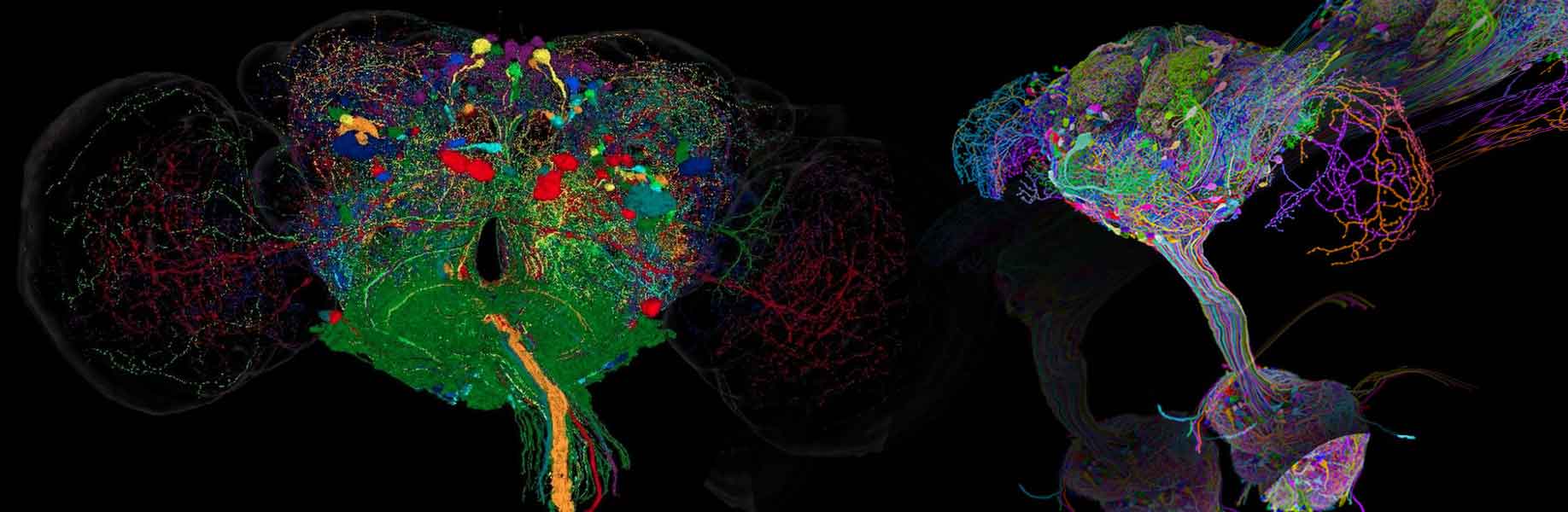

Researchers have produced the first complete connectome of the central nervous system in an adult fruit fly. It covers the brain together with the nerve cord, the insect equivalent of the spinal cord that directs body movements and processes sensory signals. The map makes it possible to study how the brain and body interact to generate behaviors such as walking and flying. The fruit fly provides an effective model because it displays complex behaviors despite having only around 160,000 nerve cells and because researchers can use genetic tools to study its nerve cells in detail.
To construct the connectome, researchers cut a single fruit fly into thousands of thin slices. They applied electron microscopy, and then artificial intelligence (AI) to combine these images into one three-dimensional representation of the central nervous system and its connections. This approach allows researchers to trace information flow from sensation through to action across the full nervous system. The map further connects to many body parts and sense organs through matches with previously identified nerve cells.
Insights from the connectome on movement control
Analysis of the connectome indicates that control of movement takes place mainly in local circuits of nerve cells within each body part rather than in a single central area of the brain. For instance, circuits serving one leg primarily manage that leg and link with circuits for other legs to enable coordinated walking. The same local arrangement applies to circuits for the wings and other regions. These motor circuits interact with circuits for vision and additional functions to shape behavior using relevant information. The findings indicate that control is spread across linked local modules rather than concentrated centrally.
The connectome is freely available online for other scientists to examine and build upon. Future work will incorporate details about neuropeptides, small molecules that nerve cells use for communication. The resource may uncover shared principles of nervous system operation in different species, including humans, since discoveries in fruit flies have frequently applied to mammals. It may additionally offer lessons for AI design by showing how biological systems organize connections to support complex tasks.
This research will be published in Nature.