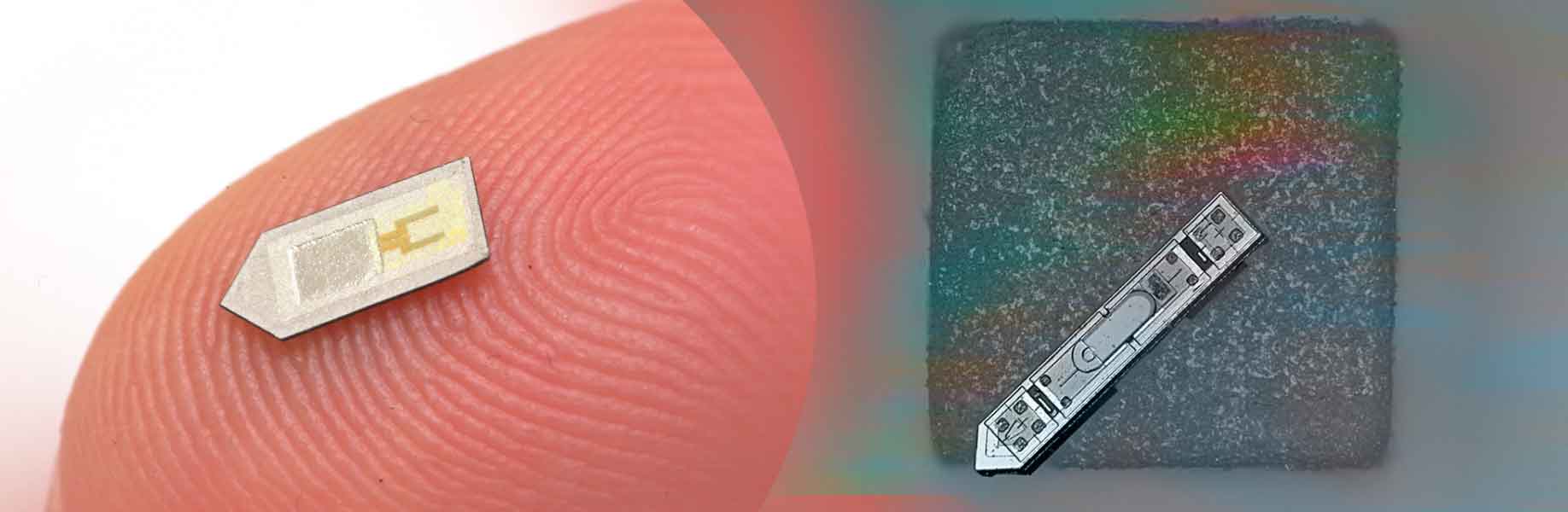

Cornell researchers have made a very small neural implant that can be placed in the brain to record electrical signals. It is about 300 microns long and 70 microns wide, small enough to sit on a grain of salt. Called a microscale optoelectronic tetherless electrode, or MOTE, it works without wires and sends brain data using light. The implant uses red and infrared laser beams that pass safely through brain tissue to provide power. A semiconductor diode, a part that controls electric flow, captures this light energy and turns it into power for the circuit. The same diode emits tiny pulses of infrared light to send back the brain's electrical signals as data.
The MOTE includes a low-noise amplifier, a tool that boosts weak signals without adding extra noise, and an optical encoder, which changes electrical data into light patterns. It uses pulse position modulation, a coding method where data is sent by timing light pulses, like in satellite communications. This uses very little power while reliably transmitting information.
Testing and performance of the implant
Researchers first tested the MOTE in cell cultures, groups of cells grown in a lab. Then they placed it in the barrel cortex of mice, the brain area that handles whisker senses. Over a year, it recorded neuron spikes, quick electrical bursts from brain cells, and broader synaptic activity, patterns from connections between cells. The mice stayed healthy and active, with less brain irritation than from larger implants. Traditional electrodes or fibers can cause immune responses or tissue damage because the brain moves around them.
The implant's materials allow it to work during MRI scans, magnetic imaging used for brain pictures, which most current devices cannot do. It could adapt for other body parts like the spinal cord or pair with future tech like light-based parts in artificial skull plates. This breakthrough reduces disruption to brain tissue while capturing fast activity, better than some imaging methods that need gene changes in cells. The work was supported by health institutes and nanofabrication facilities.
The researchers have described the methods and results of this study in a paper published in Nature Electronics.