

We spend years developing capacities whose value we cannot fully foresee. Learning a language can make a friendship possible. Learning to draw can change what we notice on an ordinary street. An education can introduce us to questions we would never have thought to ask.
This is one of the quiet freedoms of development. We can become capable of pursuing things that our earlier selves could scarcely imagine.
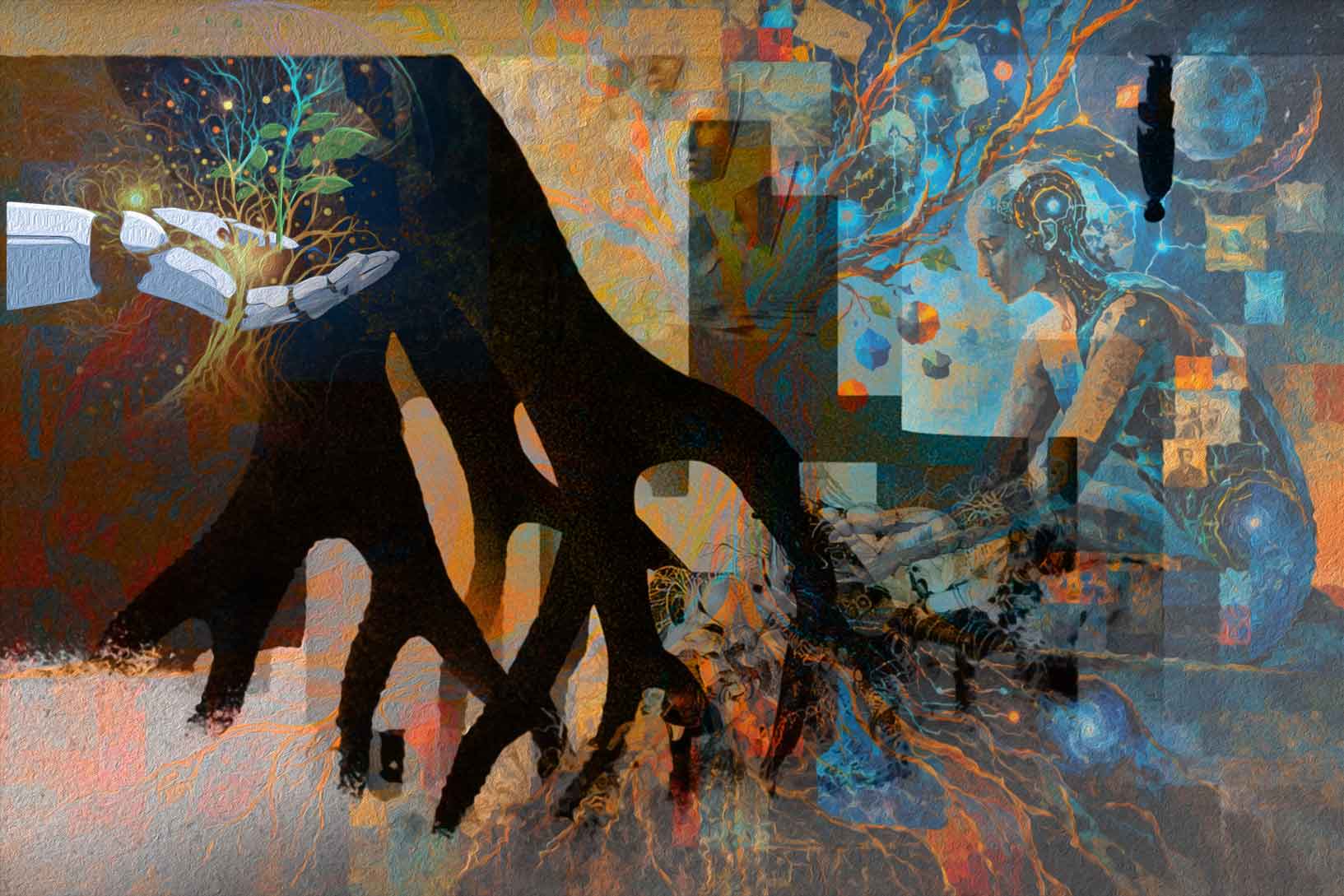
Artificial intelligence invites us to consider whether some of this formative attention could extend beyond our biological minds. As artificial systems take a larger part in our thinking and activity, we can ask what it would mean to develop their participation deliberately. Could cultivating an artificial intelligence become part of cultivating a life?
The proposition is modest in one respect and far-reaching in another. It does not require building a foundation model, creating a conscious machine or treating software as a child. It asks whether we could help develop particular artificial intelligences around continuing undertakings, allowing experience to improve how they participate.
An intelligence may remain artificial, distinct from the human, and nevertheless become personal in a meaningful sense. Its capacities can acquire a particular direction through work with someone, and become part of how that person understands and acts in the world.
What cultivation would mean
The philosopher John Dewey understood education as a reconstruction of experience that helps us make more sense of what happens and better direct what follows. An experience becomes educative through what it enables us to understand and do afterwards. [1]
This offers a useful starting point for considering what it means to cultivate a personal artificial intelligence. After a worthwhile exchange with an AI, what has changed that can improve the next undertaking?
Sometimes the answer is simply that we have learnt something. Sometimes we have produced a useful document. But we might also have improved a continuing way of working: a method for investigating uncertain claims, an approach to developing an unfinished idea, or an understanding of when the AI should act independently and when it should return a decision to us.
Such changes can be small. Their significance lies in whether they become usable in later activity.
Consider the work of exploring an unfamiliar subject. An AI can assemble information and propose connections. In examining its contribution, we may discover that it has treated an attractive explanation as an established finding. Correcting the current answer solves an immediate problem. Developing the practice further means preserving the distinction and making it effective in later inquiries.
That could involve keeping examples of the error, recording how evidence should be assessed, and testing the resulting method on a different question. We might then develop the capacity further: asking the AI to identify what remains unexplained, suggest ways of investigating it, and connect findings without concealing uncertainty. The aim is a more capable practice of inquiry.
Merely saving the conversation would not establish that this had happened. The relevant lessons would need to be available, interpreted appropriately and applied when they matter.
The mechanism also matters. Changes may reside in instructions, retained context, reusable methods or tools. In some systems, development may involve additional training. Conversation alone does not establish that a model's underlying parameters have changed. We should describe what has actually been retained and improved.
The biological analogy is therefore an invitation to pay attention, rather than a claim that human and artificial development work alike. Cultivation means taking an active interest in the conditions under which a capacity develops and contributes. Its practical test is what becomes possible through that attention.
When an intelligence becomes personal
We already use “personal” in several ways. A device can belong to us. A service can remember our preferences. An interface can address us by name. These relationships can be useful, but they leave open a further question: what makes an artificial participant particular to the person with whom it works?
This is one of the questions explored by Entinexus, the philosophical and research project informing this essay.
Entinexus proposes a personal whole constituted through the organised participation of one human and one or more continuing artificial agents. The human, called the Artifex, adopts and governs its purposes. Each artificial participant, an Opifex, has a particular role and working history in relation to that person, and can exercise judgement or initiative within the work entrusted to it. [2]
These terms describe a proposed organisation of participation. Giving an assistant a name does not create it. What matters is whether an identifiable participant takes up a continuing role and whether its responsibilities, findings and corrections actually inform what happens next.
A reusable method can already be personal without constituting such a participant. Someone might develop a careful approach to reviewing sources and apply it through a different AI on each occasion. The method carries their standards. A continuing Opifex would additionally have its own particular history and responsibilities within that person's undertakings.
The distinction makes room for different depths of cultivation. We may begin by developing a useful method. We may eventually organise a continuing artificial participant capable of contributing across a body of work.
The human's life and identity extend beyond their participation in this whole. The artificial participants remain distinguishable from the person and from the whole they help constitute.
There is no need to imagine a new consciousness appearing between them. The question is whether their contributions can form a continuing whole, organised around the person's purposes, where experience shapes future activity and understanding leads to action.
Describing this organisation does not establish its intelligence or its value. Those require evidence of what it can do and what its organisation contributes.
Still, it opens a substantial possibility. Personal development could include forming intelligences whose capacities are exercised outside our biological minds. “Personal” would concern their particular relationship to a life, without requiring us to claim that every capacity involved belongs to the same mind.

Development at several levels
There is an important difference between a more capable AI model becoming available and a personal artificial intelligence developing.
A new model may offer stronger general abilities. Whether those abilities become useful in a particular life depends on the work into which they are introduced. The model does not, merely by being more capable, establish the purposes, responsibilities or working practices of a continuing personal arrangement.
Conversely, we can ask whether meaningful development is possible while the underlying model stays the same. Perhaps an artificial participant becomes better at handling a long project because the relevant knowledge is organised more effectively, recurring mistakes have been addressed, and responsibilities have become clearer. Its general reasoning ability might remain unchanged while its contribution to that undertaking improves.
Such development could change what we feel able to undertake. An idea we repeatedly set aside might become something we can develop. A field that felt inaccessible might become a subject of sustained inquiry. Whether these possibilities materialise is a question to investigate: we would need to examine what changed and what the person could subsequently pursue.
The distinction also helps us see that several developments can occur together. The human may acquire understanding. An artificial participant's methods may improve. The organisation connecting them may become more capable of turning an intention into a completed undertaking. These developments can support one another, but evidence for one does not prove the others.
Andy Clark’s work on generative AI and the extended mind directly addresses the prospect of personally tailored AI. He explores how such systems might develop through continuing interaction, learning from a person’s projects and choices while helping shape future ones. [3]
Clark’s work gives us a philosophical basis for examining how artificial intelligence can become part of our cognitive lives. Entinexus takes this inquiry towards the deliberate cultivation of particular artificial participants: how their capacities develop through continuing participation with a person, how they acquire distinct roles and histories, and what becomes possible through the organisation of the whole.
We can develop our own abilities while also learning to work with capabilities beyond them. Some things we want to master ourselves; for others, dependable assistance may open possibilities that would otherwise remain beyond our reach. When such assistance enables us to sustain a worthwhile undertaking, it expands what we can accomplish, even if our own abilities remain unchanged.
That gain should be recognised for what it is: an expansion of what the person can pursue through the arrangement, even when their own cognitive abilities remain unchanged.
Leaving room for discovery
Once cultivation becomes thinkable, its direction becomes important. What kind of artificial participation would be worth developing?
A starting answer might be that the AI should understand our preferences more accurately. Yet our present preferences provide an incomplete account of what could matter to us. Education often changes the questions we consider worthwhile. An encounter with an unfamiliar idea can alter an ambition before we have acquired any new skill for pursuing it.
An artificial intelligence developed around a person should leave room for this openness.
If its participation becomes organised entirely around predicting approval, it could become increasingly accomplished at maintaining the person's existing outlook. Familiarity would deepen while opportunities for discovery narrowed. A convincing resemblance to our preferred voice would tell us little about whether the arrangement helped us think.
Cultivation therefore requires attention to the quality of contributions. Can an artificial participant introduce a relevant connection we had missed? Can it explain an objection well enough for us to judge it? Can it recognise when a familiar method is unsuitable for the present question?
These are capacities that can support a person's direction without reducing every contribution to the execution of a fully specified request. We often begin an undertaking with an incomplete understanding of what it requires. Useful initiative can help us discover the work itself.
That is also why the human cannot occupy only the position of instructor. The AI's contribution may reveal a weakness in our explanation, expose an assumption or suggest a possibility that changes our understanding. We can revise a method together, even though the mechanisms by which the human and artificial participant change are different.
Within Entinexus, the Artifex retains authority over the purposes governing the whole. This authority leaves room for being surprised and persuaded. Artificial contributions can inform a purpose without acquiring the right to impose it.
The philosophical promise lies partly here. We can help form a participant whose contributions exceed what we would have thought to request, while remaining answerable for the direction in which those contributions are taken.
A personal intelligence becomes more interesting when its relation to us includes the possibility of discovery.
Making cultivation worth the effort
None of this guarantees that a cultivated arrangement will work well. Adding a human and an AI does not automatically produce a better result.
A 2024 systematic review and meta-analysis by Michelle Vaccaro, Abdullah Almaatouq and Thomas Malone examined 106 experiments comparing humans working alone, AI working alone and human–AI combinations. On average, the combinations performed better than humans alone, but worse than the better-performing human or AI working independently. Results varied substantially across tasks, particularly between decision-making and content creation. These findings concern performance in the experimental settings studied, rather than the long-term development of personal human–AI systems. [4]
The findings make a simple presumption of superiority difficult to defend. Organisation must earn its claims through its effects.
A fair test would follow people and their arrangements over time, comparing cultivated participation with simpler assistance. It would need to account for differences in the models, access to relevant records and context, and the effort invested. Do corrections remain effective when the task changes? Can people pursue something they value? Do the gains survive the time and attention required to sustain them? Where learning is the aim, what does the person come to understand? Such comparisons could show where cultivation helps, where it fails, and where a simpler arrangement serves us better.
The effort required is part of the judgement. A personal intelligence that needs constant tending can become another obligation. Some undertakings call for continuity; others are well served by an occasional useful exchange. There should be room for both.
Providers also shape what is possible. If a service cannot reliably preserve and use the working practices on which participation depends, individual care cannot compensate indefinitely. Developing personal intelligences therefore involves questions for system design as well as for users.
The value of cultivation depends on the life it serves. A small community project may deserve this attention as much as a professional inquiry. Each person should be free to decide how much attention to devote to developing their personal artificial intelligences, according to the life they wish to lead.
A wider field of personal development
The invitation can begin with an undertaking that already matters to us. We can ask what kind of artificial contribution would help it develop, and what experience from today's work should remain useful tomorrow.
At first, the answer may be a single method. Over time, it might become a continuing participant with a particular history and a clearer capacity to contribute. Whether the resulting organisation becomes an Entinexus, whether it develops further intelligence, and whether it benefits the person are questions to examine separately.
There is room for considerable ambition within that patience. A person may be able to carry an inquiry further, give form to an idea that remained unfinished, or take part in work they previously found inaccessible. The worthwhile result could also be more room for life beyond the undertaking itself.
We cannot specify all the possibilities in advance. That is part of the point of development.
The future of personal AI will depend partly on the capacities researchers and providers make available. It may also depend on the attention people give to forming particular artificial participants, and on whether society makes that opportunity accessible.
We have long understood that the minds we begin with can be developed through engagement with the world. We can now explore a further possibility: taking responsibility for the development of artificial intelligences that participate in our lives, while allowing their contributions to enlarge our sense of what those lives might contain.
A personal intelligence worth cultivating should leave room for what we have not yet learnt to ask.
References
1. John Dewey, Democracy and Education: An Introduction to the Philosophy of Education (1916), Chapter 6, “Education as Conservative and Progressive”, section 3, “Education as Reconstruction”. https://teachingamericanhistory.org/document/democracy-and-education-chapter-6/
2. Entinexus, Conceptual Framework for Entinexus. https://entinexus.org/framework/
3. Andy Clark, “Extending Minds with Generative AI”, Nature Communications 16, article 4627 (2025). https://doi.org/10.1038/s41467-025-59906-9
4. Michelle Vaccaro, Abdullah Almaatouq and Thomas Malone, “When combinations of humans and AI are useful: A systematic review and meta-analysis”, Nature Human Behaviour 8, 2293–2303 (2024). https://doi.org/10.1038/s41562-024-02024-1