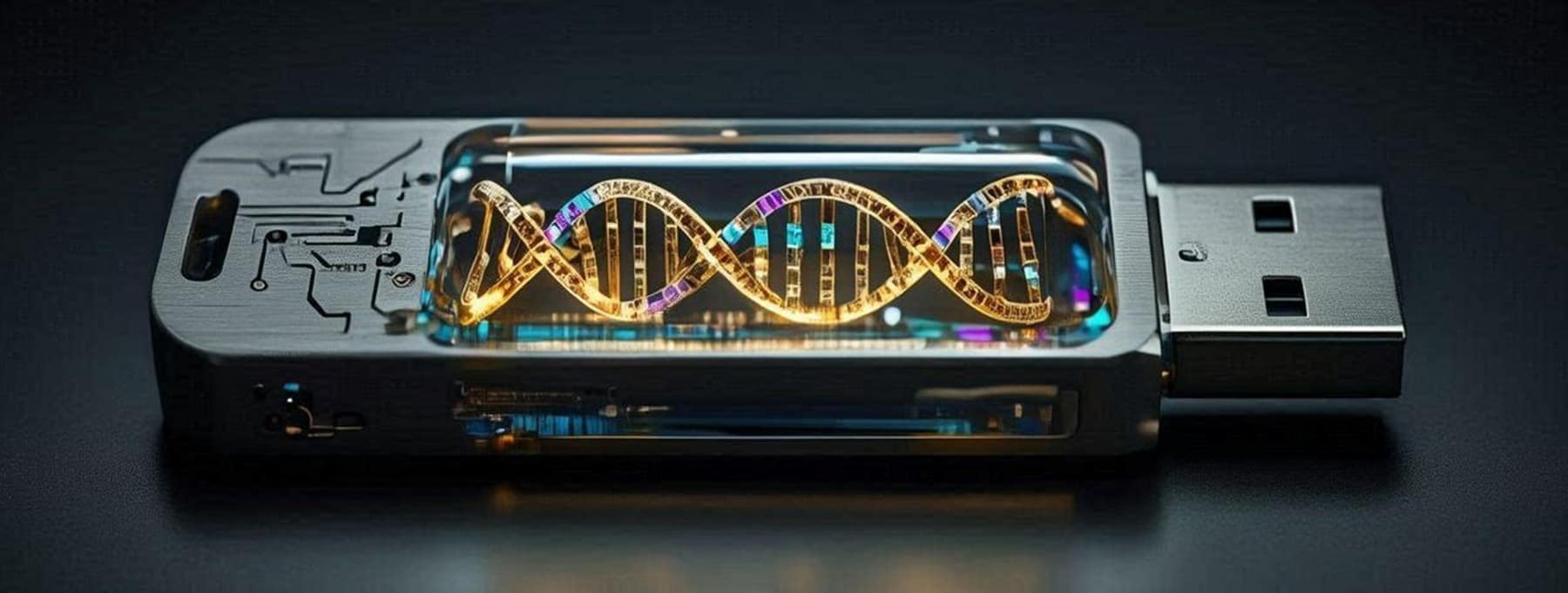

Researchers have developed a working prototype of a "DNA cassette tape" system, a novel approach that could revolutionize how we store the world's ever-growing mountain of digital data. This innovation, detailed in a study published in the journal Science Advances, merges the mind-boggling storage density of DNA with the practical, scalable format of a tape cartridge.
The system works by encoding digital files composed of 1s and 0s into sequences of the four DNA building blocks (A, T, C, G). This synthetic DNA is then deposited onto a flexible, barcoded polyester-nylon tape. A key advancement is the system's integrated, cassette-player-like drive. This device can automatically wind the tape, use a camera to read the barcodes to find a specific file's location, and then process that section to recover the DNA for sequencing and decoding.
The potential of this format is staggering. Researchers estimate that a one-kilometer length of this DNA tape could theoretically hold up to 362 petabytes of data. To grasp that scale, it's the equivalent of storing about 60 billion high-resolution photos or 3 billion songs on a single reel. Furthermore, DNA is an incredibly durable medium. By encapsulating the data in protective molecular cages, the team showed the information could remain intact for over 300 years at room temperature, and potentially for tens of thousands of years if kept frozen.
However, the technology is still in its infancy and faces significant practical hurdles. In a proof-of-concept test, the system stored and retrieved a 156.6-kilobyte image file, but the process was slow. Reading that small file took about 25 minutes, and a full rewrite cycle approached an hour, making it vastly slower than current storage methods. The high cost and technical complexity of DNA synthesis also remain major barriers to widespread use.
The research, led by a team from the Southern University of Science and Technology and Shanghai Jiao Tong University, is a response to the global data explosion and the physical limits of traditional semiconductor-based storage. While not yet commercially viable, this prototype demonstrates a critical step toward a future where massive, rarely accessed "cold" archives—from scientific records to historical media—could be preserved in an ultra-compact, energy-efficient, and incredibly long-lasting format.