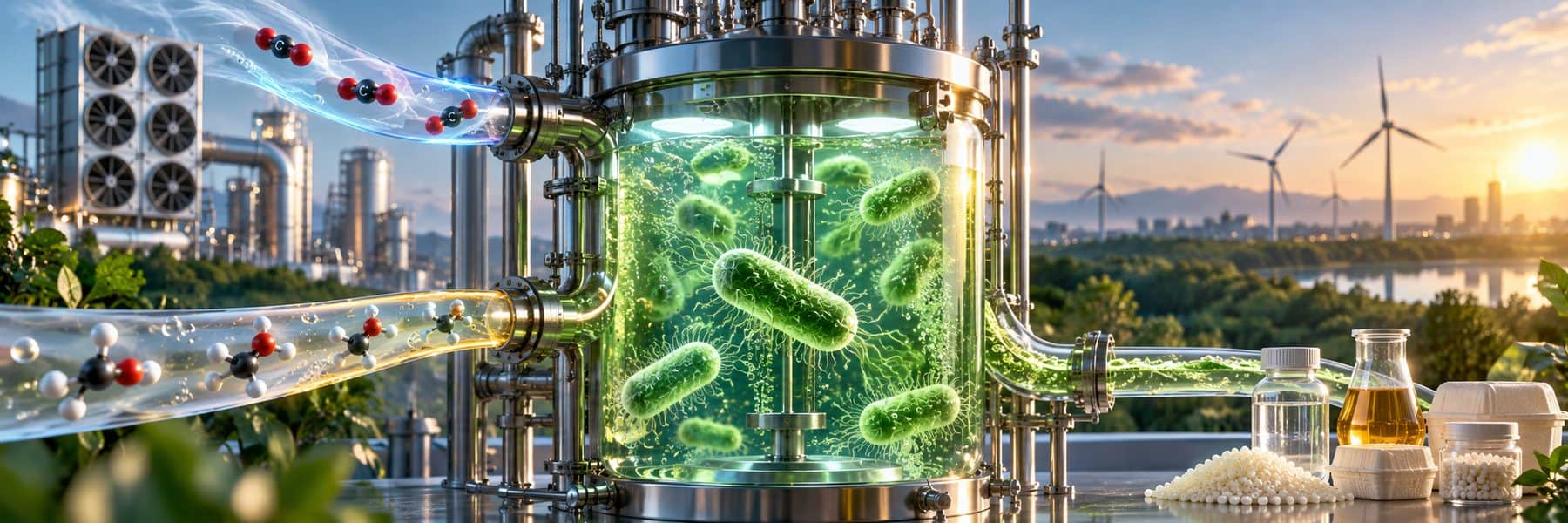

Researchers have re-engineered Escherichia coli so the bacterium can grow using carbon dioxide and methanol while also producing multiple chemicals, addressing one of the major energy bottlenecks in microbial carbon conversion.
The team built an orthogonal energy system that uses methanol as an electron donor, then coupled it to a redesigned CO₂-assimilation pathway. The resulting strain reached a reported doubling time of 8.6 ± 0.3 hours and a maximum OD600 of 37.5 ± 5.8 under the study conditions. It also produced mevalonate, lactate, 2,3-butanediol and succinate from engineered pathway nodes. Nature
The work fits into a broader effort to turn biology into an industrial production platform. Researchers are already using automated bioengineering to improve biological production systems, while synthetic-biology tools such as rapid protein-evolution platforms are expanding what engineered organisms can be designed to do. Carbon conversion also connects with wider attempts to replace fossil-derived products with synthetic fuels and renewable inputs.
The important advance here is not simply that E. coli can process CO₂. The researchers specifically redesigned the cell’s energy economy so carbon fixation is no longer constrained by its native redox system.
The study remains laboratory-scale research. It does not yet establish commercial economics, industrial durability or lifecycle carbon performance.