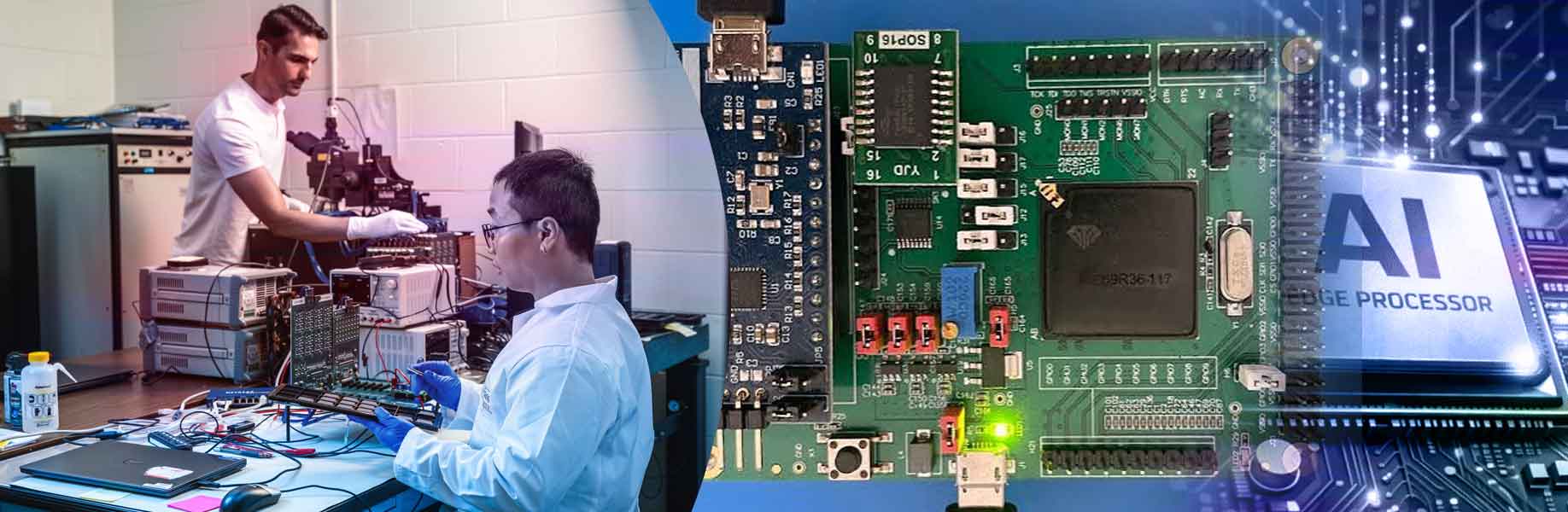

Researchers at the University of Massachusetts Amherst have shown that redesigning both the algorithm and the hardware together can make artificial intelligence (AI) applications run more efficiently on edge devices. As a demonstration, their system correctly identified languages with 95.24 percent accuracy while cutting the computing resources needed by 90 percent. This is the highest accuracy reported so far for this type of approach on emerging hardware.
Edge devices process information locally rather than sending it to distant data centers. Examples include smartphones, cameras, navigation systems, and home automation tools. These devices have limited power and processing capacity, so demanding AI tasks can drain batteries, generate heat, or slow performance. Language-related tasks, such as figuring out whether text is written in English, French, or another language, already place a noticeable load on such hardware.
Conventional methods usually place AI software onto existing chips. In contrast, the researchers developed the software and the hardware side by side so that each could take advantage of the other’s strengths. The solution combines hyperdimensional computing with analog in-memory computing. Hyperdimensional computing is a brain-inspired style of AI that represents information as large mathematical patterns rather than exact numbers. These patterns allow certain calculations to be performed in a simpler and more efficient way. Analog in-memory computing uses arrays of memristors, which are electrical components that both store and process data in the same physical location. This arrangement reduces the need to shuttle information back and forth between separate memory and processor units.
Turning a common drawback into an advantage
The encoding step in the system makes use of the natural variability, or randomness, found in memristors. Many researchers regard this variability as a problem, yet here it provides useful randomness for representing language features efficiently. The resulting platform can both encode language characteristics and carry out the identification task. The work builds on earlier studies of memristor devices, circuits, and machine intelligence applications. Researchers note that the same chips have already been applied to radio-frequency signal processing and sensing tasks. Looking ahead, the approach may also support spoken language processing, opening the way for more energy-efficient natural language features on phones, speakers, cars, and robots.
This research is published in Nature Communications.