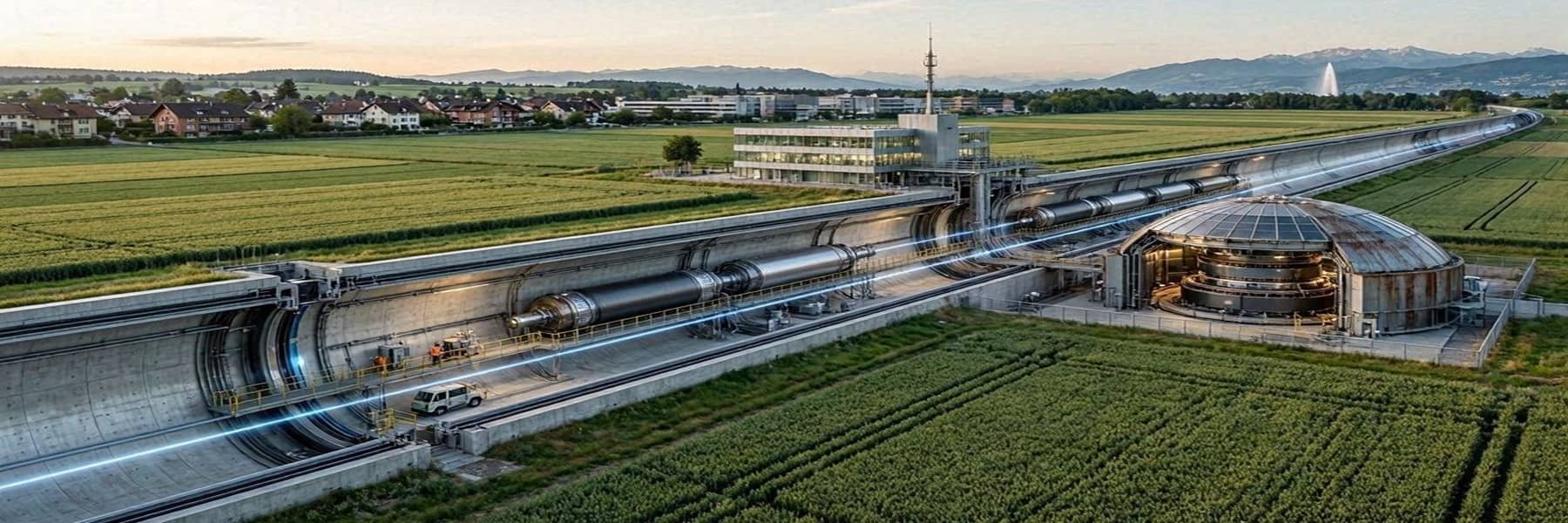

CERN has officially announced a plan to build a 91-kilometer circular collider, aka the Future Circular Collider (FCC), as the successor to the Large Hadron Collider (LHC). The first phase, called the FCC-ee, will smash electrons into positrons to generate large numbers of Higgs bosons for precise study. With a collision energy of up to 0.365 tera-electronvolts (TeV), the collisions will be cleaner than those at the LHC, enabling physicists to study the Higgs particle in unprecedented detail.
The FCC-ee is expected to be completed by the mid-2040s and will cost around 15 billion Swiss francs (approximately $19 billion). The project faces significant funding challenges, as CERN's budget will only cover about half of the total cost. The remaining funds are expected to come from the European Union, international partners, and private philanthropists.
After the FCC-ee completes its mission, the tunnel could be reused for a much more powerful proton collider, the FCC-hh, which would collide protons at an energy of 100 TeV (seven times that of the LHC). This second-phase collider is not expected to begin operating until the 2070s. The plan follows the successful model used for the LHC, which replaced the Large Electron-Positron Collider (LEP) in the same tunnel.