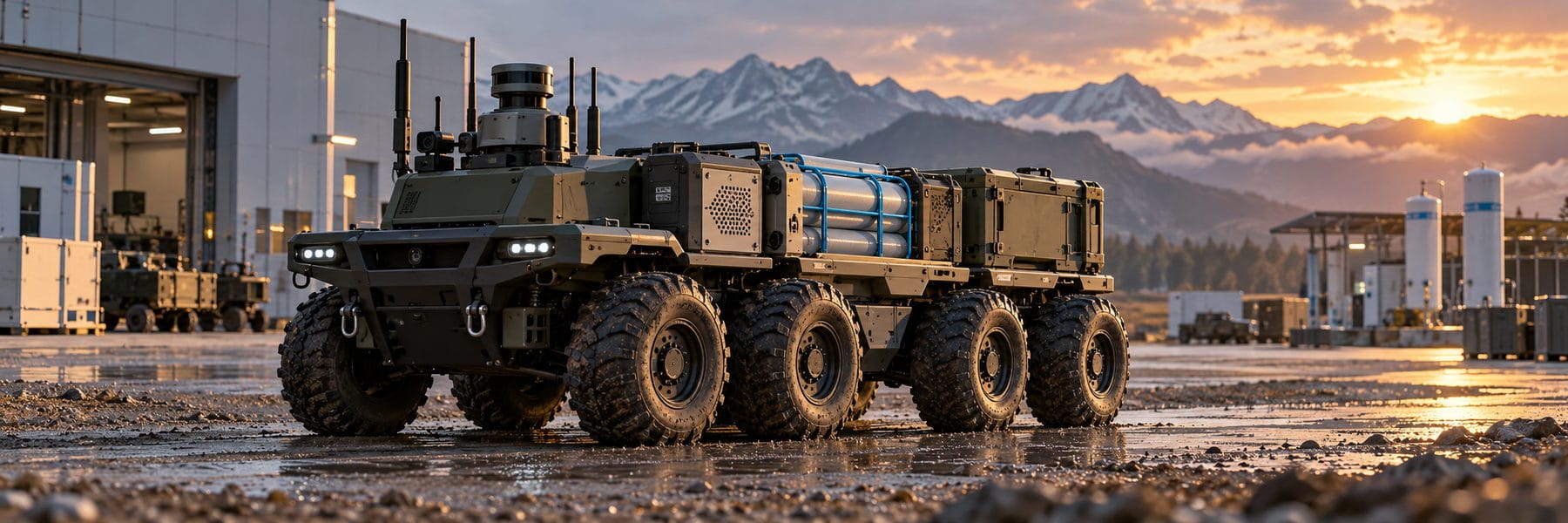

First Hydrogen says it has completed the physical build of its modular unmanned ground vehicle, moving the project from design work into a platform that demonstrates its core architecture, mobility and swappable payload system. Completion also satisfies a development milestone under its patent agreement, giving the company exclusive worldwide rights for the remaining life of the patent, subject to a 1% royalty on gross sales using it.
The UGV combines morphing-wheel technology, a constant-direction drivetrain, semi-robotic suspension and a configurable cargo deck. Its modular open-systems approach is designed so operators can swap batteries, cameras, sensors, robotic arms or computing hardware instead of committing the vehicle to one fixed role. The completed build includes an auto-opening module for launching and carrying an aerial drone.
That flexibility echoes work on. Research into also shows why rugged autonomous platforms increasingly combine several sensing channels rather than rely on one camera or mapping technology.
First Hydrogen says the drivetrain is intended to keep operating after component loss, while the suspension can adjust height and attitude to handle difficult terrain. Planned roles include logistics, surveillance, communications and drone deployment. Those are company-described capabilities: today’s announcement confirms the completed build and demonstrated architecture, not independent field validation of every proposed mission or performance claim.