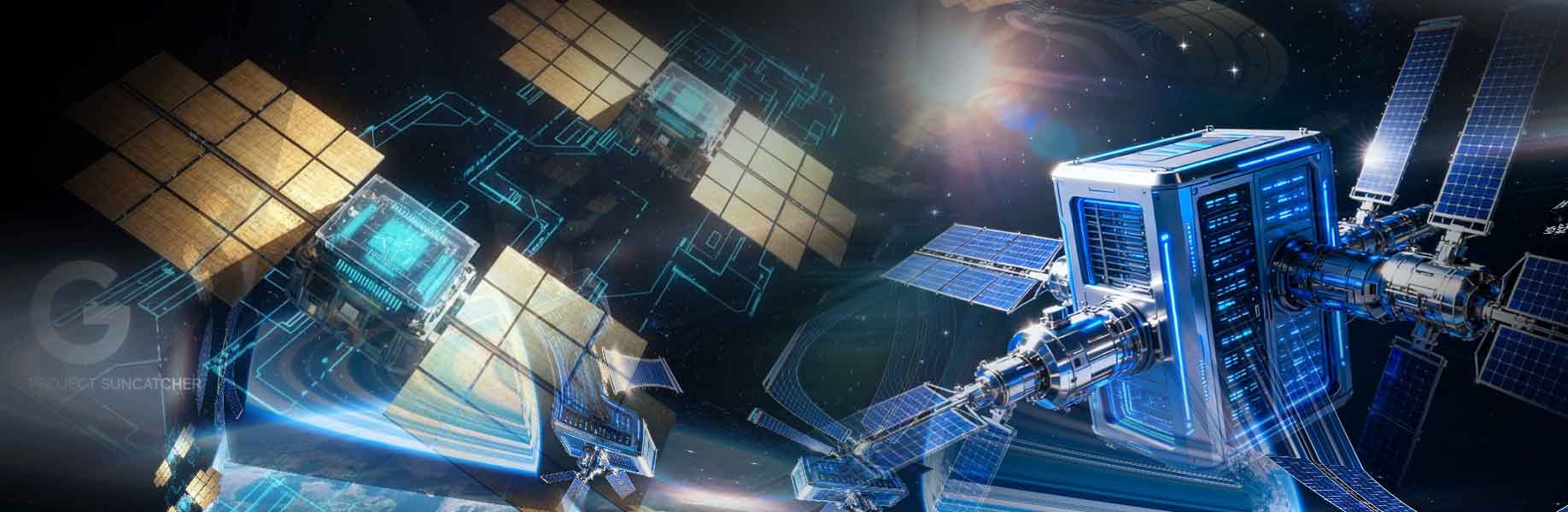

Google is working on Project Suncatcher, a research effort to deploy artificial intelligence (AI) computing infrastructure in space. AI needs huge amounts of power and hardware, but earth faces limits in energy and materials. Space offers a solution: the sun provides up to eight times more energy than on earth, nearly all the time, with no need for large batteries.
The plan uses groups of small satellites in a sun-synchronous low Earth orbit, a path that keeps the sun at a steady angle for constant light. Each satellite has solar panels, Google TPUs, which are special chips designed for fast AI tasks, and free-space optical links, lasers that send data between satellites at light speed. Satellites fly close together, just hundreds of meters apart, to share data quickly. This modular setup can grow to thousands of satellites for terawatt-scale power.
Overcoming main challenges
Four key hurdles stand in the way, but early work shows progress. First, the lasers need to provide data links as fast as earth data centers, tens of terabits per second. Lab tests achieved 800 gigabits per second each way using dense wavelength-division multiplexing, a method that splits light into colors for more channels. Close flying makes this possible by boosting signal strength.
Second, keeping satellites in tight formation without crashing. Computer models, based on orbital physics equations, simulate 81 satellites in a one-kilometer circle at 650 kilometers altitude. Distances between neighbors stay between 100 and 200 meters over one orbit, needing only small adjustments for stability.
Third, space radiation damages chips. Tests exposed TPUs to proton beams. They handled 15 kilorads of total ionizing dose, three times the five-year mission limit of 750 rads, with no full failures. Memory parts were most sensitive but still reliable.
Fourth, launch costs. Prices may drop to under 200 dollars per kilogram by the mid-2030s, making space centers as cheap as earth ones at about 800 dollars per kilowatt per year.
Next steps include launching two test satellites in 2027 with partner Planet to check links and hardware in orbit. Long-term, designs will integrate power, computing, and cooling for gigawatt systems. This moonshot, like Google's past quantum computer and self-driving car projects, tackles big unknowns to reshape AI.