
Liz Henry's interview continued, in conversation with R.U. Sirius and with help from Chris Hudak. Check out the prior intro for an intro!
R.U. SIRIUS: We talked earlier about Joan Slonczewski and her novel "A Door Into Ocean".
LIZ HENRY: A Door Into Ocean, where I sort of got the idea that feminist science fiction has a whole category of things where it's like, ‘lesbians with gills’! You know, give me the lesbians with gills. There's so many lesbians-with-gills novels out there. If you just kind of want science fiction that blows your mind… Brain Plague? [mentioned earlier] It’s amazing. It's like this artist… in a relationship with all of the little microbes in her brain that have a very fast life. She's infested with this brain plague, and they're all talking to her and worshiping her. It's just a weird nanotech book.
RU: It sounds a little Rudy Rucker-esque.
LH: She also had a very funny book that was a little more on the ‘young adult’ side, but I found it hilarious—called The Highest Frontier, [briefly mentioned earlier] that's sort of a university on a space station. And basically it's a lot of young people in the future, where that is possible. And one funny part about it… it’s almost a punchline. They'll be doing something, and then one of the young people will just say, “I have a disability.” And then everyone kind of has to adapt to it. And it's this world where everything is very adapted to everybody trying to accommodate each other's conflicting access needs and disabilities.
She wrote it post-Katrina. It was very much a post-Katrina thing… disaster-response and the flood and mutual aid, and what happens with that. But it was also a hysterically funny book— from the point of view of someone who's been a university professor kind of watching disability culture.
What AI Is Good For
RU: You said “I wanted to write programs, to play games and write poetry.” I'm wondering what you think about AI in that context, because suddenly AI is doing that sort of stuff. Have you played around with it?
LH: I have played around with it. I think it's doing the things that I never thought it would be able to do, a certain plausibility in handling of complexity. But you can still clock it because it'll do the same thing in the same kind of pattern.
It will evolve and change. We'll see where it goes. But for example, I'm reading people's grant applications right now... and, holy shit, you can tell! You can tell because they're all using it, and they all sound kind of the same. And the sentences will have the same formula.
I help with program management. I'm a program manager for the intermediary fund called Disability Inclusion Fund X-Tech. There's a disability inclusion fund. It’s a big fund, and disabled people run it, and disabled-led organizations get that money. And I have the part of it that's tech. That's a little fund. It's funded by Ford and MacArthur. So I'm looking for projects that are interesting related to disability, justice and tech. Smash them together and what have you got? What is it? People look at me blankly and go, “Is that like web accessibility?” No. No, we have that! [laughs]… there are web standards, there are committees for that. It's well understood. That's not really what we're talking about.
I'm looking for people who are doing interesting work. Like there's a deaf-run hackerspace/makerspace, in Portland.
RU: Say what?
LH: Deaf-run. A Deaf-run hackerspace.
RU: Oh—‘deaf! Not ‘death’!
LH: No, no—not ‘death’. We hope it’s not death. “Yeah, the ‘Death Space’!” [she *whaps* her hands together, like an exec who has just closed a killer deal] Disabled people love Death-Space; we’re all hurtling towards it.
CHRIS HUDAK: Oh—please tell me that the people who are working on these deaf-accessibility things have a regular meetup called ‘DEAF-Con’. They must.
LH: That would be very funny! I’ll have to ask about that! [ed: must check back some day.] Maybe the security-minded among them will do that. What’s also interesting is that sometimes I'll be adjacent to the gossip about people who are inventing the new ASL for computer terms or new neologisms, because the language has to keep evolving. And that's quite interesting and funny. Like ChatGPT? ASL for ChatGPT is a ‘C’. It's like this [demonstrates]. It's like the sign for a C, but your other hand is like a little flapping tongue, in the middle of the C, which I think is funny. I think of Trump with his toupee is blowing off!
They’re doing things a... deaf-accessible ‘learn how to use a 3D printer’ stuff. Access to video editing equipment. All the things that you kind of want from your makerspace and your hackerspace. And they run that so that it's super-accessible for other deaf people in their area; and then they go out to museums and other places and do all their education projects and propagate whatever wild installations they're gonna go put in the art museum. They’re artists as well.
RU: Cool! Are there some other examples of some projects that are unique?
LH: There's another really neat one that's like AI = AI-M-Power. So it’s like ‘AIM Power. And they're doing a lot of research into improving video conferencing software for stutterers and disfluent speakers. Say, if you have cerebral palsy and you're in a meeting and it's being transcribed… are they going to transcribe you correctly? So they have a huge dataset from Mandarin and English and I guess they have some version of the software that’s around, and they're trying to propagate their tools out to other video conferencing stuff. So they have stuff like Zoom integrations. I think that AI has bad aspects, but we can do interesting things with it too.
Inventory
Back to SF
Murderbot brains…
CHRIS HUDAK: Before you move on too far afield, you already mentioned one author whose novels you liked, that touched on these kinds of subjects; might there be a few other science fiction ‘I.P.s’ [Intellectual Properties], where you would say, “This is a good example of how to do it. this is not a good example”? You know, Dystopian versus Utopian—obviously, there’s Trek versus Blade Runner—a completely different sphere, so...
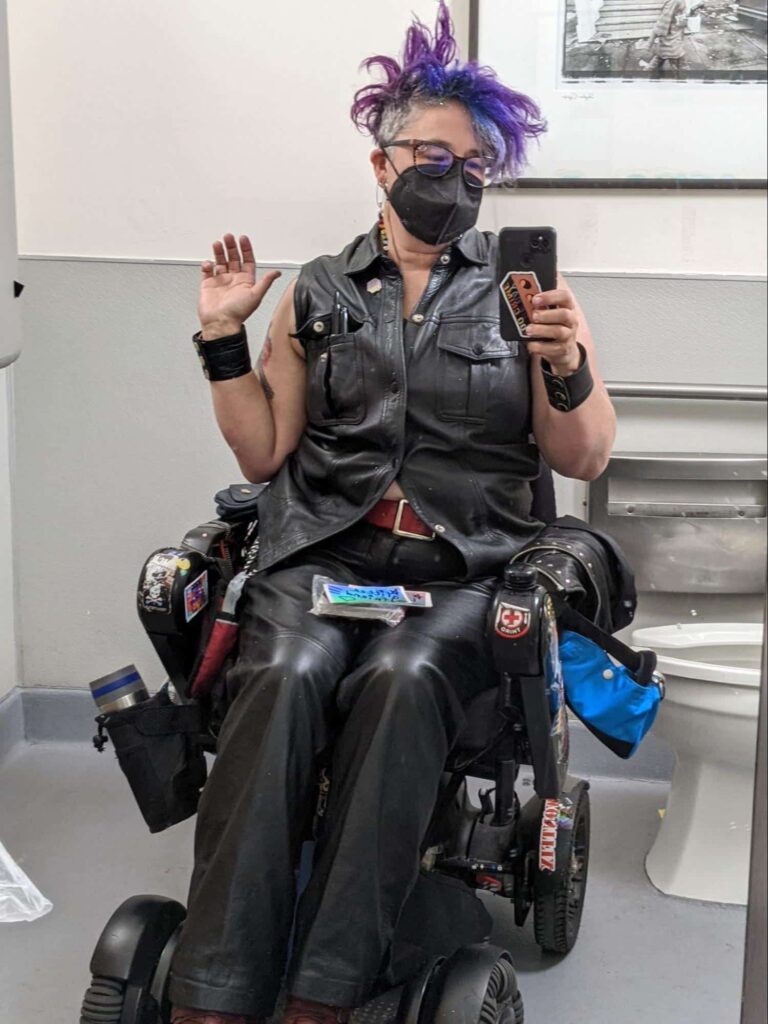
LH: Well, I'm a big fan of Murderbot. I named my chair after Murderbot.
RU: Yeah, I’ve been enjoying that too.
LH: Did you watch the show a little bit, or read it? The books are good.
RU: I’ve just watched the show.
LH: I thought the TV show was very interesting and good.
RU: I’m not quite as compelled to watch it as I thought I might be, but I’m making my way through it. Maybe I should read the novels.
LH: The novels by Martha Wells are very funny. The first season of Murderbot is just the first novella. There's plenty more Murderbot. Like ship-level consciousnesses, so Murderbot makes a lot of friends with shipmines and other AIs. I think you would like that part. Parts where ships are talking to each other is fun. And their attitude towards the humans is interesting.
But the other thing that's neat about Martha Wells writing, she had a whole sort of weird dragon-fantasy series. The world of the Raksura. I wouldn’t call it High Fantasy, but definitely in the fantasy spectrum somewhere. There's sort of these weird dragon societies. I would call it more like what Ringworld could have been; the thing that Niven was trying to do, where you have all these many different cultures, [explores] their methods of encountering another culture and doing cultural exchanges… and, ‘oh, we’re gonna have sex!’ Great. Fun. Super-fun! I think that Martha Wells approaches that idea is in a way more interesting, complicated way. Given that we have lots of people in different societies that have different rules, how do they approach each other? They have sort of a universal cultural protocol for what information we exchange, so that we don't instantly kill each other. And she kind of models that.
RU: Is that something in the real world that we've learned or is it something that we've unlearned now, with the extent of conflict and the encouragement of separateness? Because there was a sense that people were learning global rules for the community.
LH: I know, I'm just thinking about it. It's so depressing to think about actual war and all the things happening.
That was the idea of the Internet, that we’d be able to communicate. I believe still! I can't believe it… that I still do—I have really believed in unfiltered access to the means of cultural production and distribution, with the balance on production. That’s still the idea, but it's no longer unfiltered. I guess unfiltered access to the means of production and distribution doesn't mean that you don't get to control what happens in your own space.
RU: I mean, I come at this having been tapped into that idealistic phase of the unfiltered Internet, and I find myself writing about all the ways in which some of the best people who believed in that have felt that they had to push back against it.
LH: Yeah, because they’re also tools of mass harassment. Everything that can be a tool of organizing and activism for us is a tool or a weapon against us as well by people who might be more powerful or more aggressive. So that's true in general society. It’s also true of books. To me, it’s not a reason to hate on the tech or on the access. So if you say we should not let people say this on the internet, you're also saying we should ban certain books from ever being published.
RU: Yeah, it’s a very complicated area, for sure. I’m for setting the margins wide.
LH: Yeah. Do you feel like you got harassed?
RU: Hardly. Barely. I know people who got harassed and know people who harassed. I mean, like on Bluesky, which I love, but it’s almost obscenely polite. I’ve gone on X a few times at night and thought, ‘This is actually more interesting.’ Not because there are a bunch of right wing extremists on X, although links to weirdoes like Nick Land hold a certain grim fascination. But more importantly, because there are all kinds of people on X still, including well-established, deep, left-wing researchers and publishers who have been around for decades that have stayed on. Counterpunch, Jacobin, The Nation… all still there being very active, not to mention various authors and artists who are still there. Gibson is still there.
LH: I mean, I want shitposting… but, not fascism? I haven’t consistently posted on Bluesky, or Mastadon as much as I used to on Twitter…
Are people making money off 4Chan… 8Chan? It comes from having a soft spot for stirring up shit.
RU: Anonymous came out of 4chan. That was the first politics out of 4chan before the ‘alt-Right.’ Anonymous went after Scientology. They did the most effective takedown of Scientology in history. Scientology was taken down several pegs permanently by people who came out of 4chan.
LZ: Well, anyway… censorship, Internet, I forget how we got here!
Leather Liz
Transhumanism...
RU: We should probably lead out with some thought about transhumanism. You said you had thought about transhumanism, within your own context.
LH: Well, I can talk about actual transness. Like, I think we should get to modify our bodies however we want. Hell, yeah! And I've done that. And it's nice. I love it. I like the creativity and freedom that I see in trans communities. People who are going that route and saying, “we are free to modify our bodies. We're going to synthesize our own hormones. We’re going to fuck around. We’re going to be intersecting with the biohackers who put a magnet in your body. We’re gonna put RFID chips in ourselves. It’s very interesting and beautiful. It’s a logical evolution. You can look inside these vibrant communities of people who take that freedom. And they're like…. ‘We get to have this. We don't need somebody to define it in the DSM or say that we have some kind of disorder or something in our brains that makes us trans. There are certainly people who believe that…. the sort of medicalists. But there's other people who are, like, ‘we are actually choosing what we do because we want to do it.’
RU: And it was kind of the first place where the right to alter the body—alter the self—really emerged. And when it first emerged, there wasn't a huge backlash to it.
LH: Right. You mean like the 30s, 40s kind of thing?
RU: And during the 70s When Wendy Carlos Williams transitioned there wasn't a new backlash back then about it. The right just finds a new target when the old target isn't working anymore. Maybe it's just that simple.
LH: I don’t generally like the transhumanist scene. I mean fine, freeze your head. I guess. I don't like the idea that you're sort of diverting a lot of resources. I just see a lot of the longevity people as being very selfish. And that they're kind of grifters who want to start a cult. I just have a very allergic reaction to that. I'm just like, fuck off in the sun!
RU: Particularly with the growth and amplification of class distinctions, it's become much harder to talk about that kind of thing. It was easier to do that in the '60s and the '70s.
LH: Right. Like I mentioned with the exoskeletons: Who gets this? Who pays for it? Who's profiting? who's exploiting it?
I started a thing called the Anarchofeminist Hacker Hive. The thought was "What if we get together and talk about what feminist hacking would be if it existed." If we were feminist hackers, what would we be doing? We have a lot of interesting discussions around that. I think a lot of things happened. Now we can look at Chaos Communication Congress and they have a non-binary and trans contingent that is thinking politically in that way—about the use of technology and about hacking and activism
RU: So imagining in public leads to real stuff.
LH: Yes, I think science fiction is a huge part of that. We have to be able to tell stories. People understand things through stories. Stories, like how you can modify your body and your environment and your behavior in the way that empowers you. And don't think of it as a signifier of helplessness, or decay, or that your’re gonna die. Think, what is gonna free me? This is a wheelchair, this is a tool of liberation, right? Yeah. Hell yeah!