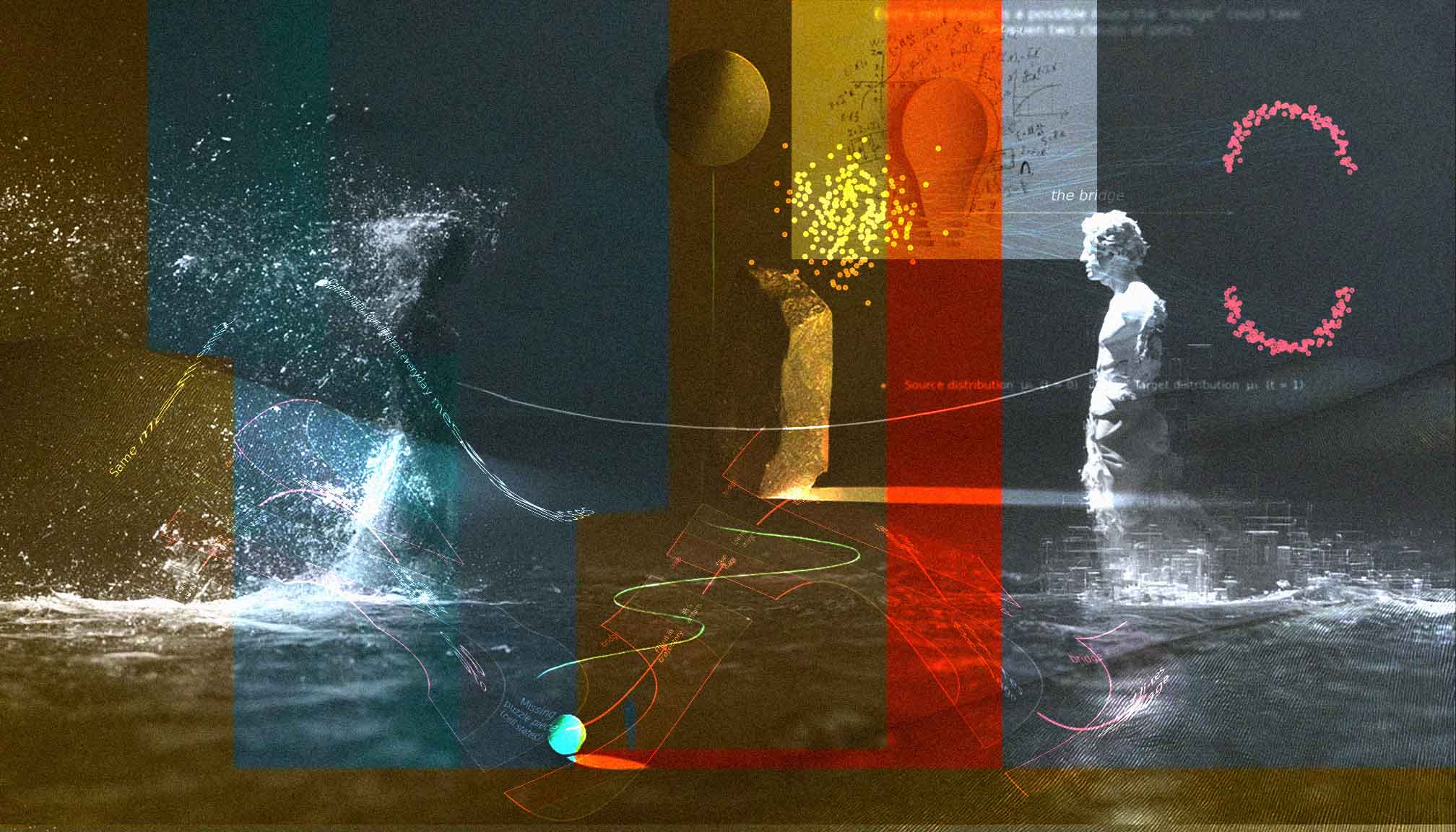
Picture two islands. On the first, everyone speaks only in static — pure noise, no pattern, no story. On the second, everyone speaks in full sentences: a sharpened photo, a healthy cell, a finished painting. Somewhere between them there has to be a bridge, a set of steps that turns gibberish into meaning. For a decade, the machine-learning world has built that bridge the hard way: by trial and error, one exhausting training run at a time. A new paper says you don't have to. You can just write down the bridge.
The Puzzle Everyone Pretends Is Simple
Diffusion models — the machinery behind image generators, cell-biology simulations, and audio synthesis — all rely on the same trick: start from something boring and predictable (usually random Gaussian noise) and slowly nudge it, step by step, into something specific and structured. That works beautifully when your starting point is noise. But real problems are rarely that polite.
What if your starting point is a blurry photo, and your destination is the sharp one? What if your starting point is a stem cell on day 2, and your destination is what it becomes on day 7? Now you're not moving from noise to structure — you're moving between two structures, and neither one is going to sit still and be simple for you.
This is the Schrödinger Bridge problem, named after the physicist, though the math itself is closer to a very stubborn logistics question: given a starting crowd and an ending crowd, what is the least surprising, most probable way for one to turn into the other?
“What is the least surprising, most probable way for one crowd to become another?”
Why Everyone Took the Slow Road
Historically, answering that question meant an iterative dance called Iterative Proportional Fitting, or training a neural network for hours or days to approximate an answer nobody could write down exactly. It's a bit like trying to find the fastest route across a city by sending out a thousand taxis, watching where they get stuck, adjusting the map, and sending them out again — again and again — until the routes finally stop changing.
It works. It's also slow, unstable, and hungry for compute. And every time the two “islands” change — a new dataset, a new pair of distributions — you start the whole taxi fleet over again.
The Trick: Write the Answer Instead of Searching for It
The paper's central move is almost cheeky in its simplicity. Instead of training something to discover the bridge, it shows that the bridge's steering signal — the “drift,” or the constant little correction that keeps a wandering particle honest — can be written directly as a weighted average over the two endpoint distributions. No loop. No convergence check. Just an integral you can estimate from samples you already have.
Even better, the authors show that every previously known exact solution to this problem — including the classic case where two Gaussian “blobs” morph into one another — falls out of this one formula as a special case. Results that used to require heavy tools borrowed from Riemannian geometry and quantum-style generator theory now arrive as a few lines of algebra. It's the mathematical equivalent of discovering that a dozen different unrelated recipes were all secretly the same dish, cooked slightly differently.
Where the Bridge Actually Gets Used
This isn't just an elegant proof for its own sake — the paper turns it into two working algorithms. One (“training-free”) needs no neural network at all: give it paired before/after samples and it computes the bridge in one shot. The other (“simulation-free”) trains a small network, but without ever having to simulate the messy stochastic path during training, which is normally the expensive part.
The authors test this on cell biology data — inferring how a stem cell's internal state drifts over days it wasn't directly observed — and on image restoration: deblurring, inpainting, JPEG cleanup, super-resolution. In several of these settings, their one-shot, training-free method matches or beats models that took far more machinery to build, and it ran on an ordinary laptop with no GPU.
The Bigger Idea, for Anyone Not Writing the Code
The technical result is specific to a corner of generative modelling, but the pattern underneath it is worth stealing for other problems entirely. A huge amount of modern engineering effort goes into iterating our way toward answers that might have had a closed form all along — we just hadn't looked at the problem from the right angle yet. Brute force is a valid strategy. It's rarely the most elegant one, and it's almost never the cheapest.
Before reaching for the biggest model, the longest training run, or the thousandth iteration, it's worth asking the unglamorous question this paper effectively asks: is there already a formula for this, hiding in plain sight, that nobody's bothered to write down?
“Brute force is rarely the most elegant strategy — and almost never the cheapest.”
Sometimes the fastest way across the gap isn't to send out a thousand taxis. It's to notice that the bridge was already there, waiting to be described.