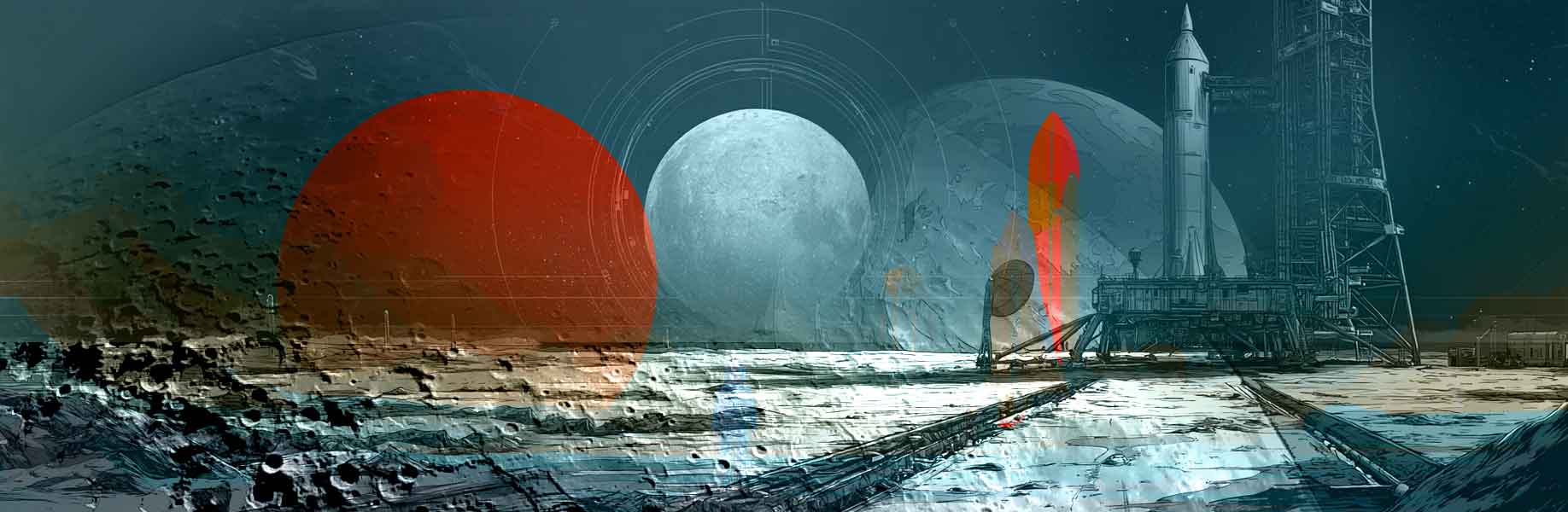

NASA's bold new plan to accelerate the Artemis program, build a Moonbase, and move on to Mars and the planets.
During NASA’s “Ignition” event on March 24, the agency unveiled a sweeping realignment of its operations and goals, designed to fulfill President Trump’s National Space Policy and cement American leadership in the cosmos.
NASA Administrator Jared Isaacman characterized the moment as a great-power competition where success or failure will be determined in months rather than years.The adversary is, of course, China. In related news, Chinese Space Science and Technology has published a special issue on the development of various elements of China’s crewed Moon missions.
The core of the new NASA strategy is a commitment to return to the Moon before the end of Trump’s current term, followed by the establishment of an enduring human presence and a permanent lunar base. Isaacman emphasized that by focusing the agency’s vast resources on these specific national imperatives and removing bureaucratic obstacles, NASA can unleash the full industrial might of the United States and its international partners.
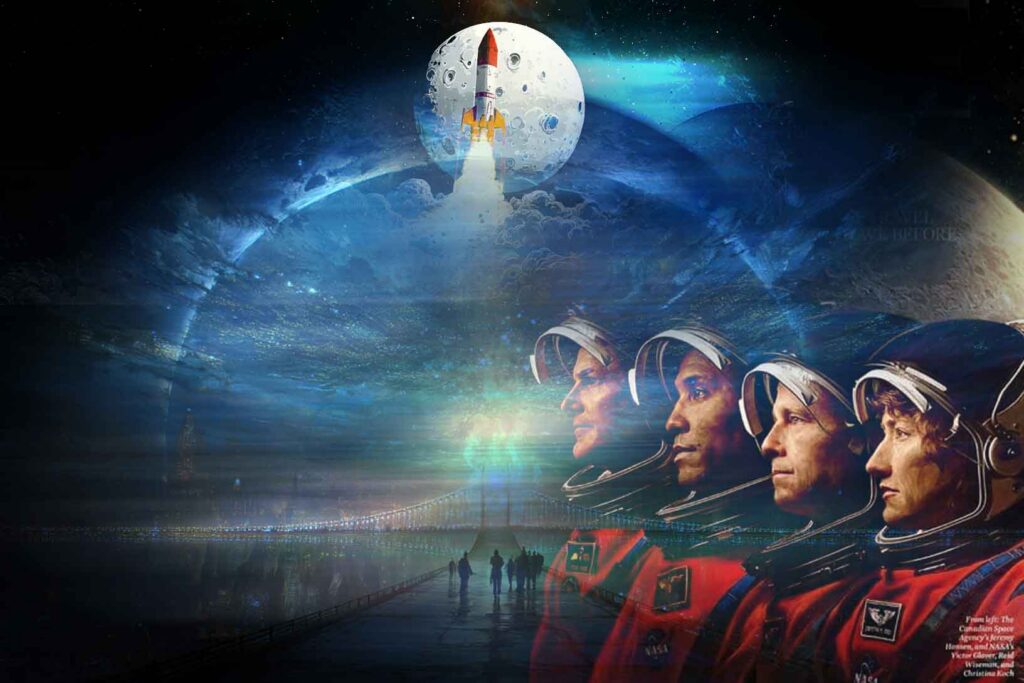
The roadmap for returning to the Moon has been significantly adjusted to meet this accelerated timeline. Building on recent updates to the Artemis program, NASA will standardize the Space Launch System (SLS) rocket configuration and aim for at least one surface landing every year starting in 2027. Under this revised architecture, the Artemis III mission, previously envisioned as a crewed landing on the Moon, will now focus on testing integrated systems and operational capabilities in Earth orbit in 2027. This serves as a critical precursor to the Artemis IV lunar landing. Looking beyond the initial missions, the agency intends to utilize more commercially procured and reusable hardware to enable frequent and affordable trips to the surface, with a goal of achieving a landing every six months as technical capabilities mature.
Nobody said out loud and clear that the SLS will eventually be abandoned and replaced with commercial launch services, but this seems likely to be the case after the initial missions.
Strategic Pivots for Surface Operations
To support an enduring presence, NASA is shifting its lunar strategy toward a phased approach for building a base. In a major strategic pivot, the agency is pausing the development of the Gateway station in its current form to prioritize infrastructure that supports sustained operations on the lunar surface. While this involves moving away from some existing hardware, NASA plans to repurpose applicable equipment and leverage commitments from international partners to ensure continued progress. A series of Requests for Information solicits industry feedback about the necessary technology for these surface objectives.
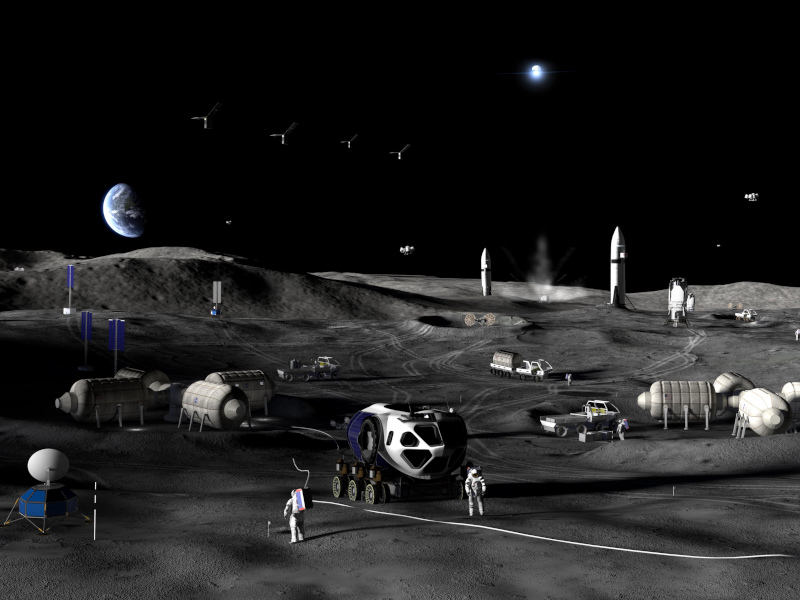
The development of the Moon base will proceed through three deliberate stages of growth. In the first phase, titled Build, Test, and Learn, the agency will transition from infrequent, specialized missions to a repeatable, modular approach. By utilizing Commercial Lunar Payload Services and the Lunar Terrain Vehicle program, NASA will increase the frequency of lunar activity, sending a steady stream of rovers, instruments, and technology demonstrations to the surface. These missions will focus on mastering essential skills such as power generation through radioisotope systems, navigation, and long-range communications.
Achieving a Permanent Lunar Foothold
The second phase of the lunar plan will see the establishment of early infrastructure. During this period, NASA will move toward semi-habitable facilities and recurring astronaut operations. This stage is heavily supported by international collaboration, most notably through the Japan Aerospace Exploration Agency’s pressurized rover and other partner-contributed scientific payloads. The third phase aims to enable a long-duration human presence, transitioning the Moon from a site for periodic expeditions to a permanent base. This will be facilitated by the introduction of cargo-capable human landing systems and heavier infrastructure, including multipurpose habitats from the Italian Space Agency and utility vehicles from the Canadian Space Agency.
NASA is also proactively managing the future of low Earth orbit to ensure there is no gap in American presence as the International Space Station approaches the end of its lifespan. The agency is introducing an additional strategy that uses the current station as an anchor for a future commercial ecosystem. Under this plan, NASA will procure a government-owned Core Module to attach to the station, which will serve as a platform for validating commercial modules. Once these private modules have matured their operational and technical capabilities, they will eventually detach to operate as independent, free-flying stations. This approach allows NASA to eventually transition into the role of a customer among many, purchasing commercial services while stimulating the orbital economy through private astronaut missions and module competitions.
A Golden Age of Space Science
On the scientific front, NASA highlighted the ongoing success of the James Webb Space Telescope and the Parker Solar Probe, as well as recent achievements in planetary defense and Earth science. Upcoming missions will further this legacy, including the Nancy Grace Roman Space Telescope, which is scheduled for launch as early as this fall to study dark energy and exoplanets. In 2028, the agency will launch Dragonfly, a nuclear-powered octocopter destined for Saturn’s moon, Titan, as well as the Rosalind Franklin Rover to Mars in partnership with the European Space Agency.
Lunar science will also be accelerated through the build-out of the Moon base. Starting in 2027, NASA targets up to 30 robotic landings via the commercial payload program, expediting the delivery of rovers and drones to the surface. These missions will include the VIPER rover and the LuSEE-Night mission, and the agency is actively calling for new payloads from students and researchers nationwide for future flights.
Harnessing Nuclear Power and Rebuilding Expertise
Perhaps the most technologically significant announcement involves the advancement of nuclear power in space. After decades of research, NASA is moving nuclear propulsion from the laboratory to the launchpad. The agency plans to launch Space Reactor-1 Freedom, the first nuclear-powered interplanetary spacecraft, to Mars by the end of 2028. This mission will demonstrate the efficiency of nuclear electric propulsion in deep space, a capability essential for mass transport beyond Jupiter where solar energy is insufficient.
Upon reaching Mars, the spacecraft will deploy the Skyfall payload of helicopters to continue exploring the planet, establishing the necessary regulatory and industrial precedents for future fission power systems across the solar system. NASA mentions “sustained exploration beyond the Moon and eventual journeys to Mars and the outer solar system." A statement by the Mars Society notes that every lesson learned on the Moon “brings us closer to boots on Martian soil” and praises NASA’s embrace of nuclear power.
I’m persuaded that nuclear power, first via nuclear fission and eventually via nuclear fusion, can and must be an essential enabler of a bright future not only in space but also here on this planet, and I’m happy to see NASA join the return to science and common sense after so many decades of “politically correct” opposition to nuclear power.
To execute these ambitious plans, NASA is fundamentally reforming its internal workforce and industrial partnerships. The agency is rebuilding its core engineering and operational strengths by converting thousands of contractor positions to civil service roles. New pathways are being created for both early-career professionals and experienced industry veterans to serve in the agency. Additionally, NASA will embed subject-matter experts directly within the supply chains of its major vendors and subcontractors. This "hands-on" approach is intended to challenge existing assumptions, solve production problems on the factory floor, and ensure that every component is on the critical path to success. Through these comprehensive reforms and focused mission goals, NASA aims to secure continued American superiority in space for decades to come.
Lifting our spirit to the Moon and beyond
I’ve watched NASA’s Ignition event multiple times, first the live stream and then various recordings. It goes without saying that I strongly praise this wave of change at NASA.
I found this very interesting: “It is imperative that we inspire the next generation of engineers, communicators, explorers,” said Carlos Garcia-Galan, who introduced himself as the Moonbase guy. “We can only do that if we take you along with us,” he continued, referring to continuous video coverage of lunar operations to ignite young minds all over the country and the rest of the planet with “wow, that is what I want to do. That's what I want to dedicate my career and my life to.”
Lifting our spirit to the Moon and beyond is, I believe, the most important thing. The next generation of space enthusiasts will then do great things in space, but not only in space. Don’t forget that the Apollo program of the 1960s inspired also those who went on to build the internet, biotech, artificial intelligence (AI) and other marvels of today’s world.
And by doing so, NASA will also do good to my generation of “orphans of Apollo.” Watching the next astronauts build the Moonbase in realtime, on high definition TV, will lift our spirit once again and help us make peace with all the decades we had to wait. But now we are going! I can’t wait to watch those video streams. In the meantime, I’m following the new NASA Moon Base account on X.
Now we only have to hope that the Artemis II mission, which should launch in only a few days, will be a spectacular first step toward the Moonbase.