
Artificial intelligence requires ever greater computing power. Could quantum computing extend what it is capable of doing?
The great promise
A new study on quantum machine learning explains that quantum computing may substantially strengthen certain AI processes. Through properties such as superposition and entanglement, qubits (quantum bits) represent and transform information in ways fundamentally different from conventional bits.
Its potential contribution is likely to lie in very specific areas: optimisation, the simulation of physical systems, searches across complex mathematical spaces, and the analysis of particular data structures. For the time being, however, this remains a developing field whose promises must still withstand the test of real-world applications.
Supercomputing
This potential quantum leap would extend a technological escalation that is already under way. AI is advancing within the world of classical supercomputing: training large models relies on heterogeneous infrastructures in which CPUs, GPUs and other specialised accelerators work together.
Spain’s Supercomputing Network, for instance, operates hybrid systems that combine processors with graphics accelerators, alongside resources specifically available for AI projects. At European level, JUPITER (the EuroHPC Joint Undertaking’s supercomputer) has been designed for compute-intensive AI applications, including the training of large neural networks, as well as climate, biomedical and materials simulations.
A computing ecosystem
This is a decisive shift. As the performance gains once delivered by ever-smaller transistors begin to slow, innovation relies less on a single processor and more on the organisation of a complete computing ecosystem: different types of chip, memory, high-speed networks, software and energy.
Quantum AI
This is where quantum computing enters the picture. Rather than taking over the entire workload, quantum circuits could serve as specialised components within an AI pipeline: transforming complex representations, measuring similarities between data points, extracting features, tackling optimisation sub-problems, or contributing to the training of hybrid models.
In many of the designs now being explored, a conventional neural network first compresses the information before passing a manageable representation to a quantum circuit. The output then returns to the classical system to complete a prediction or decision.
A long road ahead
There are, nevertheless, substantial obstacles. Today’s quantum devices have a limited number of usable qubits, are highly susceptible to noise, and require measurement processes that can be expensive. Nor has the field yet demonstrated consistent advantages over the best classical methods on relevant tasks rather than only in controlled experiments. Much of the work therefore remains at proof-of-concept stage, far from widespread industrial deployment.
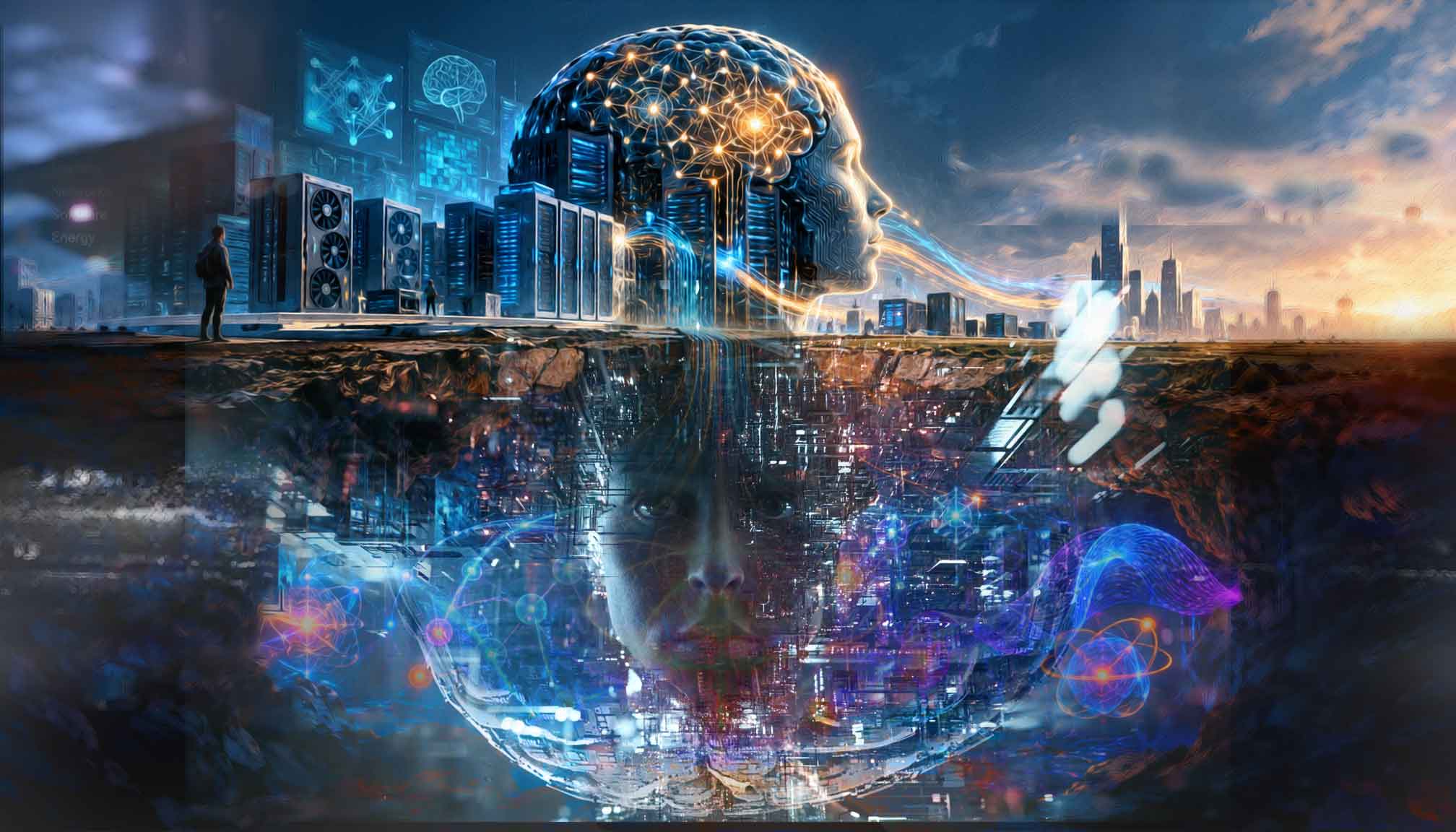
Yet the important point (rather like seismic activity building beneath the surface) is that AI is learning to work with increasingly varied and sophisticated architectures. Within that landscape, quantum computing is emerging as a new layer of computation and knowledge, whose implications for the AI of the future remain difficult to foresee.
This article is republished from Futuribles. Here's the original article in Spanish and English.