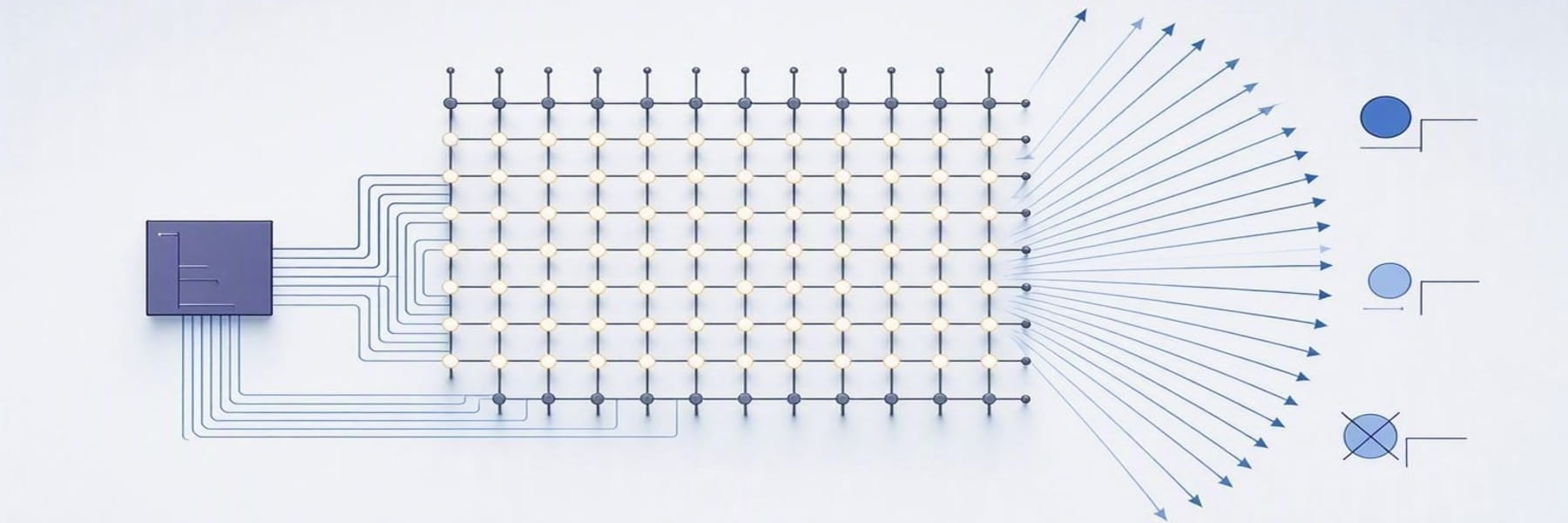

Japan has switched on its first full-stack neutral-atom quantum computer, named "Shunkai," marking a significant milestone in the country's quantum computing development. The system was developed by a research team led by Professor Kenji Ohmori at the Institute for Molecular Science, part of Japan's National Institutes of Natural Sciences, and is now operational in Aichi Prefecture in central Japan.
Neutral-atom quantum computing uses a single atom as a qubit and offers several advantages over other modalities, including room-temperature operation without the need for a refrigerator, the ability to achieve quantum entanglement between arbitrary qubits by moving atoms during computations, flexible qubit configuration, and relatively easy scalability. Shunkai will use approximately 50 qubits in its early stage and is expected to expand to approximately 500 qubits. The system will be partially open to external users for application development and quantum error correction demonstration. The research team aims to realize a large-scale, high-performance neutral-atom quantum computer with 10,000 qubits by March 2031. Scientists at the Japan Advanced Institute of Science and Technology have been working on new methods for accurate quantum simulations of larger materials. Google's quantum algorithm has also achieved breakthroughs in computing, demonstrating the potential of quantum systems to improve studies in chemistry and biology.