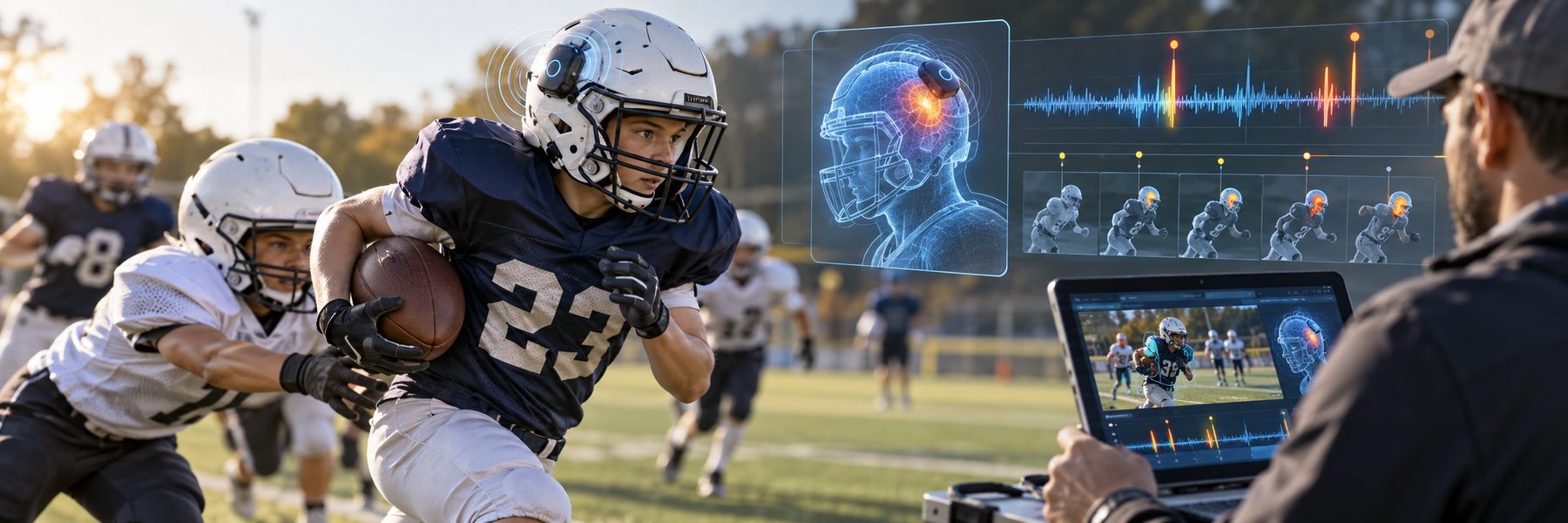

Researchers have developed a machine-learning pipeline to classify head acceleration events recorded during youth American football, with the goal of cutting the manual video review normally needed to confirm whether sensor triggers represent genuine impacts.
The study analyzed 92,832 sensor-triggered events from 84 male athletes across three seasons and three organizations. Of those, 11,706 were verified as true head acceleration events and 81,126 were false triggers, creating a strongly imbalanced dataset. Among the tested classifiers, XGBoost performed best, reaching an F1 score of 0.765, recall of 0.713, precision of 0.825 and an AUC of 0.931.
The work fits a broader move toward intelligent wearable sensing. Related research has explored wearable brain scanners for neurological monitoring, stretchable AI patches that process health signals directly on the body, and wearable systems that use machine learning to separate intentional movement from motion noise.
The operational result is the most immediate: reviewing only model-flagged events reduced estimated video-review time from roughly 90 hours to under eight. Thresholds in the 10–15 g range also cut review time by more than half while keeping the misclassification burden low.
The model does not diagnose concussion or determine injury severity. It classifies sensor events so researchers can focus human review where it is most useful, making large-scale youth-football impact monitoring more practical without removing human oversight.