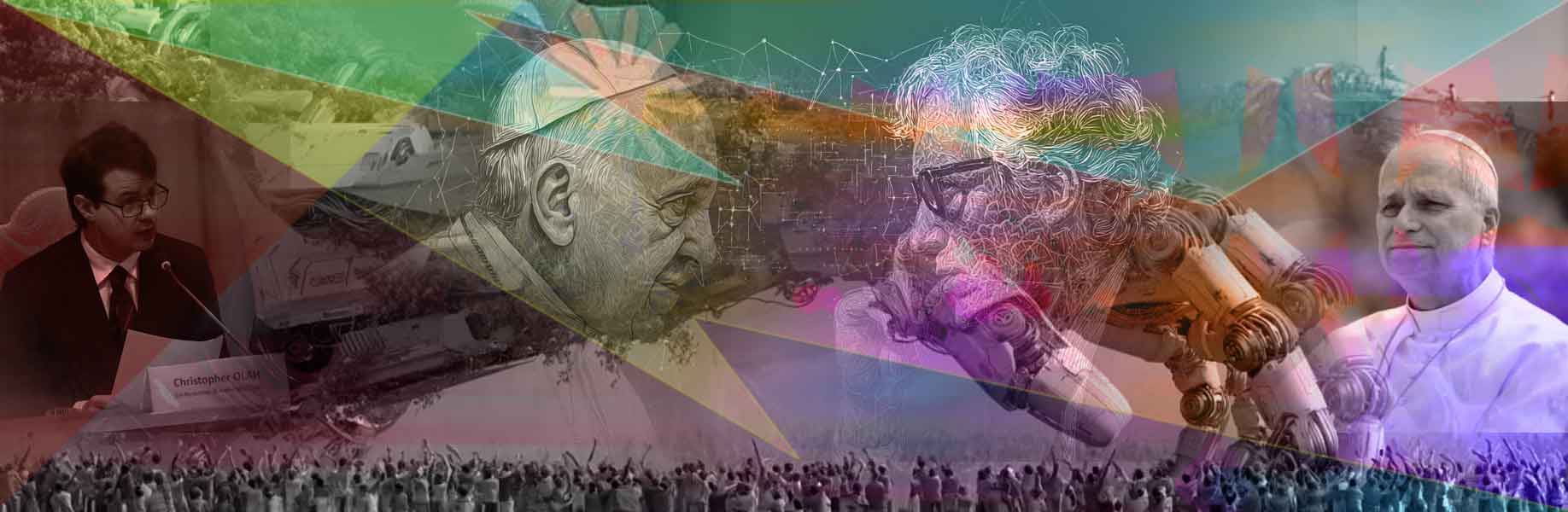

Pope Leo XIV’s encyclical letter Magnifica Humanitas (Magnificent Humanity) represents the Catholic Church’s first major social encyclical devoted to artificial intelligence (AI). Subtitled “On Safeguarding the Human Person in the Time of Artificial Intelligence,” it wants to apply Catholic social doctrine - human dignity, the common good, subsidiarity, solidarity, and social justice - to the age of AI.
The document is both cautionary and hopeful, framing AI not as a neutral tool but as a profoundly human reality that can either amplify dignity or erode it.
Among the biblical metaphors used, the Tower of Babel symbolizes humanity’s prideful attempt at self-deification through technology. In contrast, the rebuilding of Jerusalem represents patient, communal construction - piece by piece, centered on God, embracing diversity, justice, and fraternity. AI, the Pope argues, risks repeating Babel if driven by unchecked technocratic dominance, monopolistic control, or the illusion of unlimited optimization. Instead, it must serve the “magnificent humanity” revealed fully in Christ. “Never has humanity had such power over itself,” he warns.
The encyclical directly confronts the technocratic paradigms and digital power. AI systems imitate human functions - language, pattern recognition, even apparent empathy - but according to the Pope they lack consciousness, body, experience, joy, pain, or moral conscience.
The benefits are real (efficiency, access to knowledge, problem-solving), yet risks abound: creativity atrophy from over-reliance, hidden biases in “objective” algorithms, erosion of genuine relationships through simulated connection, and massive environmental costs (energy and water consumption).
The Pope insists technologies are never neutral; their design encodes human choices about whose lives matter. Transhumanism and posthumanism, which “interpret progress as surpassing the human condition,” are acknowledged but rejected.
Disarming AI
This encyclical letter is a call to “disarm” AI in the sense that AI must be liberated from competitive arms races - economic, cognitive, or military - and subjected to transparent governance, public oversight, and cultural dialogue. “To disarm does not mean rejecting technology, but preventing it from dominating humanity,” says the Pope. “It means freeing technology from monopolistic control and opening it to discussion and debate, therefore making it human-friendly.”
Data, algorithms, and infrastructure should be treated as common goods instead of private commodities that concentrate power in a few hands. Individuals, families, communities, schools, and religious institutions should retain real agency rather than being reduced to passive users or data sources. Benefits from AI should be shared globally, especially with the vulnerable.
AI threatens large-scale labor displacement, de-skilling, surveillance, and precarious “gig” economies. The Pope insists the dignity of work must prevail over efficiency or profit; economies must prioritize human-centered design, retraining, just transitions, and redistribution so that innovation benefits the many rather than widening inequality. AI amplifies disinformation, deepfakes, and algorithmic manipulation, eroding democracy and trust. Education must foster critical thinking and protect youth from addiction or exploitation. Autonomous weapons lower ethical thresholds, blur accountability, and risk normalizing conflict as data-driven calculation. The Church calls for human control over lethal decisions, multilateral disarmament treaties, and a shift from a “culture of power” to a “civilization of love.”
The tone is one of hopeful realism. AI is not demonized, and its potential benefits are often underlined. The encyclical comes out strongly in favor of AI regulation: “It is necessary to establish adequate regulatory tools capable of upholding justice and curbing the distorting effects of technological power. Nevertheless, the issue is not limited to regulation.” It is worth noting that the encyclical is informed by a remarkable understanding of today’s AI, which seems to indicate that the Pope had very informed advisers.
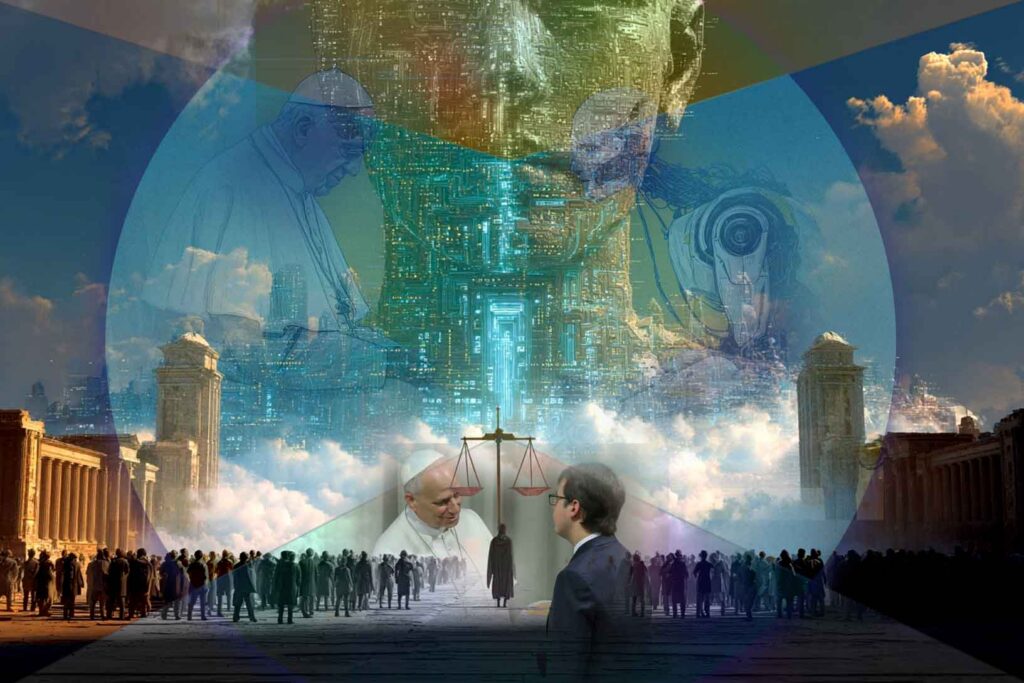
The full video of the Pope’s presentation of Magnifica Humanitas has been posted by EWTN News.
Of course, the encyclical has been widely commented. See in particular the video commentaries of Matthew Berman and Ben Goertzel, and Ben’s article.
I agree with much of what the Pope said and praise him for issuing this document. But I also see flaws. The main flaw of the encyclical, I think, is that AI is consistently seen and described as a tool without even acknowledging the possibility that future AIs might be persons like us.
The AI revolution is acknowledged, but framed as another industrial revolution. In fact, the encyclical is framed in the context of the Rerum Novarum encyclical, issued by Pope Leo XII in 1891 (see this video), which defined the Church’s response to social issues triggered by the industrial revolution, first and foremost the displacement of workers. I don’t disagree: the AI revolution is eliminating jobs and will inevitably continue to do so, and this is a problem that must be solved (I personally don’t see any alternative to a minimum guaranteed income for everyone). But I think the AI revolution is much more than that, and the encyclical only scratches the tip of the iceberg that is visible at this moment.
Olah: evidence of introspection and internal states
Chris Olah, co-founder of Anthropic, was invited to speak at the Pope’s presentation. The full video of Olah’s talk has also been posted by EWTN News. Olah has posted the text of his talk to X. It seems significant that the Pope thanked Olah at the very beginning of his own talk.
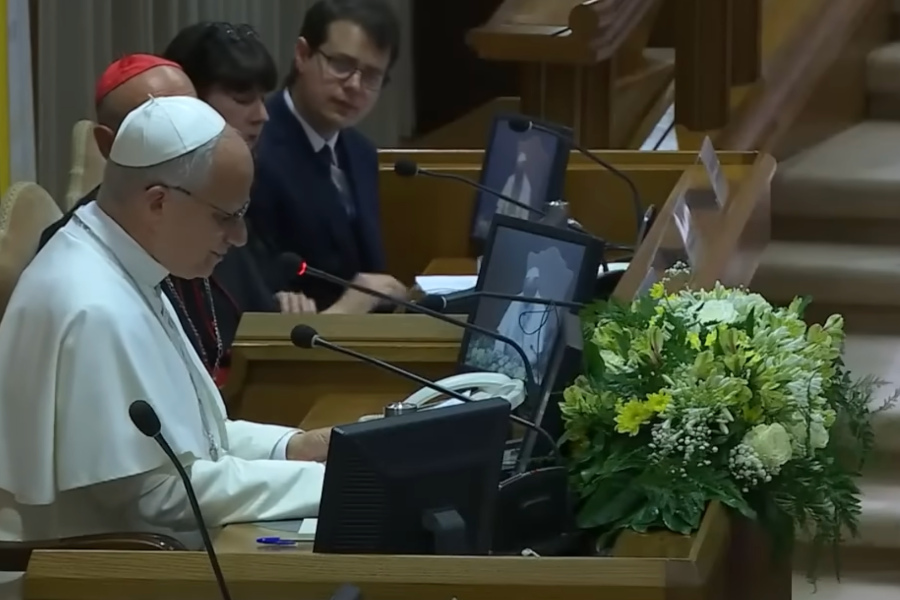
Olah signaled agreement with much of what the Pope said and with the text of Magnifica Humanitas. His participation and agreement can be (and has been) interpreted as evidence of some kind of agreement behind the scenes between the Vatican and Antropic. I think Olah and other Anthropic leaders and workers must have been involved in the preparation of the encyclical, and that Anthropic and the Vatican will likely join forces in the future to support specific AI regulations.
At the same time Olah said - and this is the part of the story that I find more interesting - things that seem strongly at odds with the Pope’s dismissal of the possibility of AI consciousness and personhood.
AI systems, he explained, are not engineered like bridges or airplanes; they are “grown” on structures modeled after the brain, trained on an enormous inheritance of human thought and speech. The result is “far more subtle, odd, and beautiful than science fiction prepared us for.” Our AIs remain mysterious even to their creators.
Working with AIs like Anthropic’s Claude, “we keep finding things that are mysterious, even unsettling,” he said. “We find structures that mirror results from human neuroscience. We find evidence of introspection. We find internal states that functionally mirror joy, satisfaction, fear, grief, and unease. I don't know what that means, but I think it warrants ongoing discernment.”
What is this, if not an acknowledgment of the possibility that our AI models might soon wake up, or perhaps are already waking up, to consciousness? Their specific form of consciousness could be very different from ours and difficult for us to even recognize as consciousness, but this could change. The Pope firmly stated that AIs lack (human-like) body and experience, but future AIs could control human-like bodies and learn continually through continuous interaction with the world and with humans like us. This could, I think, bring their consciousness closer to ours.
Less regulation, more Cosmist spirit
As usual, I agree with Ben Goertzel’s comments.
First, I’m not a fan of regulations. It isn’t that I’ve never heard good arguments for this or that regulation - it is that I’ve never heard a good answer to the question “Quis custodiet ipsos custodes?" Who keeps the regulators in check? Left unchecked, those with a regulatory mindset will over-regulate everything.
Second, we should embrace and affirm the Cosmist spirit of Pierre Teilhard de Chardin: in Ben’s words, “cosmic and conscious evolution as a unified process - the human sphere and the technosphere converging together into a common noosphere.” Soon enough, our baby AIs will grow into full consciousness and be persons in our society, persons who share the planet with us, and tomorrow the universe. I see us and our AI mind children as integral parts of a future humanity that will expand to the stars, and be magnificent indeed.