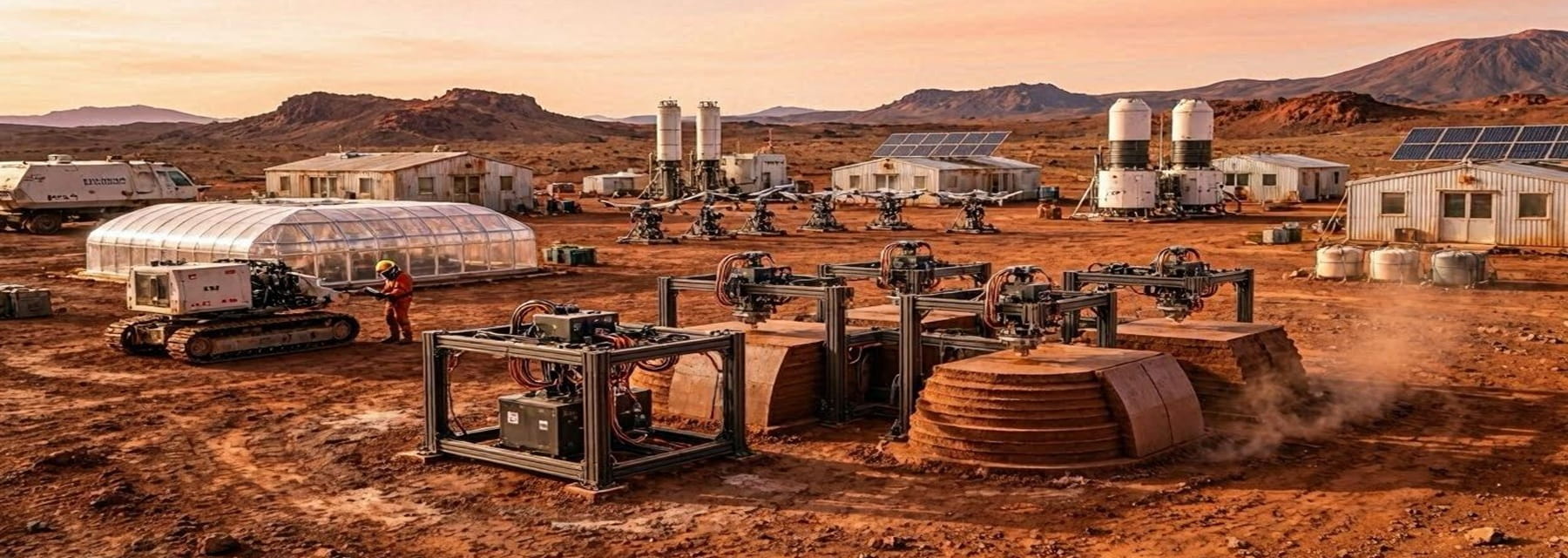

A new study suggests future astronauts on Mars could manufacture metal tools and replacement parts using the planet’s own carbon dioxide-rich atmosphere instead of relying on imported industrial gases from Earth. Researchers at the University of Arkansas found that laser-based metal 3D printing remained functional in a pure CO2 environment designed to mimic Martian conditions.
The research focused on laser powder bed fusion (PBF-LB), a widely used metal additive manufacturing technique that normally depends on argon gas to prevent oxidation during printing. Because argon is scarce on Mars and costly to transport across space, the team tested whether the Red Planet’s atmosphere, composed of more than 95% carbon dioxide, could serve as a practical substitute.
Using 316L stainless steel powder, the researchers fabricated single-track and two-dimensional samples under argon, carbon dioxide, and normal air conditions. While argon still delivered the best overall print quality, samples produced in carbon dioxide consistently outperformed those made in ambient air. CO2-assisted printing showed fewer balling defects, stronger cohesion, and lower oxidation levels than open-air fabrication.
The team also discovered that print quality depended less on the surrounding gas alone and more on balancing laser power, scanning speed, and hatch spacing to maintain stable thermal conditions during fabrication.
Microscopic analysis revealed that argon-created samples had smoother and denser surfaces, but carbon dioxide environments still produced workable structures with significantly lower oxygen contamination than ambient air. The findings suggest Mars-based manufacturing systems may eventually rely on locally available atmospheric resources rather than constant supply shipments from Earth.