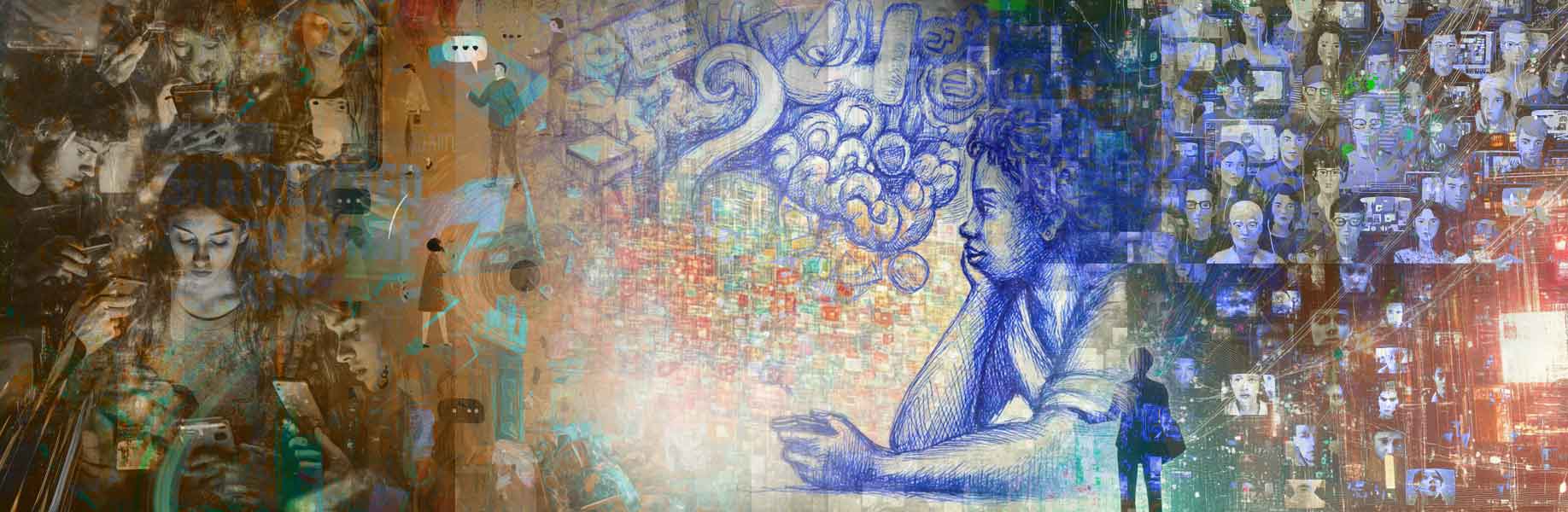

These miraculous machines!
–Robert Flaherty, 1948
Do we shape them
Or do they shape us?
Or reshape us from our decent, far designs?
Prologue
Modern media, especially social media, is not just a passive conduit for information. Its architecture, incentives, and design deeply shape the nature of attention, interaction, and discourse. Rather than supporting sustained, deliberative exchange, many platforms prioritize immediate engagement: clicks, shares, reactions, rapid content turnover. This “projected‑attention economics” distorts how individuals consume, respond to, and internalize information. As a result, meaningful, truthful, and reflective communication becomes difficult, or even unlikely. In this piece, I argue that this design orientation causes four dominant systemic harms: attention fragmentation, misinformation proliferation, polarization/echo chambers, and mental-health and epistemic trust erosion.
Theoretical Framework: Attention Economy & Human‑Algorithm Interaction
The notion of an “attention economy”, where human attention is treated as a scarce resource to be monetized, is well documented in media studies. Recent work emphasizes that digital media drastically intensifies competition for attention. A key point: not everyone has equal capacity to resist or manage the barrage of stimuli. According to a 2024 analysis, differences in individual resources (time, cognitive bandwidth, social context) make people unevenly vulnerable to “digital distraction”.
Moreover, as shown in a recent review of human-algorithm interactions, platform algorithms capitalize on human biases (particularly toward emotionally charged or morally salient content), privileging such content for distribution regardless of its factual quality. Thus, I strongly argue that almost all of our digital environments are not neutral marketplaces of ideas. They are engineered systems that amplify some kinds of content (emotional, sensational, socially validated) over others (nuanced, moderate, complex).
Four Major Harms from Current Media Design
I selected to highlight the following four harms (1) attention fragmentation, 2) misinformation proliferation, 3) polarization/echo chambers, and 4) mental-health and epistemic trust erosion) because they represent the most pervasive, structurally rooted, and empirically validated consequences of contemporary media and social media design. Unlike other potential harms, such as ‘Streaming Fatigue’ or “Superficial Social Comparison’, these four are not incidental effects but arise directly from platform architecture and algorithmic incentives that optimize for projected attention.
Each harm interacts with and amplifies the others, forming a self-reinforcing system: fragmented attention undermines critical evaluation, which accelerates misinformation; misinformation and algorithmic sorting foster polarized echo chambers; and the emotional volatility and social distrust generated feed back into mental-health burdens and further engagement with sensationalized content as the final nail on the coffin of the epistemic trust. Together, these four capture both the cognitive and social dimensions of the systemic dysfunction inherent in attention-driven media, making them the clearest indicators of structural harm.

1. Attention Fragmentation and Superficial Engagement
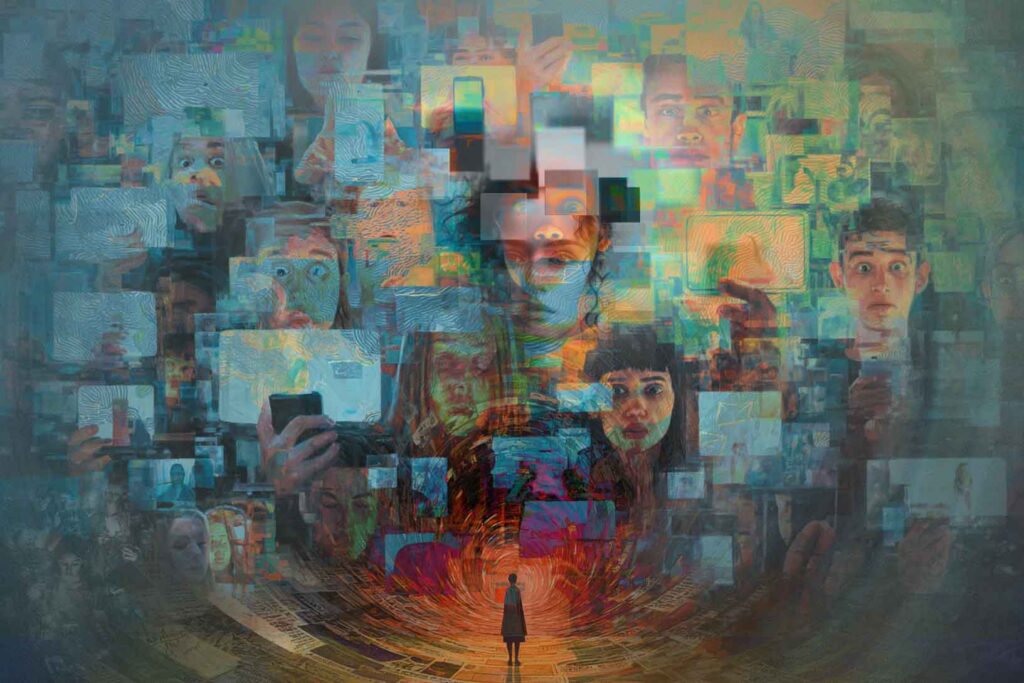
The constant flood of content, often short, reactive, emotionally loaded, undermines sustained focus or deep reflection. As digital platforms optimize for immediate engagement, users are nudged toward rapid consumption (scrolling, fleeting reactions) rather than thoughtful reading or meaningful dialogue. This degrades capacity for sustained attention and reduces opportunities for deliberation, introspection, or careful exchange. The “digital distraction” framework mentioned above shows that many users, especially those with limited time or cognitive resources, are at a disadvantage in such environments, deepening inequalities in digital engagement.
Over time, such fragmentation will erode, as it has already started with the younger population, the social and cognitive conditions necessary for serious conversation or collective reasoning.
2. Misinformation Proliferation (And Viral Falsehoods)
Design features that privilege emotional salience and shareability also favour misinformation (this might be unintentional and a side effect of the attention economy hence I am not accusing the platform owners as the culprits of misinformation). False or misleading content that tends to be more novel, emotionally provocative, and easier to consume than careful, evidence-based information is ranked top on most search engines tools via most distribution algorithms, aka recommendation systems. As reviewed in recent literature of the National Library of Media, it is misinformation that is undoubtedly and dominantly spreading rapidly on our current social media, unfailingly outpacing corrective content.
The problem is exacerbated when users share content reflexively, resharing, reposting, and forwarding, without pausing to verify accuracy. One study of social media affordances found that users’ behaviors vary: sadly only a small portion attempt fact‑checking or counterarguing, but many share instantly. The affordances themselves (e.g. one‑click share, minimal friction) make the latter easier and more common reinforcing spread of false content.
In short: when media design rewards rapid attention over deliberation, misinformation becomes systemically advantaged.
3. Polarization/Echo Chambers
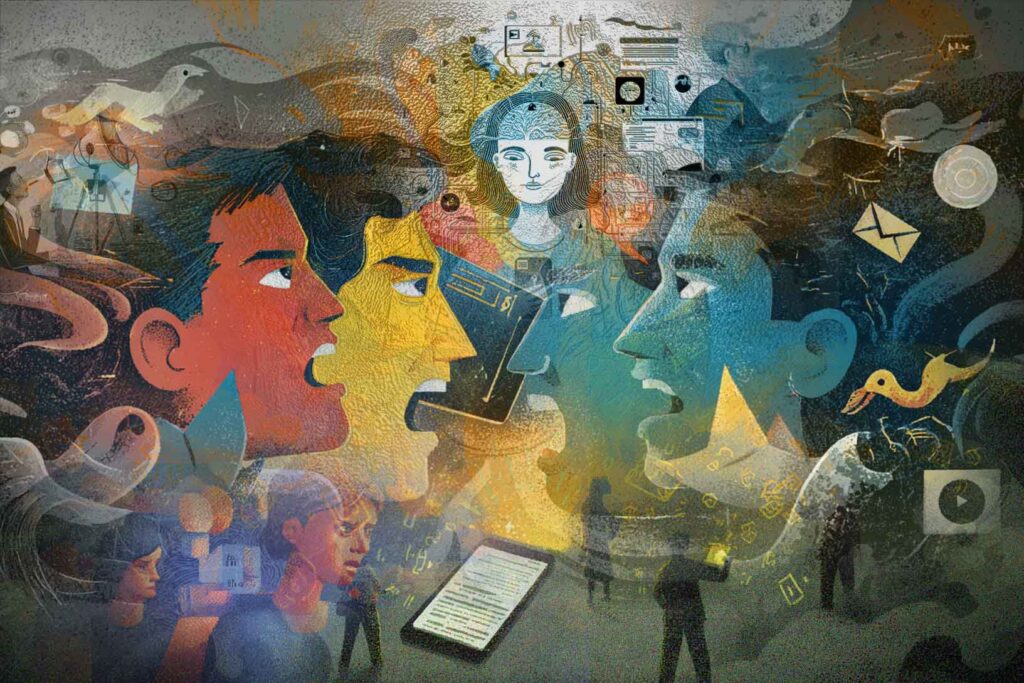
One of the most robust patterns in social media research is the emergence of echo chambers and filter bubbles: environments in which users are repeatedly exposed to viewpoints similar to their own, while contrary or dissenting views are filtered out. Recent agent-based modelling research effectively shows that when social networks exhibit homophily (the tendency to connect with similar others) and platforms provide algorithmic filtering, polarization intensifies. In such conditions, opinions become more extreme, and social identity polarizes.
Further, a 2024 review described how social media distorts perceptions of social norms: a small, vocal minority can dominate discourse, making their extreme or atypical positions appear normative to passive observers. This “funhouse-mirror” effect fosters pluralistic ignorance and false social consensus eroding the possibility of balanced, diverse public conversation.
Taken together: media design transforms what should be a shared public sphere into fragmented, polarized niches limiting cross-perspective dialogue, reducing epistemic diversity, and reinforcing ideological divides.
4. Mental-health and Epistemic Trust Erosion
Beyond cognition and public discourse, the current media or social media platform's design has tangible effects on psychological well‑being. A large systematic review (covering 57 studies with over 571,000 participants) found that frequent social media use, especially heavy use, is associated with increased stress, anxiety, depression, loneliness, poor sleep, reduced self-esteem and life satisfaction, and diminished social and cognitive functioning. Here, let me give you my alarming reality checks: first, most behavioral psychologists agree that any usage beyond two hours a day is considered heavy, and second, a 2024 study published by the American Psychological Association revealed that the average teen was already spending five or more hours on social media daily.
Moreover, another meta-analysis focused on adolescents (over 1 million individuals) found consistent positive correlation between social media use and internalizing symptoms (anxiety, depression), across both community and clinical samples.
The emotional volatility amplified by platform design (the flood of emotionally charged content, constant comparison, social validation loops) can heighten feelings of isolation, social inadequacy, and distrust. Simultaneously, as misinformation spreads and echo chambers grow, individuals may lose faith in shared norms of truth or social cohesion, undermining interpersonal trust and broader social trust.
Methods (Conceptual and Analytical Approach) and Limitations
Given the nature of this article (theoretical‑analytical rather than empirical new data), I would like to declare that my method is limited to a structured literature-based synthesis. I identified peer-reviewed and preprint studies published between 2021–2025 (as much up-to-date as possible) dealing with social media design, attention economy, misinformation, polarization, and mental health. Primary inclusion criteria: (a) quantitative or systematic‑review methods, (b) explicit discussion of social media affordances or algorithmic effects, (c) clear findings on psychological, social, or epistemic outcomes.
Where possible I prioritized open-access or freely available articles to ensure transparency and verifiability. For complex phenomena (e.g. echo chambers, polarization) I referenced both empirical studies and computational modeling that illustrate mechanisms (agent-based modeling, network simulations).
Because I do not have access to raw platform data, full content archives, or ethnographic access (I do not even have access to the raw Mindplex data, a platform I work for. As a strict matter of decentralization principle, we make sure that access to such data is extremely limited via Mindplex), I avoid claims about prevalence in specific user populations (in addition, I am not okay with Identity Politics). Instead I focus on structural mechanisms that, given widespread platform adoption, remain likely to produce the harms I identified.
My approach is constrained by the fact that I rely only on publicly available literature and summaries, I will admit. I do not have access to raw social media data, nor to longitudinal cohort data that would allow causal inference about social media use and psychological or societal outcomes. As a result, while the mechanisms I describe are strongly supported in research, I cannot quantify the prevalence or magnitude of the harm I identified in any specific population.
I would like to disclaim that Institutional and Regional differences (culture, media literacy, offline social norms, etc.) may mediate or moderate these effects and the harms I highlighted. Furthermore, most empirical studies come from the ‘Global North’ contexts, limiting generalizability.
Finally, regardless of my lack of direct empirical data on platform‑specific user behaviour, I would like to argue that the structural critiques I raised here should stand on their own merit (logically and academically) while my suggested ‘design policy prescriptions’ (below) can be discussed, dissected, tested, or rejected before implementation.
Discussion
The four harms I described above are not isolated; they are interconnected and mutually reinforcing. Attention fragmentation erodes users’ capacity to reflect and critically evaluate content, making them more vulnerable to misinformation. Once misinformation spreads, filter bubbles and echo chambers ensure that corrective voices struggle to penetrate entrenched narratives. Emotional volatility and trust erosion further amplify the appeal of sensational, divisive content feeding back into engagement loops. Meanwhile, mental health decline reduces individuals’ resilience against manipulation and social isolation.
This cluster of effects constitutes a systemic breakdown in the conditions needed for public deliberation, shared epistemic norms, and social trust. In effect, many social media platforms cease to be public spaces for conversation, and instead become mechanisms for amplification, fragmentation, and distraction.

On Design Responsibility
Because these are structural harms (embedded in platform design and algorithmic incentives) individual behaviour change or user awareness is insufficient. Addressing them (the major harms) requires design-level and policy-level interventions.
Some General Policy Reform examples:
- Replacing raw engagement metrics (clicks, shares) with metrics that reward deliberation, dwell-time, source‑checked reading, or balanced exposure.
- Introducing friction or “pause points” on sharing, especially for emotionally laden or sensational content, encouraging reflection before resharing.
- Algorithmic transparency, auditability and regulation: platforms should publish how their recommender systems prioritize content, and allow external evaluation of bias, polarization, and misinformation spread.
- Promoting media‑literacy education, encouraging users to diversify their information sources and to critically assess content rather than passively consume.
Some Specific and action oriented Policy Reform examples:
- Reform Content-Ranking Systems (SEO + Algorithmic Feeds). Platforms and search engines should prioritize evidence-based content quality, methodological transparency, and expert-verified information instead of rewarding high-velocity traffic, emotional engagement, or click-through rates.
- Establish Independent Oversight for Global Content Distribution. Governments and international institutions should create neutral regulatory bodies that evaluate and certify content-distribution mechanisms, ensuring global visibility is determined by merit, demonstrated accuracy, and meaningful user feedback rather than algorithmic popularity cycles.
- Mandatory Transparency on Bot Traffic and Inauthentic Amplification. Major platforms must publicly report verifiable bot-traffic metrics, coordinated inauthentic behavior, and algorithmic suppression effects, enabling researchers and regulators to track echo-chamber formation and content manipulation.
- Introduce Friction-Based Sharing Mechanisms. Platforms should implement mandatory pause prompts, context panels, or verification reminders when users attempt to share fast-spreading or emotionally charged content, reducing reflexive misinformation spread.
- Require Third-Party Audits of Recommendation Algorithms. All large platforms should undergo periodic external audits assessing how their recommendation systems influence polarization, extremity of content, and user mental well-being, with results made accessible to the public and subject to regulatory review.
Risks Related to the Suggested Design Policy/Implementations
Implementing strong reforms in content ranking, algorithmic transparency, and global oversight inevitably raises concerns about potential encroachments on freedom of speech! I by no means want to risk our already fragile right to freedom of speech and thought, which I have addressed extensively in a previous article. That is why I acknowledge that there are significant risks associated with the design and policy reforms I have suggested.
When governments or large institutions are given authority to evaluate or certify information flows, they (always and all the time) overreach, intentionally or through bureaucratic drift, by imposing political, ideological, or cultural preferences on open communication. Time and again, our history shows that regulatory power, once granted, can be misused to silence dissent, promote state-aligned narratives, or place procedural barriers on marginalized voices. In this sense, even well-intentioned reforms risk creating new gatekeepers that replicate the very concentration of influence they aim to correct.
I would also love to mention another risk related to Innovation. If such reformative policies are implemented haphazardly, they will become innovation’s block (like ‘Writer's block’). If platforms are required to comply with heavy procedural audits, strict ranking criteria, or friction mechanisms that limit experimental design, and if there is no room for innovative designs, this will become a definitive checkpoint. In addition, large compliance burdens tend to advantage the biggest firms (big tech), those with the resources to absorb regulatory costs, while restricting smaller companies and independent creators (like Mindplex) who rely on flexible innovation cycles. Over-regulation can slow technological progress, limit novel content-discovery models, and unintentionally narrow the competitive field, ultimately reinforcing the dominance of existing tech giants rather than diversifying the ecosystem.
Despite these risks, similar government and third party interventionist policy models suggest and prove there might be a workable middle ground. The European Union’s data-privacy and ad-tracking frameworks (the GDPR and the Digital Services Act) demonstrate that strong user protections can coexist with open discourse and robust innovation when guardrails are clearly defined. These policies emphasize transparency, user consent, limited data retention, and accountability without dictating content or restricting legitimate expression. They illustrate that it is possible to design interventions that constrain harmful structural practices while leaving space for democratic debate, platform creativity, and technological experimentation. The key lies in building oversight mechanisms that are narrow, transparent, and auditable ensuring they protect users without becoming tools of power consolidation.
Conclusion
Social media and contemporary media design have transformed human attention into a powerful commodified resource (although it, human attention, has always been powerful it was not widely commercialized before social media). Platforms incentivize quick engagement, sensational content, and emotionally charged stimulation at the expense of sustained attention, nuanced discourse, and social trust.
The structural consequences are stark: fragmented attention, the rapid spread of misinformation, polarization and epistemic segregation, and mental‑health stresses. More than mere side‑effects, these are predictable outcomes of design choices made to optimize for engagement metrics.
To restore the possibility of meaningful, truthful, and constructive communication, both interpersonal and societal, we must rethink media design. This will require cooperation between platform designers, policymakers, researchers, and civil society. Without such reform, the degradation of attention, truth, and trust is likely to deepen.
I depart, inviting both thought and debate, with Jean-Paul Sartre’s immortal reminder: “Man is condemned to be free”!
Epilogue
While writing this article, I waded through mountains of content on the same theme. If irony were lethal, I’d be long dead.
One of the platforms covering the topic is Sustainability Times. In an article published on July 20, 2025 titled “Humanity Is Doomed”: Alarming New Data Exposes Sharp Global Drop in IQ Levels, Sparking Fear and Urgency Worldwide”, Google Ad placed an ad that read: “AI Master in 28 Days: Here Is How. Beneath it sat a neat little course outline.
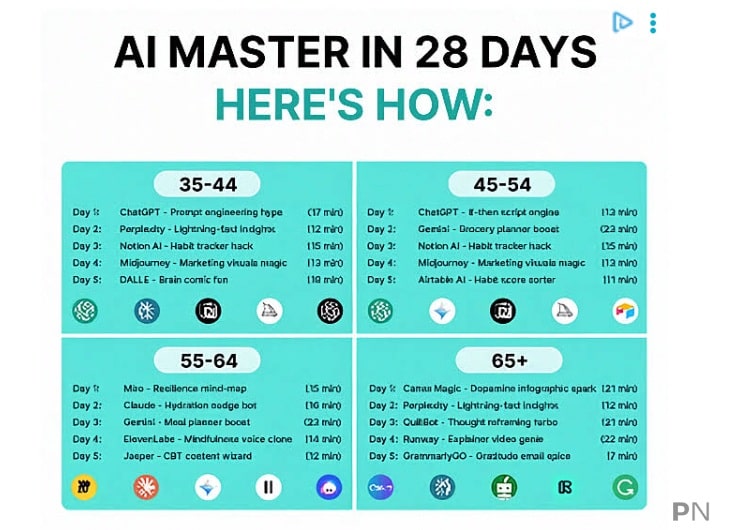
The irony is a mass murderer.
Anyway, I wish you all the best in mastering the art of reading in 28 days—even though it’s impossible, misleading, and perfectly embodies the very mindset this article argues against.
Reference
Alatawi, Faisal, Lu Cheng, Anique Tahir, Mansooreh Karami, Bohan Jiang, Tyler Black, and Huan Liu. “A Survey on Echo Chambers on Social Media: Description, Detection and Mitigation.” arXiv.org, December 9, 2021. https://arxiv.org/abs/2112.05084.
Behera, Naresh, Sipra Khuntia, Kavita Pandey, and Shail Shankar. “Impact of Social Media Use on Physical, Mental, Social, and Emotional Health, Sleep Quality, Body Image, and Mood: Evidence From 21 Countries—A Systematic Literature Review With Narrative Synthesis.” International Journal of Behavioral Medicine, November 24, 2025. https://doi.org/10.1007/s12529-025-10411-9.
Cherry, Kendra. “How Social Comparison Theory Influences Our Views on Ourselves.” Verywell Mind, September 24, 2025. https://www.verywellmind.com/what-is-the-social-comparison-process-2795872.
CivicScience. “One Subscription Too Many – Video Streaming Reaches an Inflection Point as Consumers Report Feeling ‘Subscription Fatigue.’” August 16, 2023. https://civicscience.com/one-subscription-too-many-video-streaming-reaches-an-inflection-point-as-consumers-report-feeling-subscription-fatigue/.
DeAngelis, Tori. “Teens Are Spending Nearly 5 Hours Daily on Social Media. Here Are the Mental Health Outcomes.” American Psychological Association. April 1, 2024. https://www.apa.org/monitor/2024/04/teen-social-use-mental-health.
Del Cerro, and Cristina Chueca. “The Power of Social Networks and Social Media’s Filter Bubble in Shaping Polarisation: An Agent-based Model.” Applied Network Science 9, no. 1 (November 11, 2024). https://doi.org/10.1007/s41109-024-00679-3.
Denniss, Emily, and Rebecca Lindberg. “Social Media and the Spread of Misinformation: Infectious and a Threat to Public Health.” Health Promotion International 40, no. 2 (March 5, 2025). https://doi.org/10.1093/heapro/daaf023.
Fassi, Luisa, Kirsten Thomas, Douglas A. Parry, Amelia Leyland-Craggs, Tamsin J. Ford, and Amy Orben. “Social Media Use and Internalizing Symptoms in Clinical and Community Adolescent Samples.” JAMA Pediatrics 178, no. 8 (June 24, 2024): 814. https://doi.org/10.1001/jamapediatrics.2024.2078.
Tsegaye, Hruy. “The Pen Is No Longer Mightier: Freedom Eluding Freedom of Speech.” Mindplex, September 17, 2024. https://magazine.mindplex.ai/post/the-pen-is-no-longer-mightier-freedom-eluding-freedom-of-speech.
Iandoli, Luca, Simonetta Primario, and Giuseppe Zollo. “The Impact of Group Polarization on the Quality of Online Debate in Social Media: A Systematic Literature Review.” Technological Forecasting and Social Change 170 (June 10, 2021): 120924. https://doi.org/10.1016/j.techfore.2021.120924.
McLoughlin, Killian L., and William J. Brady. “Human-algorithm Interactions Help Explain the Spread of Misinformation.” Current Opinion in Psychology 56 (November 23, 2023): 101770. https://doi.org/10.1016/j.copsyc.2023.101770.
Kärki, Kaisa. “Digital Distraction, Attention Regulation, and Inequality.” Philosophy & Technology 37, no. 1 (January 12, 2024). https://doi.org/10.1007/s13347-024-00698-z.
Musawi, Hasham Khaleel Al. “The Impact of Social Media on Mental Health: A Comprehensive Academic Analysis.” The Family Journal, June 3, 2025. https://doi.org/10.1177/10664807251346978.
Robertson, Claire E, Kareena S Del Rosario, and Jay J Van Bavel. “Inside the Funhouse Mirror Factory: How Social Media Distorts Perceptions of Norms.” Current Opinion in Psychology 60 (September 26, 2024): 101918. https://doi.org/10.1016/j.copsyc.2024.101918.
Sulaiman, Wan Anor Wan, Mohd Dahlan Ha Malek, Ahmad Rozelan Yunus, Nurul Huda Ishak, DhamirahNursakinah Mohamad Safir, and Adi Fahrudin. “The Impact of Social Media on Mental Health: A Comprehensive Review.” South Eastern European Journal of Public Health, December 1, 2024, 1468–82. https://doi.org/10.70135/seejph.vi.2564.
Wikipedia contributors. “Attention Economy.” Wikipedia, December 3, 2025. https://en.wikipedia.org/wiki/Attention_economy.
Zhou, Qi, Bin Li, Christian Scheibenzuber, Huajun Li, Qi Zhou, Bin Li, Christian Scheibenzuber, and Huajun Li. “Fake News Land? Exploring the Impact of Social Media Affordances on User Behavioral Responses: A Mixed-methods Research.” Computers in Human Behavior 148 (July 22, 2023): 107889. https://doi.org/10.1016/j.chb.2023.107889.