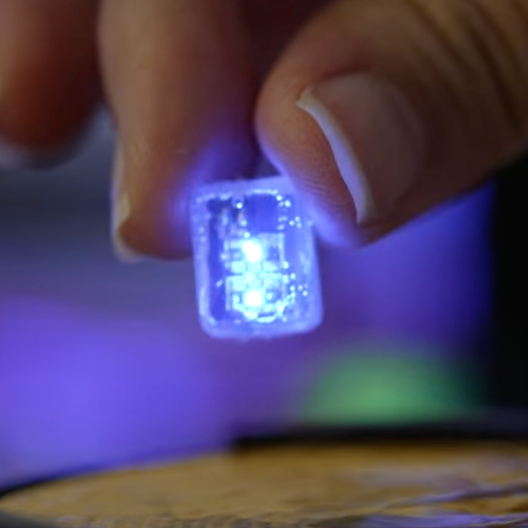

Rice University engineers say they have developed the smallest implantable brain stimulator ever demonstrated in a human patient. The pea-sized device can be powered wirelessly via an external transmitter and can stimulate the brain through the dura (the protective membrane attached to the bottom of the skull). No implant required.
The "Digitally Programmable Over-brain Therapeutic" (DOT) device could revolutionize treatment for drug-resistant depression and other psychiatric or neurological disorders. This therapeutic alternative offers greater patient autonomy and accessibility than current neurostimulation-based therapies, and is less invasive than other brain-computer interfaces (BCIs), say the researchers.
No battery required
“In this paper [in open-access journal Science Advances], we show that our device, the size of a pea, can activate the motor cortex, which results in the patient moving their hand,” said Jacob Robinson, a professor of electrical and computer engineering and of bioengineering at Rice. “In the future, we can place the implant above other parts of the brain, like the prefrontal cortex, where we expect to improve executive functioning in people with depression or other disorders.”
In-home use
The researchers tested the device temporarily in a volunteeer human patient, using it to stimulate the motor cortex⎯the part of the brain responsible for movement—and generating a hand movement response. They next showed the device interfaces with the brain stably for a 30-day duration in pigs.
Implantation would require a minimally invasive 30-minute procedure that would place the device in the bone over the brain (not the brain itself). Both the implant and the incision would be virtually invisible, and the patient would go home the same day.
Robinson envisions the technology being used from the comfort of one’s home, where patients would retain complete control over how the treatment is administered.
No brain surgery
The equivalent treatment is deep brain stimulation (DBS), a safe procedure. But it’s still brain surgery, and its perceived risk will place a very low ceiling on the number of people who are willing to accept it and may benefit from it, according to Robinson.
For some conditions, epilepsy for example, the device may need to be on permanently or most of the time, but for disorders such as depression and OCD, a regimen of just a few minutes of stimulation per day could suffice to bring about the desired changes in the functioning of the targeted neuronal network.
Future research
Robinson said he is “really interested in the idea of creating networks of implants and creating implants that can stimulate and record, so that they can provide adaptive personalized therapies based on your own brain signatures.” An associated company, Motif Neurotech, is in the process of seeking FDA approval for a long-term clinical trial in humans. Patients and caregivers can sign up on the Motif Neurotech website to learn when and where these trials will begin.
The work was supported in part by The Robert and Janice McNair Foundation, the McNair Medical Institute, DARPA and the National Science Foundation.
Citation: Woods, J. E., Singer, A. L., Alrashdan, F., Tan, W., Tan, C., Sheth, S. A., Sheth, S. A., & Robinson, J. T. (2024). Miniature battery-free epidural cortical stimulators. Science Advances. https://www.science.org/doi/10.1126/sciadv.adn0858 (open-access)