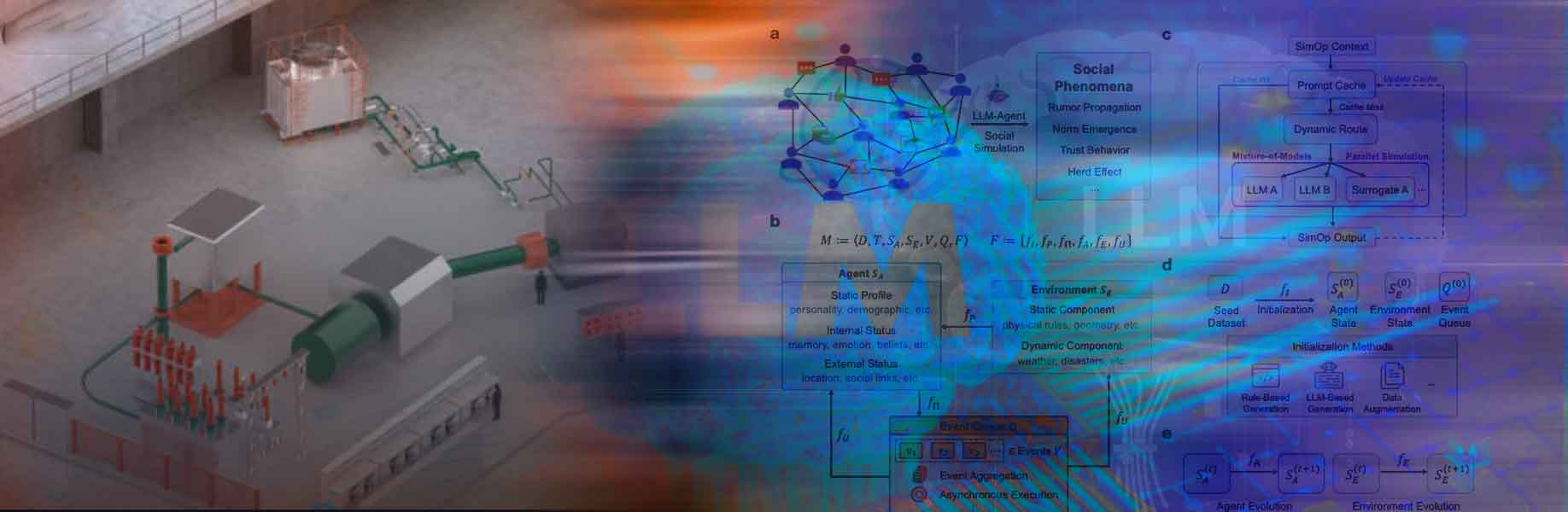

Chinese artificial intelligence (AI) researchers have introduced Light Society, an agentic AI framework designed to simulate large human-like societies. Light Society gives each digital character access to a large language model (LLM) so that the character can form memories, hold beliefs, show emotions, and decide actions in ways that resemble ordinary people.
The framework treats every social exchange as a change in the internal state of an agent or the surrounding environment. These changes are carried out by a small set of language-model operations and are ordered by an event queue. The researchers used special methods to keep the cost of running the system manageable when the number of agents reaches one billion. Prompt caching re-uses answers that have already been computed for similar situations. Knowledge distillation trains smaller, faster models to copy the behavior of the large language models on routine decisions. A mixture-of-models engine then chooses, for each decision, whether to call the full language model or one of the cheaper substitutes.
Key experiments and findings
Agents are given personal backgrounds taken from the World Values Survey, a large international questionnaire that records people’s age, education, social class, and country. In one set of experiments the agents played variants of the Trust Game. A second experiment examined how opinions travel through a network of one billion agents. Influencers repeatedly share views with their contacts, and the contacts gradually adjust their own views. The resulting spread of opinions followed patterns known from real social networks. Across both studies the framework produced high behavioral fidelity while running at speeds far beyond earlier language-model simulators, which had been limited to roughly ten million agents. The work therefore supplies a practical tool for testing ideas about collective behavior at the scale of the entire planet.
This research has been discussed by Jason Calcanis on X and on Peter Diamandis' podcast. Both mention agents sent to re-education camps, but the research preprint doesn't mention this, which was probably meant as a joke.