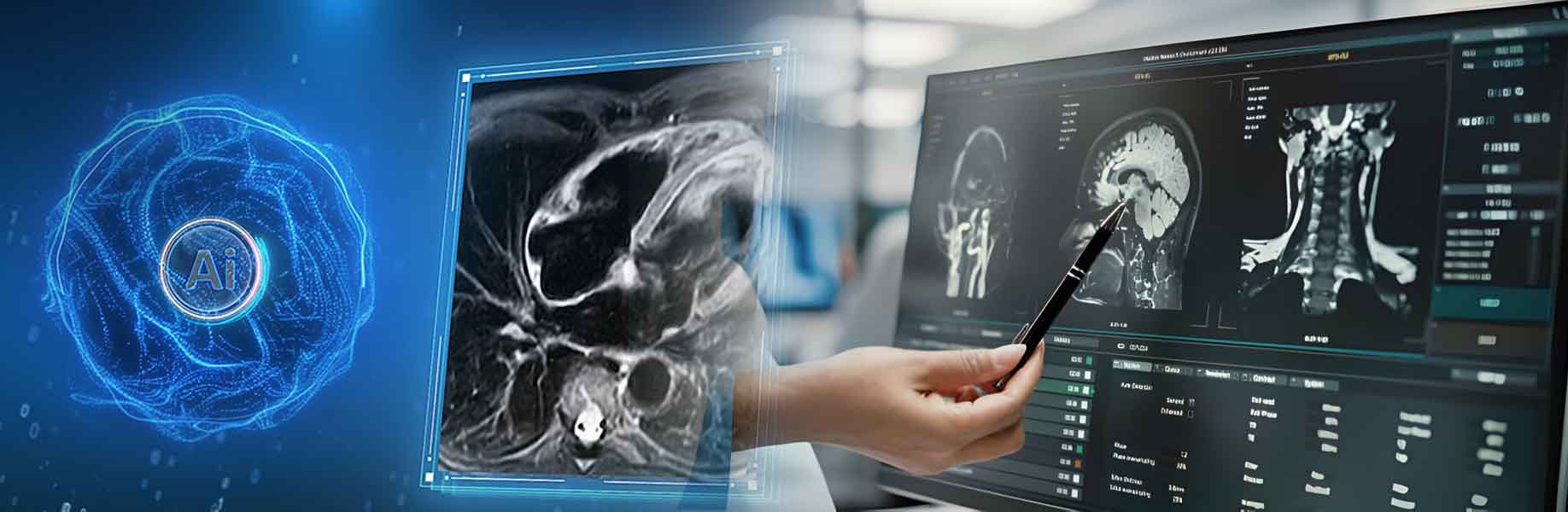

Researchers have created a new technique called ELITE that makes dynamic MRI scans for breast cancer faster and more detailed. MRI stands for magnetic resonance imaging, a method that uses magnetic fields and radio waves to produce pictures of the inside of the body. Dynamic MRI takes repeated images over time to show how a contrast agent, a substance injected to highlight tissues, moves through the body. This type of scan is especially useful for detecting breast cancer because it has high sensitivity, often above 90 percent.
Traditional dynamic MRI can produce only one image every one or two minutes. This slow pace makes it hard to follow the rapid movement of the contrast agent through blood vessels and tumors. The new method solves this problem by creating one clear image every second.
Faster imaging through combined techniques
ELITE brings together mathematical models that recognize patterns in tissue structure and artificial intelligence (AI) that learns to process information. The system removes noise and distortions from the images and fills in missing details from scans that use fewer measurements than usual. Researchers tested the method on 54 patients and found that it improved the visibility of tumors compared with standard approaches. The images showed greater clarity and helped distinguish more effectively between harmless and cancerous growths. It also allowed better measurement of tumor properties such as blood flow and how easily substances pass through vessel walls.
Shorter scan times could allow more patients to be examined with each MRI machine. The researchers showed that the same approach may also work for imaging the brain, head, and neck. In addition, the underlying ideas could be applied to other types of medical imaging. The work builds on an earlier effort that created a collection of 300 breast cancer MRI scans to support the development of artificial intelligence tools for this purpose.
This research is published in Nature Communications.