
Engineers at Princeton have developed a mathematical approach that allows thin curved shells to snap reliably into several different stable shapes. The work begins from the everyday observation that a plastic ketchup bottle cap stays open or closed because of the way a flexible shell meets a rigid edge along a curve. The same geometry, when applied more generally, produces structures that can hold multiple positions without any extra locking parts. Each of those positions is stable, meaning the shell resists external forces and stays put until deliberately switched.
The researchers started with the mathematics of curved-crease origami. Ordinary origami uses straight folds, but curved creases create continuous looping surfaces known as shells. Shells are efficient load-bearing forms found in eggshells, skulls, bridges and ancient domes. When the curved edge of such a shell is held fixed, geometry permits only a limited number of configurations that avoid stretching the material. Theory predicted two stable states, yet physical prototypes made by laser cutting and three-dimensional printing unexpectedly showed six or more. The extra states arise because the material spontaneously forms thin bands of concentrated bending and stretching. These bands, called pseudocreases, act like additional folds that the structure creates on its own to lower its energy.
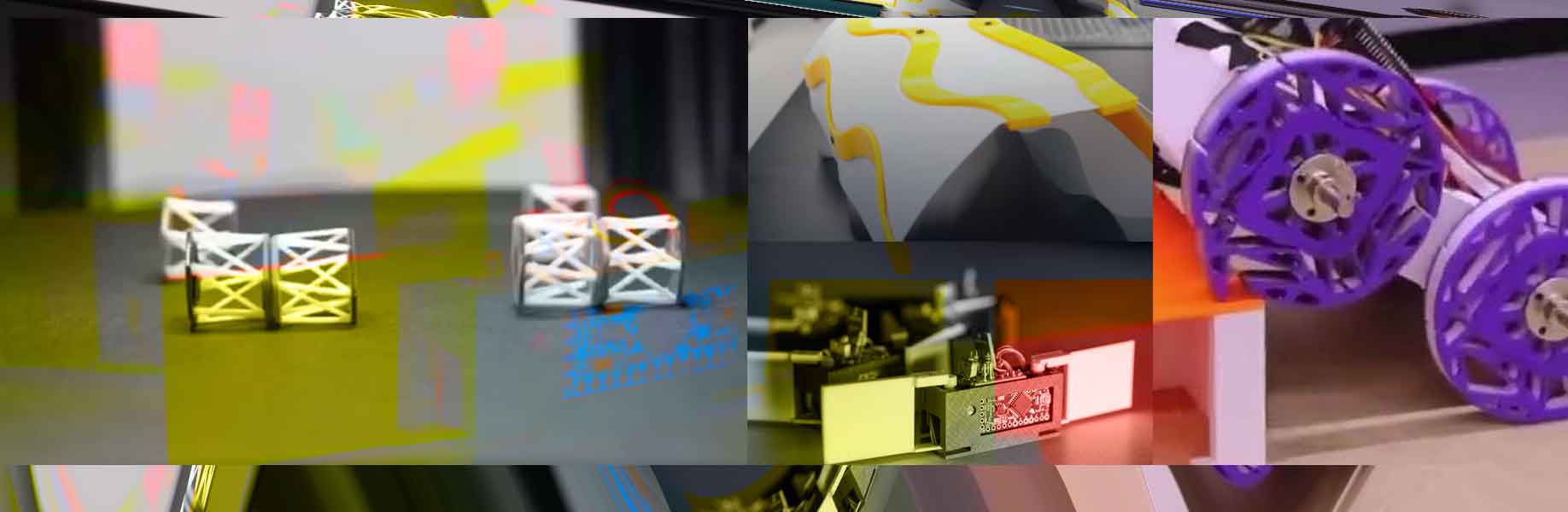
Mathematical analysis of the pseudocreases allowed the designers to predict and control the multiple stable shapes. Because the behavior comes purely from geometry rather than special materials or complex mechanisms, the same rules work across many sizes and ordinary substances. The researchers then built small robots that use these multistable shells. Magnets alone switch the shells between shapes, producing rolling and crawling motion with no onboard motors or electronics. Different robots can even be controlled independently inside a shared magnetic field by assigning each one its own combination of active and inactive configurations.
Applications of the geometric principle
Beyond the robots, the same design rules point toward reconfigurable architecture, boxes that open and close by snapping, and simple electrical switches. The core idea is that geometry itself serves as the actuator, the element that produces motion. Encoding several stable states directly into the structure removes the need for heavy mechanical parts and opens a route to lightweight, adaptable systems that can be scaled from small robots to larger structures.
This research is published in PNAS.