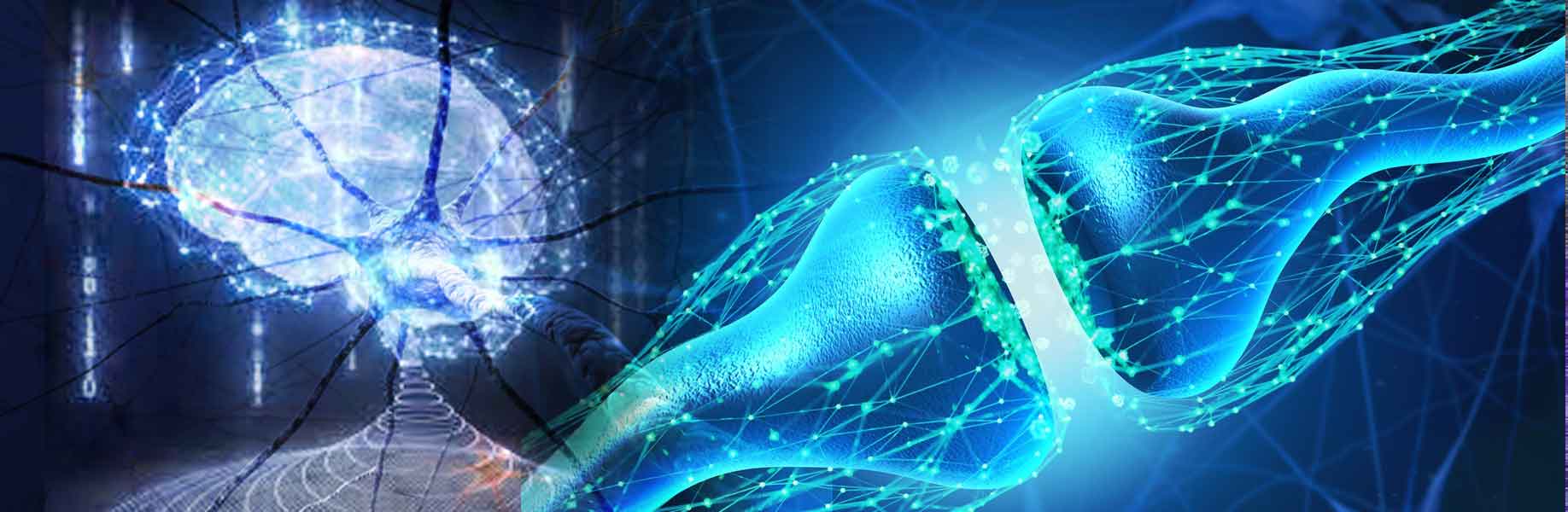

The human brain is much more efficient than today's computers because memory and calculation happen together at the points where nerve cells connect. Copying this design is a main goal of neuromorphic computing, which aims to create brain-like hardware that is fast and low-power.
Researchers have developed an artificial synapse that functions completely with light. Most current versions still mix light and electricity at some stage. This one handles both input and memory updates using only optical signals.
The component is made from a rare-earth-doped crystal that produces a long-lasting glow after illumination. Light creates excited charge carriers inside the crystal. Some carriers release light right away while others stay trapped and are released later. The history of light exposure changes how many carriers are trapped. This history dependence allows the device to adjust its response like biological synapses do through experience.
A model was built to track the generation, trapping, and release of these carriers over time.
Demonstrating brain-like behavior
When tested with ultraviolet light, the device exhibited paired-pulse facilitation, where a second light pulse shortly after the first produces a stronger light output because some trap sites are already occupied. With near-infrared light, paired-pulse depression occurred, with the second pulse giving a weaker response as previous pulses clear trapped carriers. These opposing effects allow signal strengthening and weakening, important features of real neural systems.
The crystal layer was added to a standard silicon image sensor to form a prototype system that processes information at the point of sensing. Strong signals last longer than weak ones and noise disappears faster. This direct processing improved image recognition. A simulated neural network using the device's properties reached 95.99 percent accuracy on classifying handwritten digits after built-in noise reduction. Standard separate processing achieved only about 78 percent.
The device operates on millisecond to second scales, matching biological vision timing. Improvements in size and materials could increase speed. The work opens a route to all-optical systems that sense, remember, and compute in one unit, promising benefits for energy-limited applications such as robotics and portable imaging devices.
This research is published in Advanced Photonics.