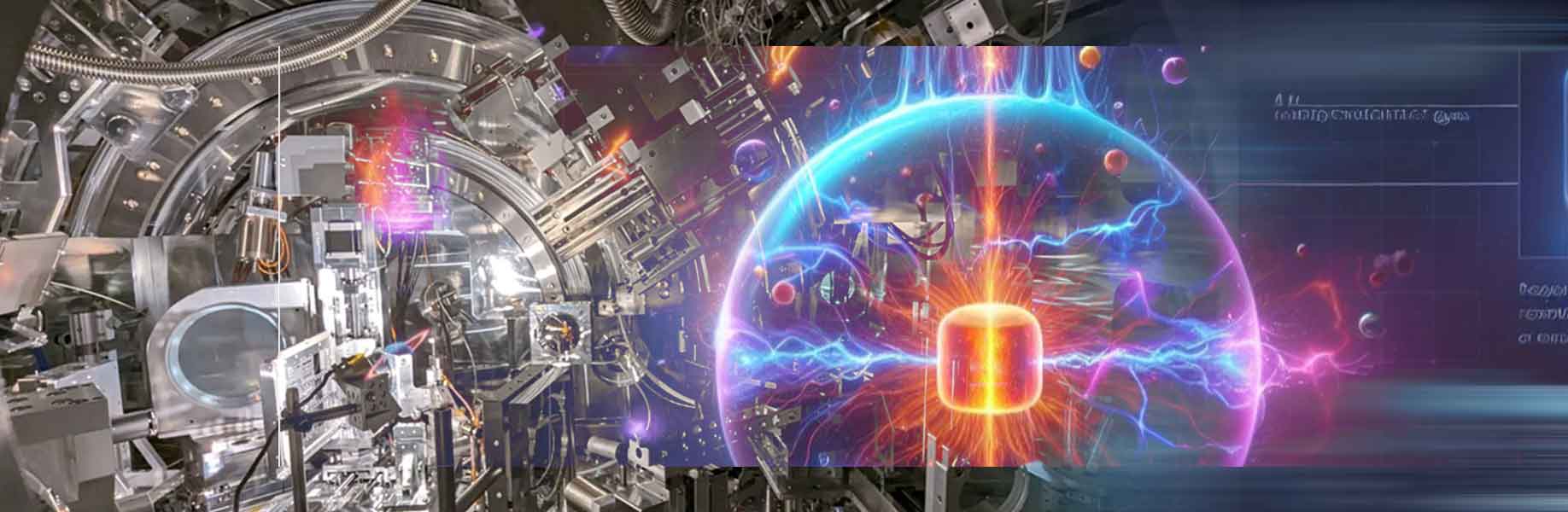

Scientists often study matter under extreme conditions, such as very high pressure and temperature. These states exist inside stars and gas giant planets. Researchers can also create them for short periods in laboratory experiments, for example during laser fusion research. To understand what happens inside the sample, they use X-ray scattering. In this technique, a strong X-ray beam is sent through the material. Scientists then examine how the X-rays scatter to learn about properties like density and temperature. However, the measured data alone often cannot clearly determine these properties.
Computer simulations are therefore essential. They create theoretical models that help match the experimental observations with specific values for temperature and density. A very accurate but computationally heavy approach called time-dependent density functional theory is used in computer simulations. This method models the quantum behavior of electrons in detail. Yet it requires enormous computing power, particularly when researchers need to test many different combinations of temperature and density in what is called a parameter scan.
A major improvement in simulation efficiency
A new method developed at the Helmholtz-Zentrum Dresden-Rossendorf solves this problem. It uses a mathematical tool known as imaginary time, a concept from quantum mechanics closely linked to temperature. By applying a reliable convergence test and a smart filtering process, the method removes numerical noise while keeping all important physical information intact. Unlike simple smoothing techniques that can hide details, this approach preserves the true structure of the signal.
Tests show the new method makes simulations up to 50 times faster. It also delivers more accurate results with fewer errors. This allows scientists to run far more detailed studies. The advance is especially valuable for experiments at the European XFEL facility. It will help researchers better understand the conditions needed for laser fusion, a potential future source of clean energy. It also benefits laboratory astrophysics and the study of material properties such as electrical conductivity and radiation absorption.
The new technique, published in npj Computational Materials, is expected to become a standard tool for analyzing data from modern X-ray experiments on extreme states of matter.