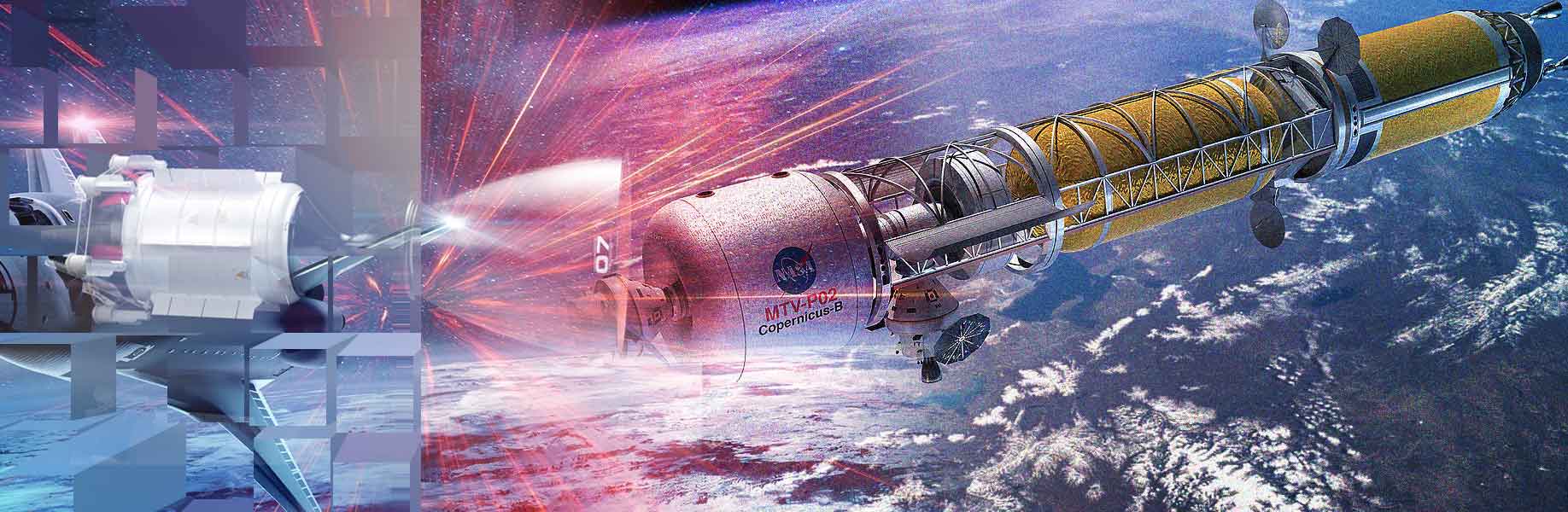

Nuclear Thermal Propulsion has been studied for years as an alternative to chemical rockets. Universe Today reports on Centrifugal Nuclear Thermal Rocket technology, a new design from the University of Alabama at Huntsville and The Ohio State University, which aims to improve nuclear propulsion.
Unlike traditional nuclear rockets, this system uses liquid uranium as fuel, spun rapidly in a centrifuge. Hydrogen is bubbled through the molten uranium and expelled through a nozzle to create thrust. This could achieve a specific impulse, a measure of rocket efficiency, of about 1500 seconds, nearly double the 900 seconds of NASA’s DRACO nuclear rocket program, while keeping similar thrust levels.
Challenges in building the rocket
The new rocket design faces several engineering hurdles. A recent paper in Acta Astronautica outlines the main challenges. One major problem is uranium vaporization, where uranium turns into gas and escapes through the nozzle, potentially reducing efficiency by two-thirds. To address this, the paper proposes dielectrophoresis, a technique to redirect uranium back into the system, though even a 99% recovery rate may not be enough.
Another issue is neutronics, the study of nuclear reaction particles. Adding Erbium-167 helps control temperature, but elements like xenon and samarium can disrupt the reaction if not removed. Hydrogen bubbles, which heat and expel the fuel, are also hard to predict. Tests using a gallium alloy and nitrogen aim to understand bubble movement. Finally, engine integration was modeled using a genetic algorithm, achieving a specific impulse of 1512 seconds under ideal conditions. However, the design needs more centrifuges and faster rotation. More research, especially on uranium loss, is needed before a prototype can be built.
However, CNTR technology could enable faster, more efficient space travel. Eventually, notes the paper, it could enable viable near-term human Mars exploration by reducing round-trip times to 420 days, as well as deep space missions.