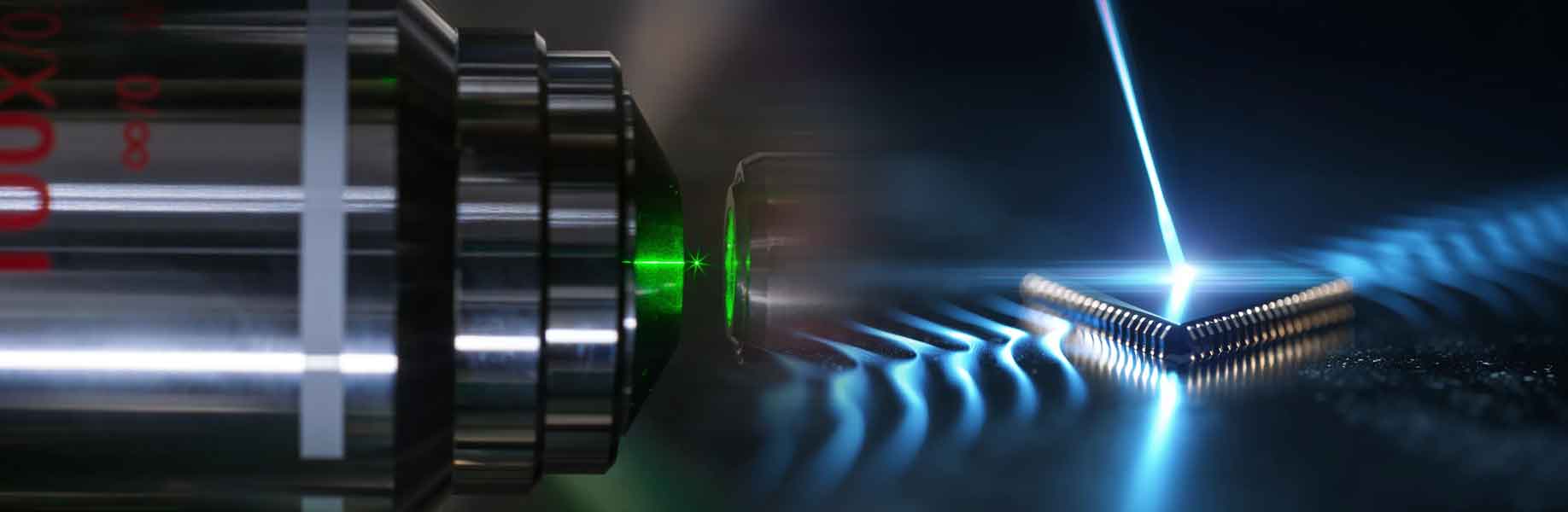

Scientists have created a new type of laser that controls tiny particles of vibration instead of particles of light. This device, known as a squeezed phonon laser, offers much greater precision for measurements at very small scales. It could lead to better understanding of gravity, faster particle acceleration studies, and advances in quantum physics.
Phonons are individual packets of mechanical vibration or sound energy, similar to how photons are individual packets of light. A phonon laser makes these vibrations behave in a steady, laser-like way. Squeezing in this context means reducing unwanted random fluctuations, called thermal noise, that normally disturb the signal and make accurate readings difficult. Optical tweezers are tools that use focused laser beams to trap and hold tiny objects in place, even levitating them in a vacuum.
The main challenge for both light-based and vibration-based lasers has always been noise, which causes small but constant changes in the beam or signal. By carefully applying light to push and pull on the phonon laser, the researchers reduced this thermal noise significantly. This squeezing effect allows much more precise detection of tiny movements and forces.
Noise reduction advance
The improved control means the squeezed phonon laser can measure acceleration more accurately than current methods that rely on ordinary photon lasers or radio waves. Such precision could support future quantum compasses that function without satellites and resist jamming, offering reliable navigation in places where GPS fails. The device works by combining nonlinear damping with parametric modulation of mechanical vibrations in a levitated nanoparticle system, creating correlated phonons across two modes.
This study is published in Nature Communications. Researchers from the University of Rochester and Rochester Institute of Technology carried out the work.
This development brings scientists closer to using mechanical vibrations for extremely sensitive measurements of forces and quantum effects. Further progress may open applications in navigation, fundamental physics experiments, and possibly medical imaging that uses sound waves.