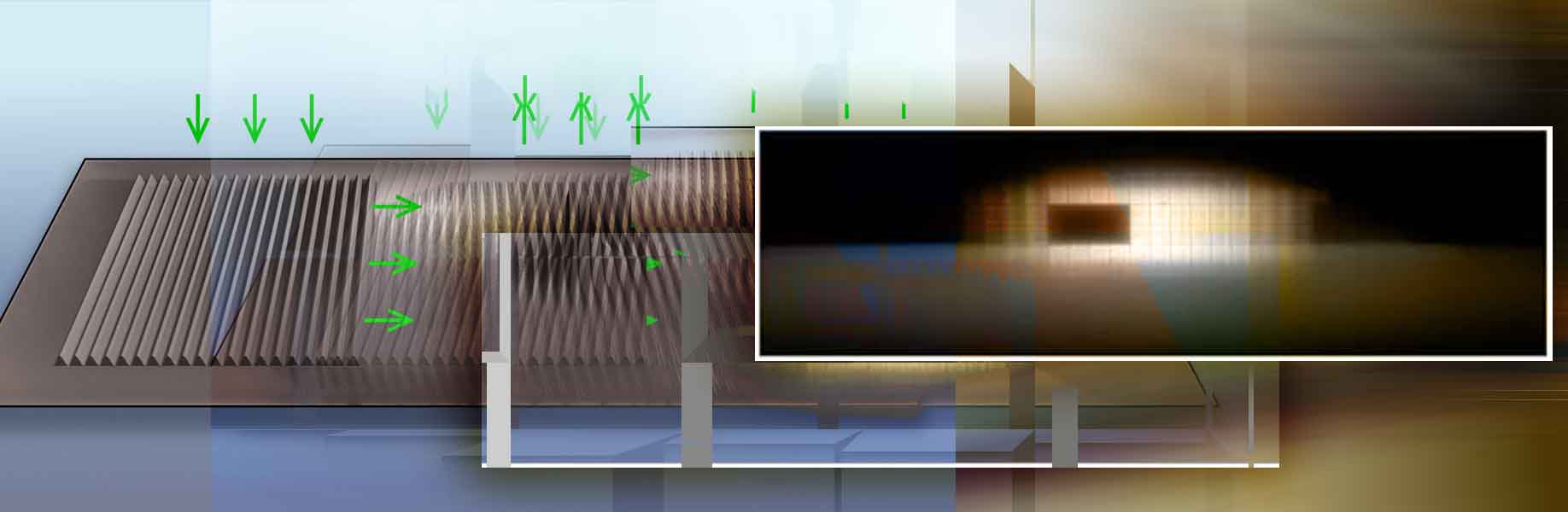

In screens pixels produce light to form images, while in cameras they detect light to record scenes. No single pixel has been able to do both until now. Researchers at ETH Zurich have developed a new type of pixel that can steer light outward and examine incoming light at the same time.
These pixels rely on interference. When light waves overlap, they can strengthen each other or cancel each other out depending on how their peaks and troughs align. The researchers shaped the surface of a tiny area on a chip with patterns accurate to a few nanometres. Incoming light is first converted into a surface wave that travels along the material before being scattered back out as visible light. The precise surface shape determines how the outgoing waves interfere, allowing the pixel to create specific patterns or images.
Dual control and analysis through mathematical patterns
The same pixel can also work in reverse to study light. By comparing an incoming light wave with a known reference wave, the pixel produces an interference pattern that a camera records. From this pattern, researchers can calculate the phase, or timing, of the light wave and its polarization, which is the direction in which its electric field vibrates. Fourier analysis, a straightforward mathematical technique, is used both to design the surface patterns needed for a desired output and to interpret the measured interference patterns. This approach allows the pixel to handle intensity, phase, and polarization without requiring complex calculations.
Because one pixel can now perform multiple functions, it may eventually support devices that combine camera and display capabilities in a single thin layer. The method also works across different colors of light. In the longer term, many such pixels could be arranged in a grid to create more advanced combined systems. The approach is simple enough that calculations could one day happen directly on the material itself rather than requiring a separate computer. A patent application for the technology has already been filed.
This research is published in Nature.