
AI Is Changing Science, But Who Actually Benefits From the Revolution?
Artificial intelligence could be a great equalizer in scientific discovery. It offers researchers everywhere access to new abilities. This boost in capability is expected to speed up breakthroughs and expand the limits of human knowledge. However, a recent study indicates that the situation may be more complex.
A paper published on arXiv on July 18, 2026, looks at an important question: when AI is involved in science, who benefits the most?
The researchers studied large-scale bibliographic data to measure AI integration by looking at references to artificial intelligence research. They examined how these connections relate to scientific impact over time. Their findings suggest that simply using AI-related knowledge does not ensure equal benefits across the scientific community.
The study found that papers using AI references were generally linked to higher citation impact, but the benefits varied greatly based on the scientific field, career stage, and institutional resources. In other words, while AI seems to boost scientific influence, this increase is not shared fairly.
AI May Become a Scientific Advantage But Not Automatically an Equal One
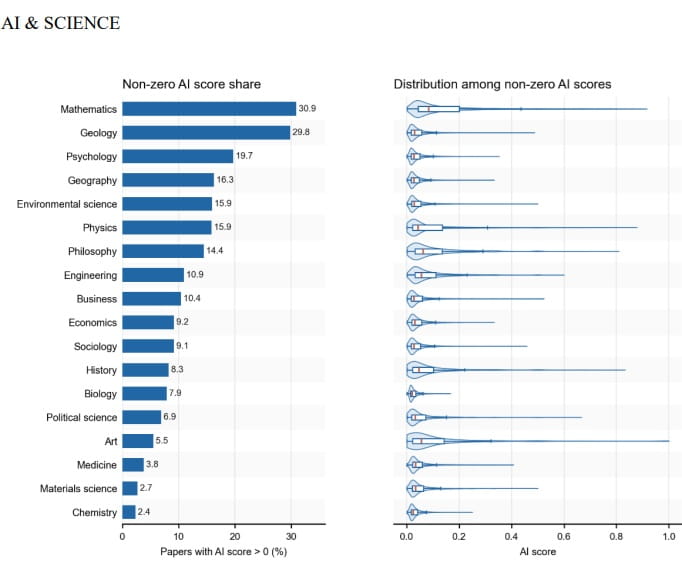
When it comes to AI's impact in scientific research across disciplines, Mathematics has the highest share, followed by, surprisingly, Geology and Psychology. Unlike the much anticipated impact in the health sector, Medicine and Chemistry show much lower levels of AI referencing papers.
One interesting finding in this research relates to the stage of professional life of researchers. According to the data provided by the research, senior researchers gain greater advantage from the extensive inclusion of knowledge about AI, while junior researchers benefit more from a deep engagement with the most recent and most influential AI studies.
This leads us to the bigger issue: will AI ease the hurdles that face new scientists, or does it further solidify the power of experienced researchers and institutions that have resources, networks, and the technical expertise?
The researchers have looked into how different institutions approach AI and found something interesting: it isn’t just the most advanced institutions that shine. In fact, those with moderate AI capabilities often see the biggest improvements in their scientific work. This finding pushes back against the idea that only the largest tech hubs will lead the way in the future of science.
It seems that the ability to turn AI knowledge into real scientific advancement is just as important as having the latest AI technology. This discussion comes at a time when the scientific community is grappling with what it means to adopt AI. Our recent coverage “The AI Promise in Science Is Starting to Look Like the AI Problem,” highlight concerns that while AI could boost research output, it may also bring about challenges related to quality control, reliability, and the burden of assessing AI-generated work.
The Future of AI in Science May Depend on Translation, Not Just Technology
The new study adds another layer to the debate. It’s not just about whether AI can help scientists make new discoveries; it’s also about whether the scientific community can build the necessary institutions, skills, and practices to use AI effectively.
The researchers refer to this as “translational capacity,” which is all about making AI knowledge useful and relevant across various scientific fields. This distinction could be a key factor in our understanding of AI’s impact on science.
History shows that progress in science isn’t solely about having advanced tools; it also relies on how well we share those tools, educate people on their use, and foster an environment where unexpected breakthroughs can happen.
AI, in the very list, will be our most powerful scientific tools, but this study highlights that the real challenge lies in figuring out how both artificial and human intelligence can navigate the intricate landscape of science. Ultimately, the future of AI-driven discoveries may hinge less on who has the best technology and more on who can translate that into real scientific advancements.