New Theory of the Origins of Life and Other Minor Issues: An Interview with Astrobiologist Dr. Bruce Damer
A scientist rethinks life’s beginnings with a testable mechanism reshaping how we understand biology, evolution, and ourselves. Bruce Damer reveals a vision that moves from volcanic pools to humanity’s future.
Recently several people told me excitedly that Dr. Bruce Damer was doing important work. I’m not even sure which important work they were referring to, but when I saw that he had posted something about having a sandwich and was offering up a new testable theory about the origins of life, I figured it was time for a Mindplex close-up.
Damer is an astrobiologist at UC Santa Cruz and Chief Scientist of the BIOTA Institute. He is best known for co-authoring a leading scientific hypothesis for the origin of life on Earth and where life might arise elsewhere in the cosmos. His research carries both practical and philosophical implications for humanity’s future. He is also a founder of the new Center For Minds, which pioneers research into psychedelic-catalyzed insight.
Bruce has designed spacecraft concepts for NASA and continues being a creative force in advancing architectures for life and civilization beyond Earth. A historian of technology and psychedelic culture, he speaks globally on paths forward for the human future.
Incidentally, someone recently also indicated that Damer is the man carrying the Learyesque utopian project forward (hence my silly question about utopia). I absolutely agree with him about rejecting totalistic utopian ideations.
Credit: Tesfu Assefa
RU SIRIUS: Let’s start with the discourse you just posted as Part 1 of a Substack series that is a theory about the origins of life. This is, you claim, a testable theory and relates to preliminary experimentations you and Dave Deamer have already carried out. And I’ll quote from it: “Life began through the actions of [this] object, a powerful chemical search engine acting as a progenitor for life.” These are, in a way, contemporary but also unique tropes for explaining the origin. An object, for example, rather than a seed or a program creating a simulation. The “search engine” for creating conditions for life to be created. Say a little about this theory (I will link to the piece so you can give a capsule summary, obviously) and about the choice of language. Is it essential to understand where you’re taking this?
BRUCE DAMER: When I describe the progenitor as an “object” or a “chemical search engine,” I am not reaching for dramatic language. I am trying to convey a shift in how we think the first steps toward life might have occurred. Much of the traditional work on life’s beginnings has assumed that a single replicator molecule was the starting point, a kind of chemical copying machine that somehow managed to build more of itself. The difficulty with that view is that the chemistry of water actually works against it. In bulk water in a test tube or a pool, molecules drift apart, break down, and rarely meet in ways that would support sustained replication.
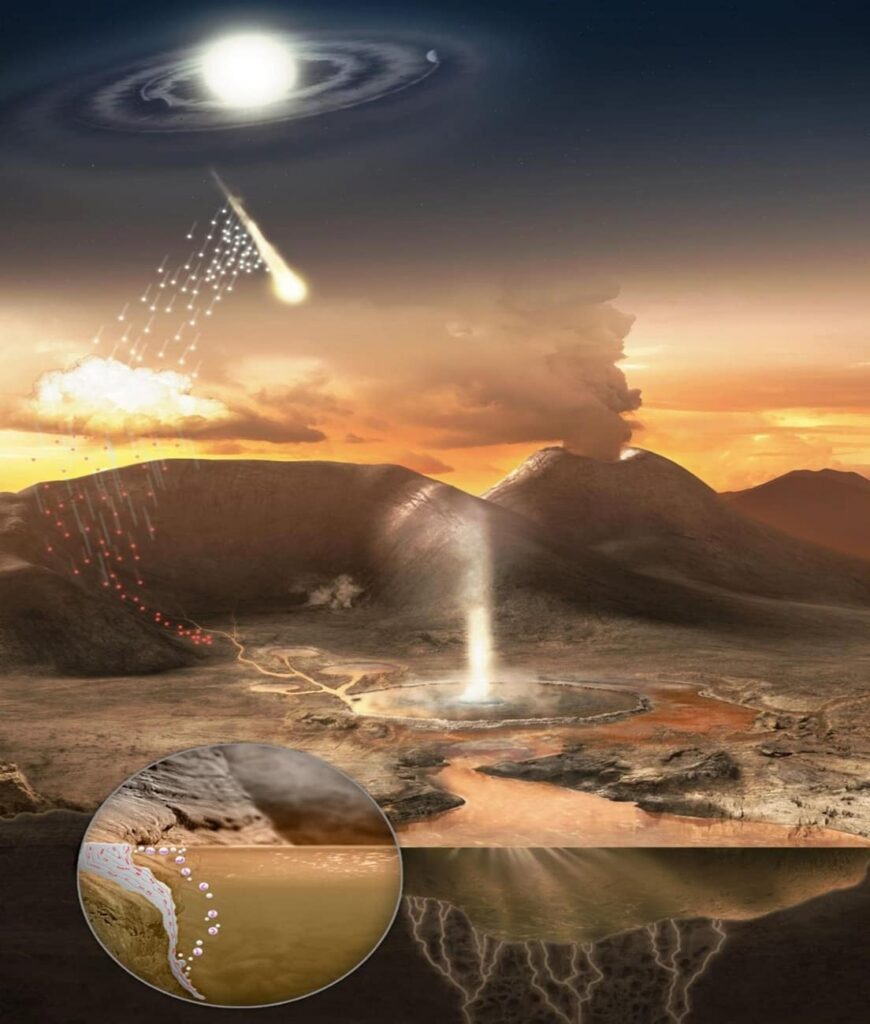
Our proposal begins somewhere else entirely. Before a replicator, there may have been a medium. This medium forms naturally during cycles of wetting and drying in volcanic hot spring settings, which provide heat, fresh water, and a steady supply of organic compounds delivered by meteorites, dust and the hot spring itself. During the drying phase, simple fatty acids assemble themselves into stacks of membranes. These stacks trap nanoscopic films of water along with nucleotides, amino acids, and other building blocks of life. As the water leaves, these components are drawn together, creating the conditions for them to stitch together into long chains called polymers. When a geyser erupts and water returns to refill a pool, the membrane layers swell and bud off vesicles, some of which enclose these newly formed polymers. These are what we call, in astrobiology, ‘protocells.’
Credit: Courtesy of Bruce Damer Collection (Fig 1: Artist’s conception of volcanic pools on the early Earth as life was getting started, four or more billion years ago. Top: faint young sun with disc of accretion materials and planets sweeping them up. Middle: geyser erupting from freshwater hot springs. Bottom: cutaway view of one pool with protocells cycling on mineral surfaces through wet and dry phases.)
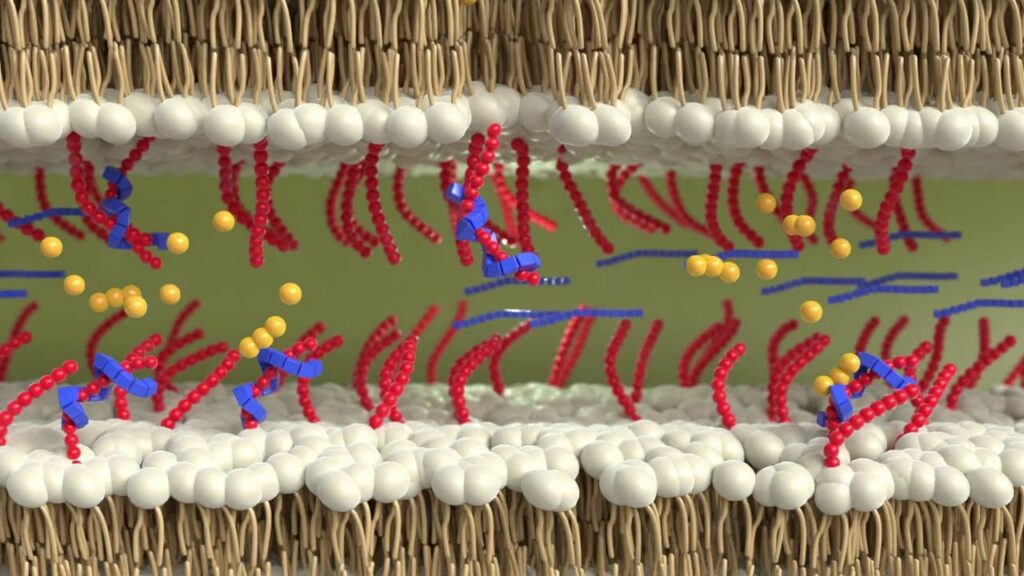
BD Cont.: The generative, layered system is something very different from the watery environments of test tubes or open pool water. It is a distinct, novel environment with boundaries, structure, and measurable behavior. It also performs a type of combinatorial search because of what happens in the 2D thin water films between the layers. Molecules are crowded there and constantly brushing past one another, creating far more frequent encounters than would ever occur in 3D bulk water. When membrane- attached peptides sweep across nucleic acid strands lying flat between membranes, rare functional pairings can emerge.
Credit: Courtesy of Bruce Damer Collection (Fig 2: Computer generated view of nanoconfined water layer between lipids where rare pairings can occur (see red peptide getting together with blue nucleic acid strand, center).
BD Cont.: These pairings matter because together the polymers may carry out small but significant catalytic or informational tasks. In fact, all of life is made possible through mutually beneficially pairings of nucleic acid polymers like RNA and DNA, with amino acid strands including peptides and proteins. So, the origin of life is recast as follows: How can we form these polymers, get them together into trial pairings, and test their functions which might eventually lead toward metabolism and genetic heredity? Part of that testing is whether the polymers perform jobs to stabilize their surrounding protocells. If they do that job, the protocells survive watery immersion and are still around when the pool dries down. As the protocells nestle together, they fuse and deliver their polymers back into another layered, drying state where new combinations can form and be tested. This system is in fact a simple chemical rendition of the ‘life cycle’ which characterizes all living things: birth through polymer synthesis, survival assured by their functions, and re-combination of polymer sets for the next generation.
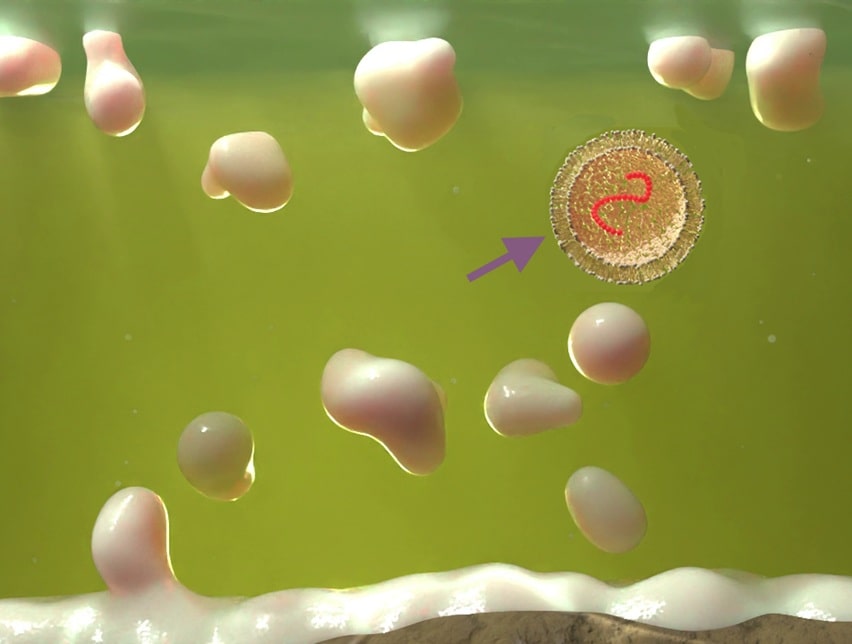
Credit: Courtesy of Bruce Damer Collection (Fig 3: Protocell budding off dried layers when water flushes back into the pool. This protocell (purple arrow) is carrying a polymer which may give it an advantage to survive to the next dry-down.)
BD Cont.: This is why we call this layered object and the cycles it generates a ‘progenitor,’ employing the genealogical sense of the word. It is the original ancestor that gives rise to everything that comes later. It helps explain how polymers form and accumulate, how protocells are generated, and how the first simple circuits of biological function may have begun. It is not a metaphor, and it is not an abstract concept. It is a physical system that we can assemble and test in the laboratory.
So, the language is important, but only because it helps make clear that we are talking about a real, observable mechanism. The progenitor is a self-assembled medium that empowers combinatorial chemistry to explore possibilities which would likely never occur in bulk water. It is testable and grounded in experiments and offers a very different starting point for the story of life.
To dive deeper into this science, I again invite readers to take a look at Part 1 of my Substack article on the ‘sandwich shop insight’ which led to the progenitor four years ago. [ed: linked to earlier]. Catch the preprint of the full hypothesis paper, just accepted for publication in the journal Astrobiology.
RU: I want to next leap all the way to the end of the piece, where you talk about “some pretty extraordinary societal, scientific and technological implications of this work and how it might benefit the Human future.” What ‘future’? Sorry, but seriously—without blowing your next piece, can you give a small taste of at least one of the themes you might be developing as to how a paradigmatic shift in how we understand life’s origins might prove valuable to the human future?
BD: In Part 2 of the Substack series, I will look at how understanding the mechanism behind life’s beginnings might influence the human future, both scientifically and culturally. I will not give away too much from the next installment, but one idea is worth sharing: If the progenitor can be validated, then we gain a blueprint for what I call a ‘genesis engine,’ meaning a reproducible system that allows chemistry to generate functional novelty even before genes existed.
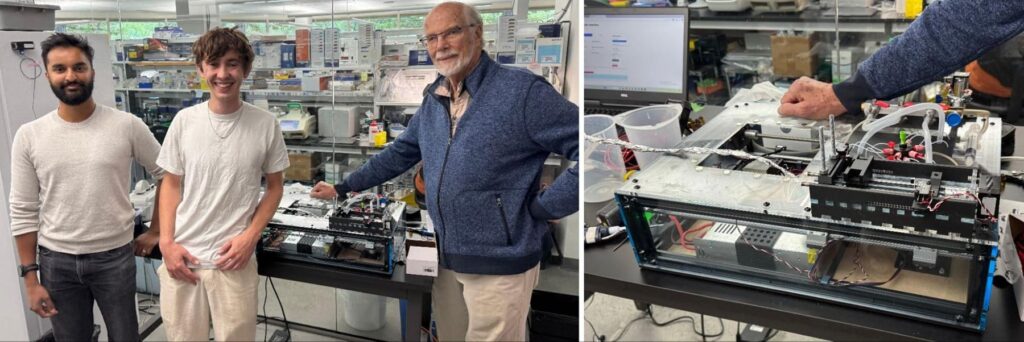
Credit: Courtesy of Bruce Damer Collection (Fig 4: Research students (left) with Dave Deamer flanking the “Genesis Engine Mark II” in the lab in Scotts Valley, California.)
BD Cont.: Imagine a set of automated wet/dry cycling experiments in the laboratory. Each vial contains a mixture of prebiotic ingredients and undergoes hundreds or thousands of cycles. Cameras record what happens, and chemical analyses track which polymers rise or fall in abundance. Once the system reaches a sufficient complexity, we introduce a stress such as ultraviolet light, a temperature shift, or a change in acidity. Some protocells will fall apart, while others survive, and a few may show signs of adaptation. Suddenly we are watching not a static mixture of molecules, but a dynamic chemical search for solutions. We are observing the kinds of primitive, adaptive steps that could have been taken on the early Earth, long before true cells emerged. Early versions of such a genesis engine have been built and used by our group and others (see above). While this primitive chamber lacks automated chemical setup and analysis, it is a start!
The technological implications of this are significant. A genesis engine could provide a new way to explore chemical space. Instead of relying only on human-designed pathways, we could allow simple prebiotic chemistry to discover unexpected functions. That might eventually lead to new catalysts, new materials, or new forms of chemical organization that do not rely on complicated interactions of modern DNA, RNA and proteins. It also gives us a chance to study the earliest stages of evolution directly, something that has never been possible before and may help us see evolutionary processes, and life, through a new lens.
There is also a broader perspective change that might emerge from this work. Watching fragile protocells struggle under stress, fail, recover or disappear entirely may give us a clearer sense of how narrow and risky the path to life really was. Billions of cycles, countless failures, and only occasional plateaus of stability. It is not mystical, but it is profound. Much like the first photographs of Earth from space changed how people understood the planet, a clear view of how life begins might change how we understand ourselves. It could highlight the rarity of life, the ingenuity possible from even simple chemistry, and the responsibility that comes with being both the embodiment and inheritors of that long process.
I do not want to oversell what is still an early area of active research. Accumulation of evidence is how hypotheses become theories, and a great deal remains to be demonstrated. But if the progenitor turns out to be a plausible mechanism, it will not only advance the science, it will give us a new way to think about adaptation, resilience, and the creative forces that shaped our own existence. Those insights may be valuable as we consider our place in the cosmos, and what kind of future we want to build.
RU: It’s interesting that you referenced the unity provided by a picture of the whole earth because I’d already made a note to self to challenge you with the thought that supposed paradigm changes don’t really work anymore, as in the picture of the whole Earth didn’t result in global unity and the end of nationalism, racism and so forth. These things dissipate into the increasing chaos and noise of the mediated and now virtualized culture. Any signal is about as good as any other signal, whether it's the origin of life to the theories of ISIS to the sex habits of the ruling classes ad infinitum.
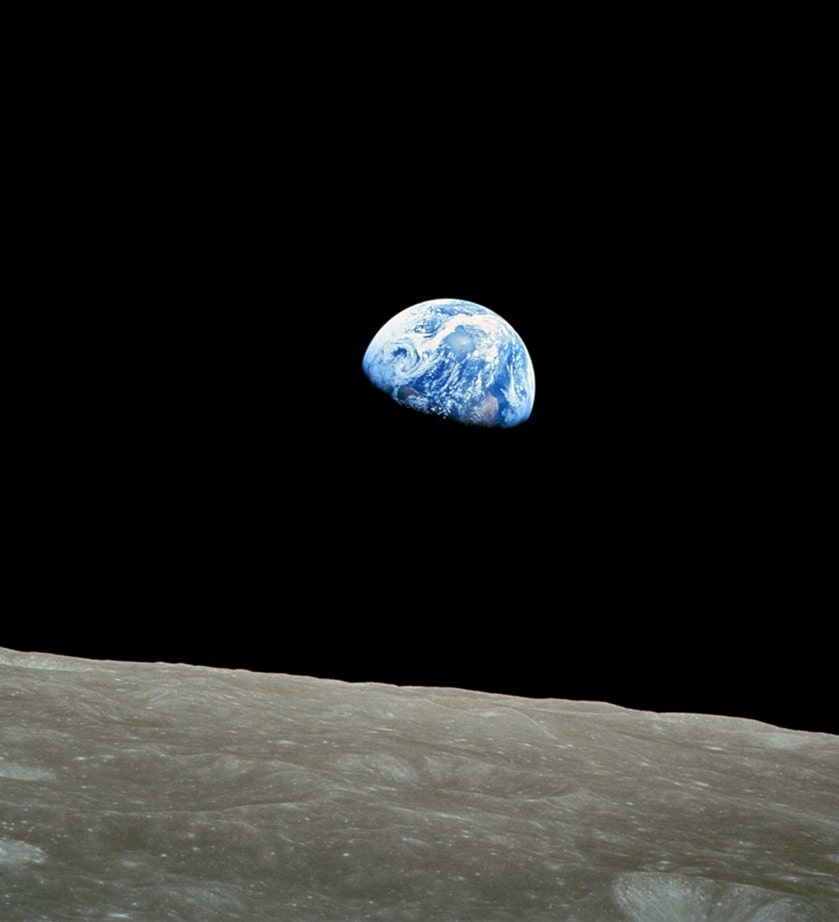
Credit: NASA (Fig 5: Earthrise photograph, taken by Bill Anders, December 24, 1968.)
BD: I understand the impulse behind your challenge, but I think it rests on a misconception about what paradigm shifts actually do. They rarely erase conflict or silence competing signals. They change the underlying frame within which those conflicts play out. The ‘Earthrise photograph’ taken by the Apollo 8 crew in 1968 did not end nationalism, racism or geopolitical rivalry, and I never suggested it did. What it did do was alter the mental model people used to think about the planet. It shifted the background of human imagination from a cartographic map of borders to a single, fragile sphere suspended in space. That shift did not solve our fractures, but it changed how people talk about global risk and cooperation, ecological responsibility, and our shared fate. Paradigms do not overwrite human behavior, but they do reshape the conceptual terrain on which that behavior unfolds.
The same is true today. The noise of the mediated world has increased, but so has our ability to see underlying structures. The fact that a signal is contested does not mean it has no effect. Many of the most powerful ideas in history operated not by imposing unity, but by creating a common reference point for discussion. Evolution, germ theory, plate tectonics and the Big Bang did not quiet the noise of their eras, yet all of them reorganized thought and future action in durable ways.
I push back gently on the idea that “any signal is as good as any other.” Humans are not passive receivers of noise. We are pattern-seeking organisms, and over time, coherent and testable frameworks tend to outlast the churn. Theories that reliably explain more of how the world works usually survive while the rest burn brightly yet fade. Even in today’s fractured information environment, ideas with real explanatory power still climb to the top, not because culture becomes harmonious, but because people gravitate toward what helps them make sense of reality, and get things done.
This brings me back to the progenitor work. I am not arguing that a validated origin-of- life mechanism will unify the planet or quiet the chaos. What I am saying is that understanding how life emerged from non-life carries long-term cultural weight. It gives us a clearer sense of the physical constraints that shape all living systems, including our own societies. It can also help restore a grounding sense of continuity between mind, matter and environment at a time when many people feel unmoored. A shared origin story verified in experiment is not a cure for human division, but it can provide a baseline from which to think about responsibility, resilience and the fragility of complex systems.
You are right that today’s fractured media ecosystem can bury important signals under spectacle, but that does not erase their influence. The great shifts in worldview tend to work slowly. They do not produce immediate unity, yet they guide the long arc of how generations understand themselves. If we can illuminate the steps that carried chemistry across the threshold into biology, we are not just solving a scientific puzzle. We are clarifying our own place in nature, and that kind of clarity has value even in an ideologically fraught age.
RU: Let’s move forward from the start of life into the late 20th century. I saw you speak a few years back at a Timothy Leary memorial and I’ve noted some influence and inspiration on you from Leary and from Terence McKenna. So... what would you say is the new strategy for utopia, if any?
BD: Utopia is a difficult concept to realize because it usually implies a complete redesign of society, imposed from the top down or imagined from the outside. Nearly every attempt at that kind of utopia has failed, partly because human systems are complex and partly because people do not respond well to rigid blueprints. So, I want to start by challenging the premise a little. The question is not whether we can design a perfect society. The more useful question is how people and cultures can move toward healthier, more positively adaptive ways of living.
One thing my work on life’s origins has taught me is that large scale change rarely comes from grand plans. It emerges through simple systems that create conditions for exploration. The early Earth did not produce a perfect cell in a single stroke. It generated countless cycles of trial, failure and refinement inside a medium that allowed new combinations to appear. Successful patterns persisted because they worked, not because they were ideal.
Human cultures operate in a similar way. Most of the meaningful progress of the last century did not come from utopian schemes. It came from better tools, more effective communication, improved health and enhanced opportunities for individuals and communities to explore what works. To me, that suggests a different approach to the concept of utopia as not a destination, but a set of conditions that allow many kinds of human flourishing to emerge.
This is where the influences you mention come in. Timothy Leary and Terence McKenna were both asking a version of the same question: how do people break out of restrictive mental frames to see and act on new possibilities? Whether or not one agrees with their methods, they were pointing at something real. Insight, whether it arises from psychedelics, meditation, scientific inquiry or lived experience, can help people shift their worldview and life trajectory. Individuals who change their own personal operating assumptions can sometimes change societal systems operating around them.
But insight alone is not a strategy. The real challenge is translating new perspectives or innovations into sustained action. That requires what I would call ‘tributaries,’ small entry points where new ideas can flow into the larger cultural river. The breakthroughs that matter tend to be local, concrete and grounded in practice. They build trust and capability rather than trying to impose a single vision. Over time, those tributaries can therefore alter the course of the mainstream without ever claiming to replace it.
If there is a modern strategy for utopia, it may be this: like the molecules moving about between layers, create environments, tools and communities that increase the likelihood of insight and decrease the barriers to constructive action. Support the kinds of systems where experimentation is possible, where mistakes are survivable, and where good ideas can be tested rather than simply dismissed. Encourage people to enter the cultural river with something to contribute, rather than remaining on the sidelines, circling in the eddies of cynicism or despair. Most large changes begin that way. I am wary of grand narratives that promise salvation or prognosticate doom. Both tend to miss the actual work being done by people who build things. The future is shaped less by sweeping ideologies or the latest scare or conspiracy theory, and more by the steady efforts of individuals and groups improving their corner of the world. That may sound modest, but it is how complex systems evolve and may be how life itself crossed the threshold from chemistry to cells.
So perhaps the answer is that the new strategy for utopia is not utopian, it is evolutionary. It involves insight, experimentation, and the willingness to add your tributary to the flow. That is where I place my hopes and bets on the human future. And frankly, it is where the most interesting and inspiring work is happening today.
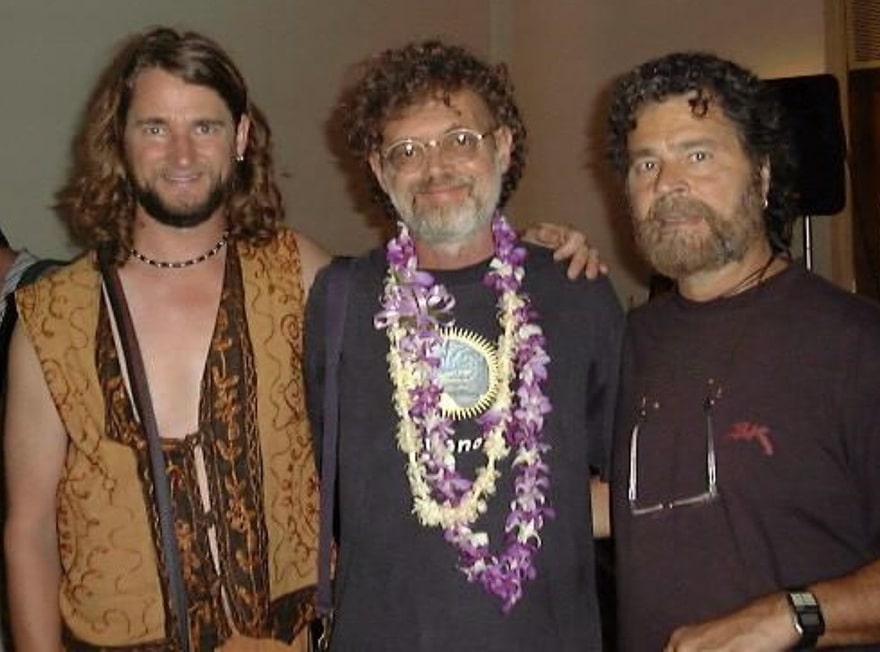
Credit: Courtesy of Bruce Damer Collection (Fig 6: Left to right: a much younger Bruce Damer, Terence McKenna and Robert Venosa at AllChemical Arts, Kona, Hawaii in September 1999.)
BD Cont.: One final note about Terence which relates to utopias. Meeting him back in the ‘90s pinballed my life into extraordinary new directions. Not only was I gatewayed into hyperspace through his good graces, but late-night conversations with him helped fuel my inquiry into questions of how the universe complexifies, novel things emerge, and where the heck this all might be going. I have spent the past quarter century after his passing pursuing these themes. I only wish Terence was still around so I could report back to him how it has all turned out. While it is still a work in progress, I sought to build my own utopia (inner and outer) within which to live out my life and to share with others.
Additional resources on Dr. Damer’s life and work:
His research organization working on the origin of life, the BIOTA Institute. The Center for MINDS, investigating psychedelically-catalyzed insight.
Dr. Damer’s academic Publications on the origin of life, and personal archives on humanity’s future in space, the early metaverse, and the history of computing.
Fun and informative videos can be found on his YouTube channel, and audio on his personal historical podcast, the Levity Zone.
Fascinating! Damer’s wet–dry cycle theory offers a fresh, testable perspective on the origins of life, demonstrating how complexity can emerge naturally under the right conditions.
This interview with Dr. Damer offers the clearest and most compelling explanation. The idea that wet–dry cycles in early Earth’s hot springs could create a natural engine for polymer formation and protocell evolution feels both scientifically grounded and genuinely fresh and insightful.