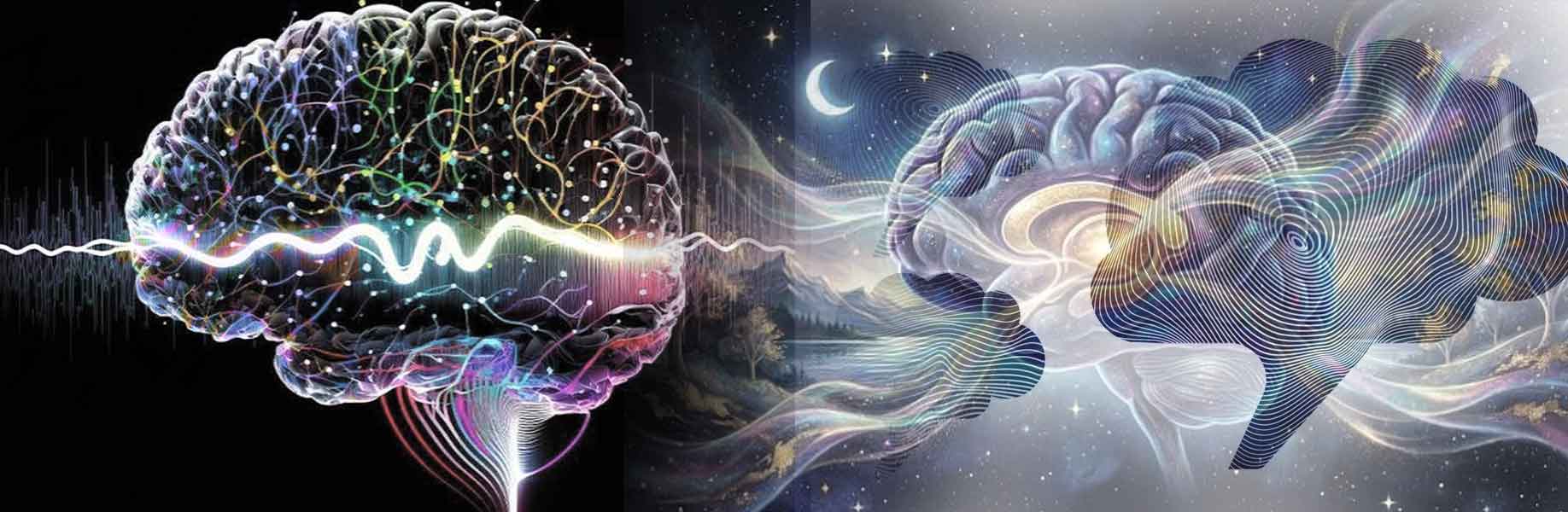

MIT scientists developed a theory to explain how the brain generates quick, flexible thinking and a unified sense of awareness. The theory holds that these abilities arise from analog computations carried out by traveling waves of rhythmic electrical activity among large groups of neurons. The theory is published in The Journal of Neuroscience.
Physical connections between neurons store memories and represent ongoing goals. Synapses are the chemical contact points where one neuron passes signals to another. These connections form the basic infrastructure of the brain. Yet they change too slowly through chemical processes to handle the rapid, improvised demands of everyday sensory experience. Brain waves provide the needed control system. These waves are synchronized rhythmic fluctuations of electrical activity that travel across the brain and can coordinate millions of neurons in a fraction of a second.
Waves enable fast and flexible processing
Many neurons respond to multiple different cues and contexts at the same time and therefore take part in several functional networks. Brain waves of different frequencies organize these overlapping networks. Slower alpha and beta waves, linked to memories and goals, regulate faster gamma waves that process incoming sensory information. Evidence also points to ephaptic coupling, in which the electric fields generated by waves rapidly influence nearby neurons without relying on chemical synapses. The waves move across the cortex and act as mobile patterns that decide where and when sensory information is processed. Where waves meet they can add or subtract, allowing analog computations that handle many operations simultaneously.
The scientists suggest that consciousness arises when these dynamic wave patterns bring the cortex into an organized, globally integrated state that links widespread activity. Supporting observations come from studies of general anesthesia, which show that different drugs disrupt wave dynamics in similar ways and thereby produce unconsciousness. The theory suggests that treatments based on modulating brain waves could prove valuable, especially since waves can be influenced non-invasively. The authors note that the brain appears to exploit its own physical properties for efficient computation under evolutionary pressure to maximize processing per unit of energy.