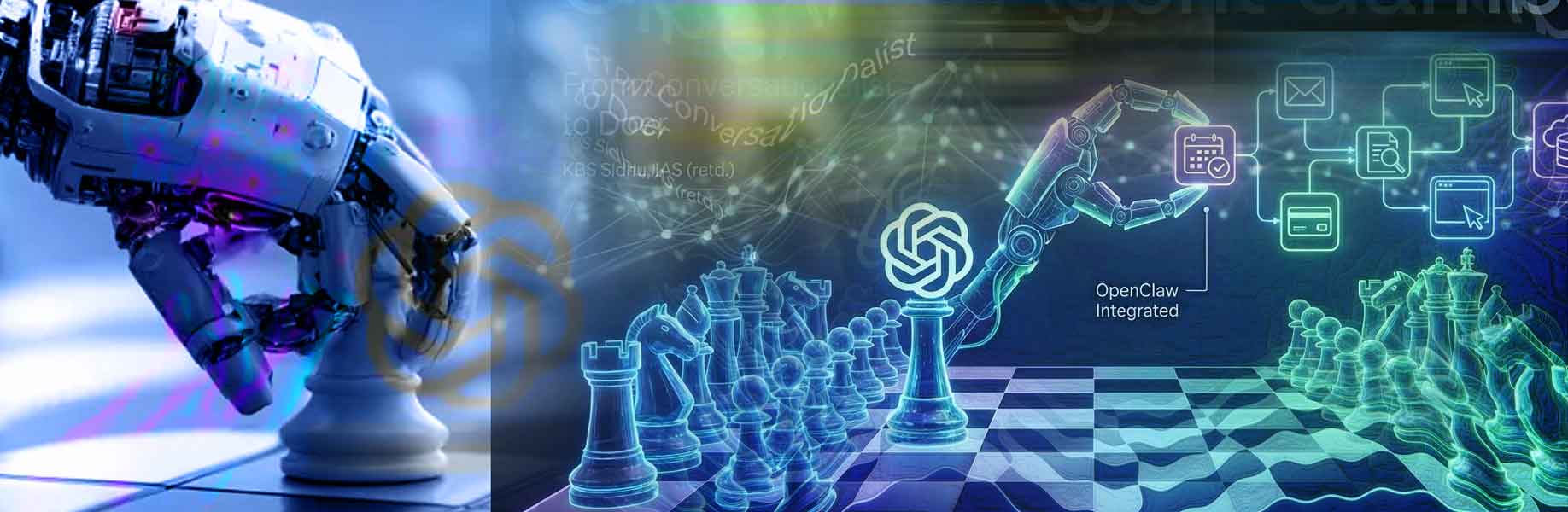

OpenAI launched ChatGPT Work on July 9, a new AI agent that merges its chatbot with its Codex coding tool, powered by the freshly released GPT-5.6 model suite. The product lets non-technical users delegate multi-step workflows across Slack, Gmail, Google Drive, and CRMs, producing finished documents, spreadsheets, and web apps. It is available immediately to free users on desktop, with web and mobile access rolling out to paid tiers over the coming days.
The launch lands at a moment when OpenAI's dominance is measurably eroding. According to Sensor Tower's 2026 State of AI report, ChatGPT's share of the global AI assistant market fell to 46.4% by May, down from over 50% in January, as Google Gemini climbed to 27.7% and Anthropic's Claude reached 10.3%. More critically, Anthropic overtook OpenAI in US enterprise AI adoption for the first time in April, claiming 34.4% of business usage compared to OpenAI's 32.3%, according to Ramp's AI Index data reported by Business Insider. By May, Anthropic had extended that lead to 41% of business AI subscription spending versus OpenAI's 39.5%.
ChatGPT Work is a direct response to Anthropic's Claude Cowork, which launched in January and has been steadily gaining enterprise traction. OpenAI is leaning on two advantages: breadth of access and price. GPT-5.6 Sol, the flagship model, scores one point below Anthropic's Claude Fable 5 on the Artificial Analysis Intelligence Index but costs roughly one third as much per task. In coding benchmarks, Sol leads the field, scoring 80 on the Artificial Analysis Coding Agent Index at roughly 40% lower cost than Fable 5.
The pricing strategy signals where this fight is heading. OpenAI's enterprise revenue, which already exceeds 40% of its roughly $25 billion annualized run rate, is projected to reach half of total revenue by year end. With Anthropic eating into that segment, undercutting on cost while matching intelligence is the clearest lever OpenAI can pull. The global enterprise conversational AI market, valued at $24.9 billion this year, is projected to reach $176.7 billion by 2034, and every percentage point of market share in that space translates to enormous revenue.
But the deeper question is whether these agents actually improve the quality of work, not just its speed. The evidence is mixed. OpenAI points to early adopters like Zapier, where ChatGPT Work uncovered seven figures in potential sales by tracing customer touchpoints across a CRM, and Virgin Atlantic, which compressed weeks of competitive analysis into hours. Glean's Work AI Index 2026, a study involving researchers from Stanford, UC Berkeley, and UC Santa Barbara, found that 87% of digital workers now use AI and 75% say it saves them roughly 11 hours per week.
The catch is that most of those saved hours are being consumed by a new, largely invisible form of labor the researchers call "botsitting." Workers spend an average of 6.4 hours per week feeding AI missing context, checking outputs, and correcting mistakes. Only 13% of organizations report performing significantly better as a result of AI adoption. More troubling, 69% of AI users admit to "botshitting," the practice of shipping AI-generated work they have not fully reviewed or could not defend if questioned. ChatGPT Work is technically impressive and priced aggressively. Whether it changes the trajectory of OpenAI's market share will depend less on benchmarks and more on whether it can close the trust gap that Anthropic has opened in the enterprise, and whether the hidden labor of managing these agents ever gets properly accounted for.